
A troubling pattern of criminalizing forest defenders is once again unfolding in Indonesia. While large-scale deforestation continues in West Kalimantan, a traditional leader who sought to protect his community’s ancestral forest now finds himself facing criminal charges.
Tarsisius Fendy Sesupi, the traditional leader of the Indigenous village of Lelayang (Kualan Hilir, West Kalimantan, Indonesia), recently had to defend himself in a pretrial motion before the Ketapang District Court. Local police accused him of extortion after he enforced a customary sanction against the industrial timber plantation company PT Mayawana Persada (PT MP) for alleged violations within Indigenous territory.
The imposition of customary sanctions in response to such violations is a long-standing and widely recognized practice. In this case, the sanction had been formally agreed upon during a meeting between community representatives and the company. Rather than acknowledging its legitimacy, however, the police characterized the action as a criminal offense and even tried to forcibly arrest Fendy Sesupi. In doing so, they also appeared to disregard Indonesian legal provisions requiring prior consultation before proceeding against an Indigenous leader.
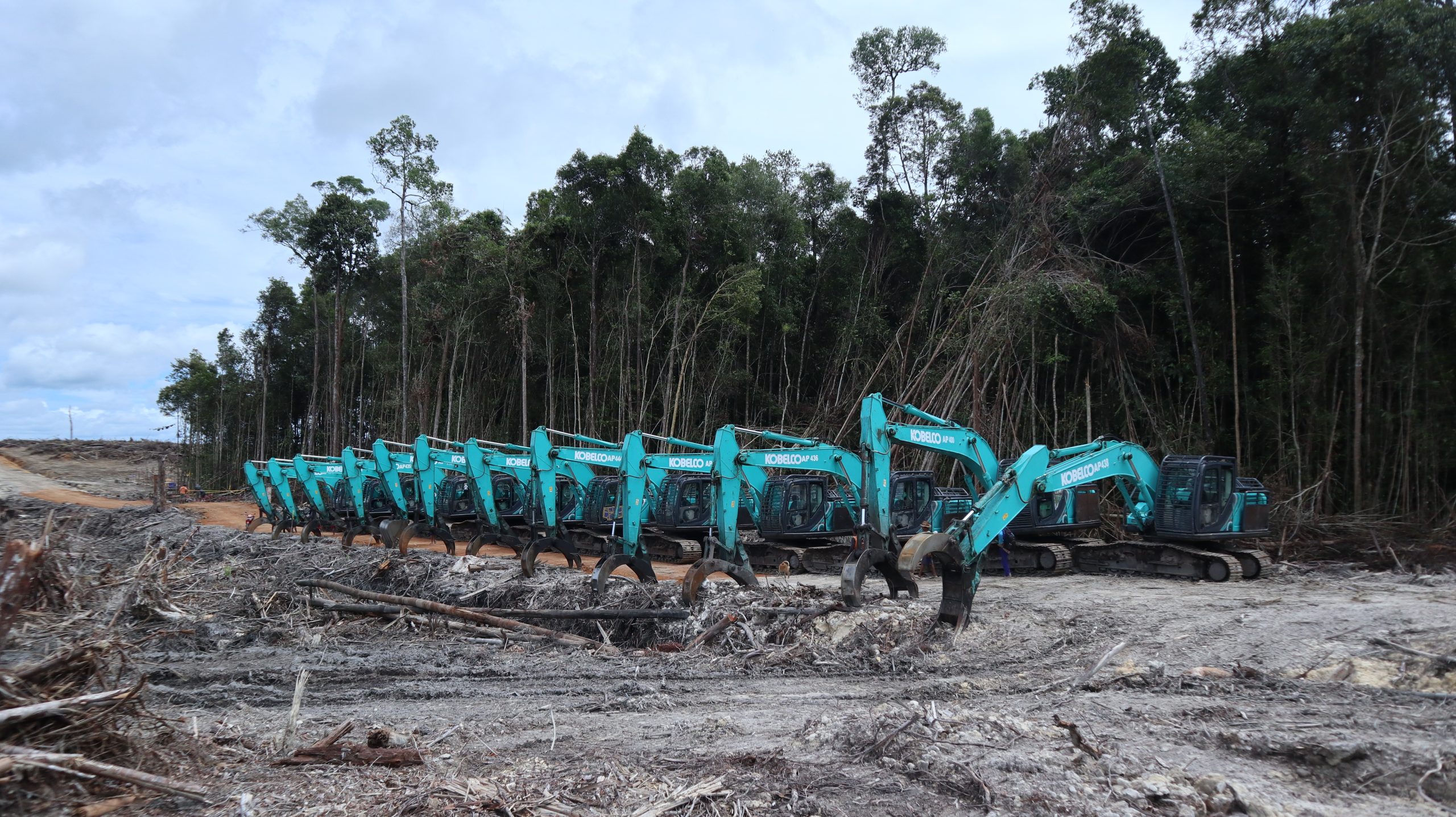
The facts surrounding PT Mayawana Persada are significant. The company, secretly controlled by the second largest Indonesian paper conglomerate, RGE-APRIL, has been responsible for one of the largest recent deforestation operations in Indonesia, clearing 3,000 hectares of rainforest in 2023 alone. The destruction included critical orangutan habitat and carbon-rich peat domes—ecosystems essential for biodiversity conservation and global climate stability.
Deforestation continued into 2024. According to data from Auriga, an additional 6,145 hectares were cleared during that period. This occurred despite a March 28, 2024 directive from Indonesia’s Ministry of Environment and Forestry ordering PT MP to halt forest clearing and focus on restoring damaged peatlands.
The consequences for Indigenous communities have been severe. Fourteen villages across Kayong Utara and Ketapang Regencies—including Lelayang—have been affected. In 2022, tensions escalated when huts and rice barns belonging to local residents were reportedly burned by unidentified outside parties amid the ongoing conflict.
“We are only protecting the land inherited from our ancestors,” said Paulus Suwardiman, head of the neighborhood association in Dusun Lelayang.
This case underscores a troubling contradiction: while Indigenous leaders defending their forests face criminal prosecution, corporations linked to large-scale deforestation often avoid meaningful legal accountability. Indonesia has repeatedly committed to reducing deforestation and safeguarding Indigenous rights. Yet in practice, forest guardians are treated as suspects, while ecosystem destruction continues
The question now before the Ketapang District Court extends far beyond one individual’s legal fate. It concerns whether Indonesia’s justice system will protect those defending ancestral forests—or shield those who profit from their destruction.
As the pretrial ruling approaches, many are watching closely. The outcome may signal whether customary law and Indigenous rights still have a place within Indonesia’s legal framework—or whether defending the forest has become a punishable act.