

On Tuesday, December 9, the West Kalimantan police tried to forcibly arrest Mr. Tarsisius Fendy Sesupi, the Traditional Head of Lelayang Hamlet, Kualan Hilir Village, Simpang Hulu District, Ketapang Regency, West Kalimantan, Indonesia.
For years, the community has resisted the encroachment on its customary land and the deforestation—largely illegal—carried out by the logging company PT Mayawana Persada, as documented in a report released by a wide NGOs coalition.
The company’s concession is a key habitat for orangutans, a species on the brink of extinction, and its peatlands are a critical carbon sink that helps mitigate climate change.
According to satellite mapping, PT Mayawana Persada has cleared at least 35,000 hectares of rainforest—an area more than half the size of Singapore—converting it into acacia and eucalyptus plantations, and it continues to expand. In the process, the company has also destroyed community gardens and orchards. Despite a government order to halt deforestation, the environmental devastation and conflicts with affected communities have not stopped. On the contrary, the company has gone on the offensive, leading to the arrest of community leaders such as Mr. Fendy.
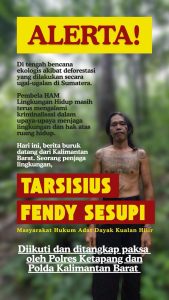 Mr. Fendy is now accused of trespassing on company property and of making threats of violence. Ironically, throughout years of peaceful resistance to defend their land, it is the Indigenous communities that have endured violence, intimidation, and now criminalization. Mr Fendy, in particular, is a champion of indigenous peoples’ rights, a human rights defender, and a true environmentalist, driven by love for his ancestral territory and land, which has been a source of life and livelihood for generations. The police tried to arrest Mr. Fendy on the eve of Human Rights day. The arrest was deferred at the last minute by the intervention of the members of the Regional House of Representatives, but is now scheduled again for December 15th.
—-
Who is behind PT Mayawana Persada? Mayawana is owned by a chain of holding companies in the secretive jurisdictions of the British Virgin Islands and Samoa, neither of which require the names of shareholders to be disclosed to the public. Corporate documents, operational management connections, and supply chain links indicate the company is related to the Royal Golden Eagle Group (RGE). RGE is a global producer of pulp, paper, packaging, tissue, viscose and palm oil, and is the parent conglomerate of APRIL, Asia Symbol, Sateri, Apical and Asian Agri. In 2015, RGE—and several of its subsidiaries including APRIL—announced a policy of “zero deforestation” in its supply chain. Among the buyers of RGE’s products are some of the world’s largest fashion brands, consumer goods manufacturers, and mass retailers, many of which make sustainability claims to customers about not causing rainforest destruction or harming communities. These sustainability claims are being called into question over Mayawana’s continuing deforestation in Borneo.
Back to News