Asia

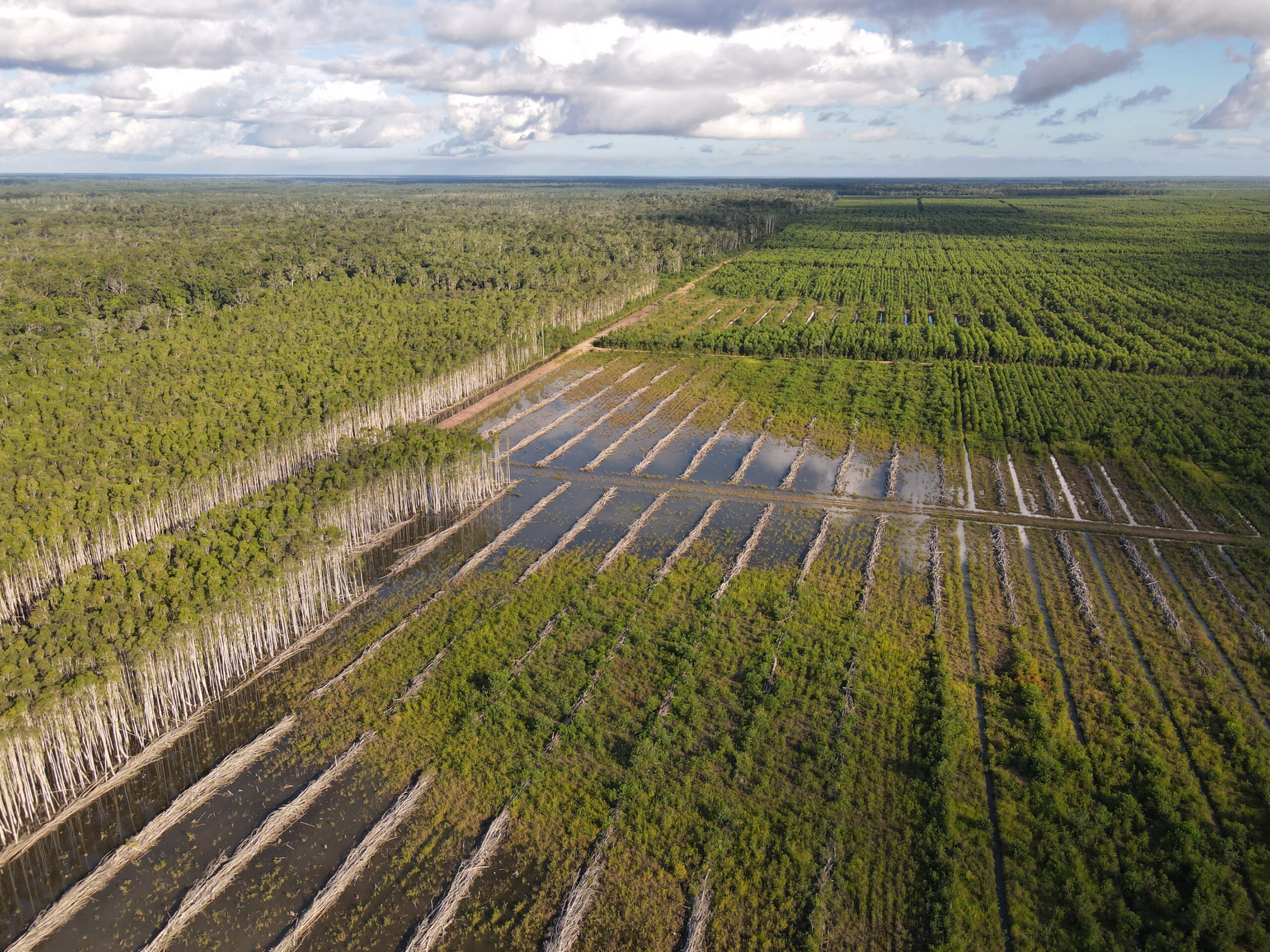
In Asia, the paper and biomass industries clear-cut entire forests, precious habitats, indigenous land and peat-based carbon stock, and convert them into industrial plantations. To address this issue, EPN coordinates three working groups:

  •  The Environmental Paper Network’s Indonesia Pulp and Paper Working Group
  •  The Biomass Action Network’s East Asia Working Group
  •  The Biomass Action Network’s Asia Pacific Working Group

The EPN Indonesia Pulp and Paper Working Group 

The Environmental Paper Network’s Indonesia Pulp and Paper Working Group coordinates the effort by local, national, and international NGOs to stop deforestation driven by the pulp and paper industry and uphold local communities’ rights.  


The first driver of deforestation

Over the past decade, Indonesia’s pulp sector expanded its production by 70%, from 6.7 million tonnes in 2015 to 11.3 million tonnes in 2024, and deforestation in Indonesia is now booming again, with a fivefold increase between 2017 and 2022.

The paper industry plays a significant role in driving deforestation, clearing around a million hectares of forest since 2001, including some of the last habitats of the Sumatran Tiger and the Orangutan. This story is now being repeated again at the frontline of deforestation. Human rights violations and deforestation are the price of the growing demand for single-use paper packaging.

A snapshot of our campaigning work 

The Environmental Paper Network’s Indonesia Pulp and Paper Working Group coordinates and supports efforts to investigate the deforestation by the two largest Indonesian conglomerates Asia Pulp and Paper (APP) and Asia Pacific Resources International Limited (APRIL) while mapping social conflicts and land grabbing. Together with partners, we managed to stop a new operation aimed to carve the untouched forests of Papua, on the island of New Guinea. 

We also investigated a new, secretly owned pulp mill threatening the last remaining rainforests in the eastern corner of Borneo. The Working Group meets virtually quarterly in different time zones to promote, facilitate and coordinate local and global campaign efforts.


To join this working group, please reach out to sergio@environmentalpaper.org

EPN Indonesia Working Group Resources


  • Old Habits Die Hard Report – Fresh Cuts: APP’s Continuing Violations Exposed (2025) EN
  • Deforestation Anonymous Report: Rainforest destruction and social conflict driven by PT Mayawana Persada in Indonesian Borneo (2024) EN | ID
  • Pulping Borneo – Deforestation in the RGE Group’s supply chain and RGE’s hidden links to a new mega-scale pulp mill in North Kalimantan, Indonesia (2023) EN | ID | CN
  • Papering over corporate control – Paper Excellence’s relationship with Asia Pulp & Paper and the Sinar Mas Group (2022) EN | ID
  • Trashing the Last Rainforest: How Papua Treasures are being dumped into the wastebin (2022) EN | ID | KO
  • Swallowing Indonesia’s forests – Food estates and deforestation (2021) EN | ID | DE | CN | KO | JP
  • Sustainability Default – Buyers and banks’ ineffective control policies allow paper giant APP to neglect forest conservation commitments (2020) EN | ID | CN
  • Sustaining Deforestation (2020) EN
  • Defaulting on Social Conflict Resolution l Indonesian Pulp & Paper Industry May Be Exposed to USD 1-10 Billion In Social Compensation Risk (2020) EN
  • APP Social Conflict Mapping (2019) EN
  • APRIL Social Conflict Mapping (2019) EN

The Biomass Action Network’s East Asia Working Group

The Biomass Action Network’s East Asia Working Group brings together member groups working across East Asia (currently mainly Japan and South Korea) to protect people and the environment from the biomass energy industry. It also includes groups from places that supply biomass to East Asia (mainly Southeast Asia and North America). The group is currently coordinated by Hansae Song.


Key issues linked to biomass energy in East Asia

  • Japanese and Korean governments have heavily subsidised the biomass industry in a bid to meet climate commitments.
  • As a result, the biomass industry has boomed with Japan being the world’s fastest-growing markets for wood pellets.
  • To meet the demand, Japan and Korea import biomass fuels from around the world, including from the U.S., Canada, Indonesia, and Vietnam. 
  • This has been at the expense of a genuine clean energy transition and is causing deforestation in critical areas around the world.

A snapshot of our campaigning work 

Members of the working group are engaged in work at both the policy and grassroots level, with a particular focus on biomass supply chains, financial flows, and the shared dynamics of social and environmental injustice across borders. Recent campaign successes have included a reduction in subsidies awarded to biomass in South Korea, with the energy minister publicly acknowledging the need to phase down biomass.

In 2025, members of the working group produced a report challenging the biomass industry’s claim that the wood pellets and chips they burn are sourced sustainably. The report revealed that private certification schemes, such as the Sustainable Biomass Program (SBP), are in fact developed by the very industry they purport to regulate. Evidence shows that this structural conflict of interest has resulted in weakened standards and superficial compliance mechanisms that encourage practices far removed from true sustainability.

To join this working group, please reach out to sophie@environmentalpaper.org

BAN East Asia Working Group Resources


  • Sustainable Biomass Program: Certifying the Unsustainable (2025) EN
  • Climate and Biodiversity Loophole: Support for Biomass Power Undermines Global Targets–A South Korea Case (2024) EN
  • Japan-South Korea NGO Statement on Biomass (2021) EN


The Biomass Action Network’s Asia Pacific Working Group

The Biomass Action Network’s Asia-Pacific Working Group brings together member groups working across the Asia-Pacific region, including from Indonesia, Malaysia, Bangladesh and Nepal, to protect people and the environment from the biomass energy industry.


Key issues linked to biomass energy in the Asia Pacific

  • A shift to co-firing coal with biomass in power stations (in order to meet countries’ carbon reduction targets) is extending the life of dirty coal power stations, while doing nothing to reduce emissions at the smokestack. This has direct impacts on air quality and local people’s health, as well as on the climate.
  • The conversion of native forests into monoculture plantations to supply biomass for energy has direct impacts on indigenous and local communities who depend on forests, as well as causing biodiversity loss. 
  • Increasing demand for biomass from major “consumer” countries is increasing deforestation in the Asia Pacific region. This is exemplified by the case of Indonesia, which has begun supplying wood pellets to Japan and Korea in recent years. 

A snapshot of our campaigning work 

The Asia Pacific Working Group has played an important role in documenting the expansion of bioenergy in key countries across the region. For example, in 2022 member group Trend Asia published a report on the Indonesian government’s plans to co-fire coal with wood in power stations and the devastating implications that this has for the country’s forests and, by extension, forest-dependent peoples.

Since then, additional demand from international markets in Japan and South Korea has increased the threat to Indonesian forests. The Asia-Pacific Working Group has facilitated collaboration between member groups based in Indonesia and those working in countries importing wood pellets from Indonesia, leading to information sharing, research trips to affected areas, and coordinated action and protests.

Elsewhere in the region, member group NAFAN produced a briefing which made recommendations for how the Nepalese Government can protect Nepal’s forests from exploitation by the bioenergy industry and ensure the rights of forest-dependent people and communities.

To join this working group, please reach out to sophie@environmentalpaper.org

BAN Asia Pacific Working Group Resources


  • Case study of upcoming energy plantations in Indonesia (2023) EN
  • Co-firing with biomass in Indonesia: Debunking Emission Reduction Claims (2022) EN
  • The Industrialisation of forest-based bioenergy and its impacts on women and other forest-dependent peoples (2022) EN