
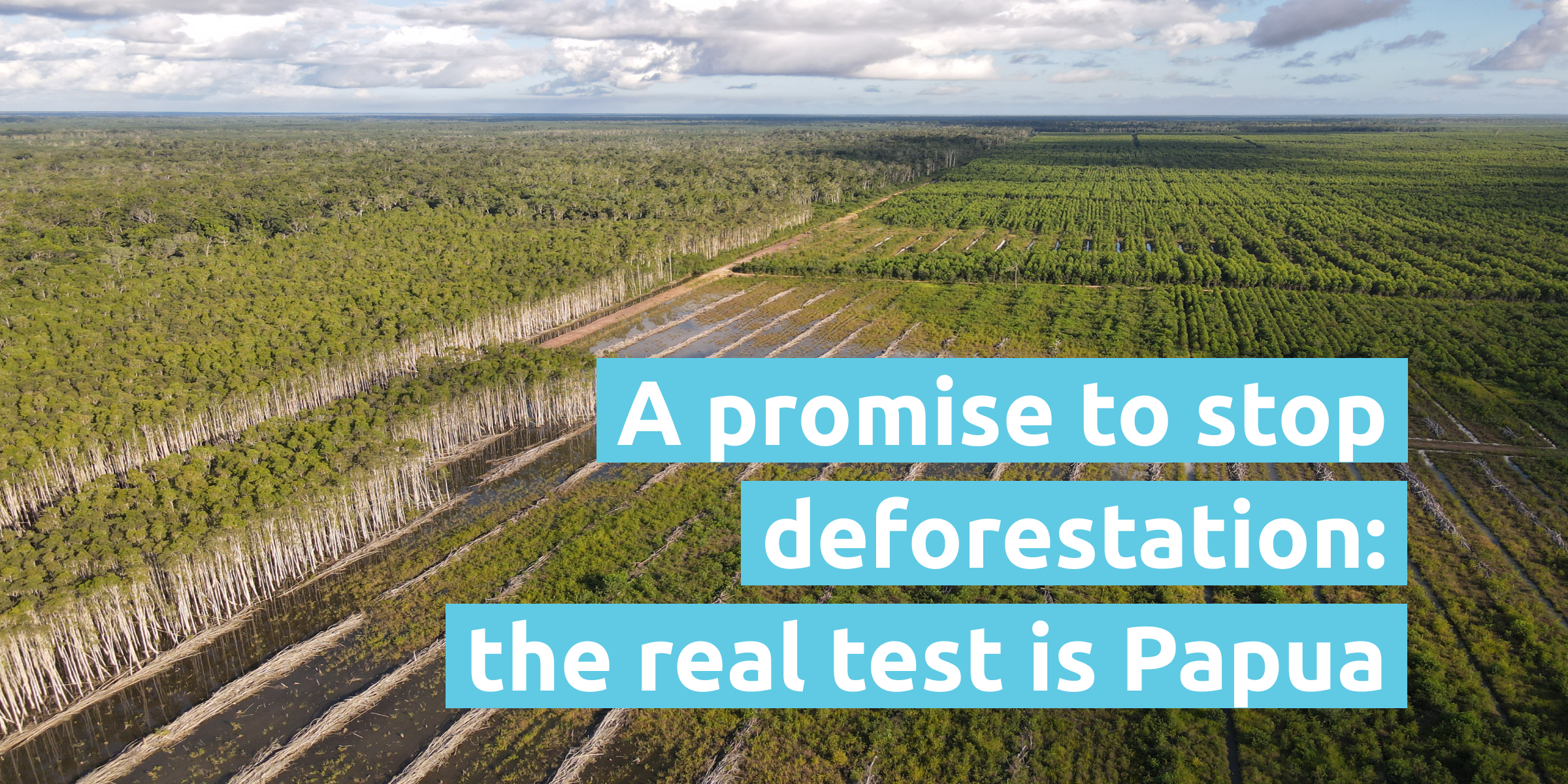
A call to immediately stop the heavy machinery
At the opening of the International Sustainability Forum (ISF) in Jakarta on 6 October, Special Presidential Envoy Hashim Djojohadikusumo and Mari Pangestu announced that the Indonesian government would no longer expand ‘food estates’ in forest areas and would end deforestation for the expansion of food and biofuel production. Future increases in food and biofuel production, they said, would instead focus on degraded land.
‘Food estates’ are government sponsored projects, purposely to ensure food security. In Papua, these projects have resulted in a wave of ‘National Strategic Projects’ (PSNs) led by the army and a handful of rich businessmen close to the President.
Despite many of these projects being ill conceived, they have received high priority. Some 3 million hectares of land, much of it forested, has been awarded to private companies for development. Located in High Conservation Value areas, or areas protected by the Moratorium, these concessions have been exempted from the most relevant environmental legislation.
The most notorious example is the The Merauke Food and Energy project, where agribusiness giants have secured vast concessions, often at the expense of Indigenous land rights. Carried over from the previous administration, the project aims to clear 3 million hectares (7.4 million acres) of land in the Merauke regency.
Meanwhile, land clearing and deforestation associated with the South Papua PSN from 2024 to the present have affected 49,787 hectares. Among the impacts, a surge of bushfires that crossed the area this summer.
Furthermore, all this land traditionally belongs to Indigenous clans in Papua, whose attempts to protect it have seen intimidation by the army. There are already 154 conflicts associated with the PSN projects, affecting 103,000 families and a million hectares. In March 2025, the U.N. special rapporteurs raised serious concerns that the leading project, the The Merauke Food and Energy is displacing Indigenous communities, clearing forests without consent, and using military forces to suppress dissent, threatening more than 50,000 Indigenous people.
The announcement to stop such devastation is certainly a step in the right direction. However, Indigenous communities and environmental defenders in South Papua have welcomed the announcement cautiously, whilst questioning its implementation: Will these promises actually stop the destruction happening on the ground?
The implementation trap
According to the local network, Merauke Solidarity, this is not the first time Indonesian officials have committed to sustainable development at international forums. Yet these commitments have too often failed to translate into concrete changes in government programmes and implementation.
Worse still, corporate heavy machinery, accompanied by military personnel, continues to clear natural forests in Papua for projects designated as National Strategic Projects. For the Indigenous communities who have protected these forests for generations, this is not simply a debate about economic development. It is about land, livelihoods, culture, food systems and their right to determine what happens to their territories.
Forests are still at risk
According to monitoring by Merauke Solidarity, land clearing and deforestation associated with the South Papua PSN from 2024 to the present have affected 49,787 hectares. The consequences extend beyond the loss of trees. Lowland forests, wetlands and peatlands have been affected, while traditional food sources and Indigenous communities’ living spaces have come under pressure.
These changes can trigger social conflict and violence, while disrupting the relationships that Indigenous peoples have maintained with their territories over generations.
A forest is not merely an area covered by trees. For communities living within and around these ecosystems, it can be a source of food, clean water, medicine, cultural knowledge, livelihoods and spiritual and social connections. When forests disappear, these relationships are damaged as well.
What does “degraded land” actually mean?
One of the most important questions raised by the government’s announcement concerns the phrase “degraded land.”
Using degraded land instead of forests for future food and energy projects may sound environmentally responsible. But who decides if land is degraded or not? Lowland forests, wetlands, savannas and other ecosystems are sometimes classified as degraded, unproductive or even “empty” land. Such classifications can ignore the communities that live there and the ecological and cultural functions these territories provide.
A landscape that appears economically unproductive from one perspective may be essential to the survival of the people who depend on it.
Indigenous communities possess knowledge accumulated through generations of living with, using, protecting their territories. They are not simply people affected by development decisions. They are rights holders and knowledge holders who should have a meaningful role in deciding how their territories are used.
Development, not dispossession
The Merauke Food and Energy project illustrates a broader challenge facing development in Indonesia: how can food and energy security be pursued without sacrificing forests, biodiversity and Indigenous rights?
Food security is an important national goal, but it cannot be achieved by destroying the local food source, the forest. Indigenous people in Papua traditionally do not eat rice, but sago, a small palm growing wild in the forest. When forests are cleared, communities can lose access to traditional food sources. Water systems can be disrupted too. Biodiversity can decline. Cultural practices and traditional knowledge can be weakened. Livelihoods can disappear.
These impacts cannot simply be measured in hectares of forest lost. They affect the ability of communities to sustain themselves across generations.
Ecological restoration must take place in areas that have already been damaged, and it should be corroborated by the restoration of rights, livelihoods, territories, social relationships, cultural practices and food systems. The Indonesian government must restore the rights of those Indigenous communities that have experienced violence and the loss of their land. Affected Indigenous peoples must be recognized as rights holders and decision-makers over their territories.
Protecting these forests requires concrete decisions, binding policies, and it needs accountability and respect for the people who have cared for these territories for generations.
Back to News