
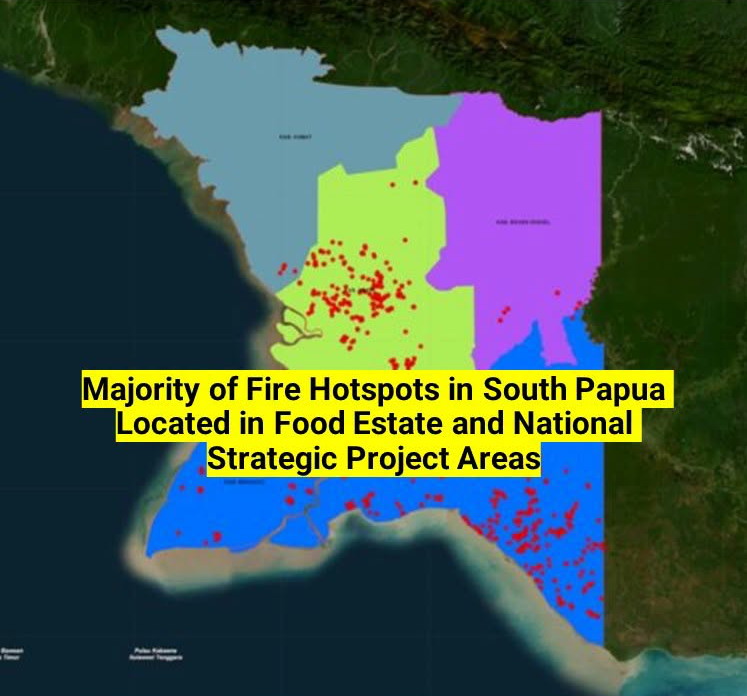
A new spatial analysis by the Indonesian NGO WALHI Papua, suggests that the recent surge in fire hotspots across South Papua is far from accidental. Instead, the data points to a clear pattern: most hotspots are concentrated in areas designated for the government’s “Food Estate program” and within concessions linked to National Strategic Projects (PSN).
WALHI identified 399 hotspots inside areas that have already been allocated for large-scale development. They did this by overlaying hotspot data from 1–9 July 2026 with maps of Food Estate zones and corporate concessions. Of these 399 hotspots, 245 were located within Food Estate areas, 115 inside Forest Business Permit (PBPH) concessions, and 39 within oil palm plantation concessions.
These figures account for nearly one-third of the 1,292 hotspots recorded across South Papua during the same period. According to WALHI, the findings reveal a strong concentration of fires in landscapes that have already been converted, or are being prepared for conversion – through government planning and industrial land-use permits.
Deforestation and growing fire risk
“The high concentration of hotspots within Food Estate areas is an important finding,” said Uli Arta Siagian, National Executive Campaign Coordinator of WALHI, “it shows that areas designated as future national food production are already experiencing significant ecological pressure, even in the early stages of development.”
WALHI argues that these fires should not be viewed simply as isolated natural events. Rather, they must be understood within the broader context of large-scale landscape transformation.
Deforestation, road construction, drainage of peat swamps and wetlands, and other land conversion activities fundamentally alter ecosystems that have historically been resistant to fire. South Papua is naturally dominated by lowland rainforest, peatlands, swamps, and other wet ecosystems that retain moisture and help prevent the spread of fire. As these landscapes are converted into industrial-scale production areas, their ecological characteristics change, making them increasingly vulnerable during dry periods.
Indigenous territories under pressure
Beyond the environmental implications, WALHI highlights the significant overlap between Food Estate development areas and the customary territories of Indigenous Papuan communities.
In Merauke Regency alone, the customary lands of the Marind, Yei, Kanum, Muyu, and Mandobo peoples cover much of the area now earmarked for national food production. Each community holds customary (“hak ulayat”) rights over its ancestral forests and lands, with hundreds of clans maintaining long-standing relationships with these territories. According to Walhi’s spatial analysis, much of the land designated for Food Estate development falls within these customary territories.
While the Food Estate programme’s ability to deliver sustainable food production remains highly questionable due to unsuitable soil conditions, vast areas of forest that have long served as the primary source of food and livelihoods for Indigenous communities are being cleared. Rather than improving food security, this large-scale deforestation is creating profound food insecurity for the people who have depended on these ecosystems for generations.
For WALHI Papua Executive Director Maikel Peuki, this creates a dual crisis.
On one hand, Indigenous communities risk losing access to the lands and forests that sustain their livelihoods and cultural identity. On the other, replacing Indigenous-managed ecosystems with industrial production landscapes weakens the ecological functions that have historically helped protect these areas from fire.
“The fact that hundreds of hotspots are found within Food Estate areas and concessions demonstrates that a development model based on large-scale land expansion cannot be separated from the growing ecological crisis in South Papua,” Maikel said. He argued that food security policies should strengthen ecological resilience rather than increase the vulnerability of landscapes already under pressure.
WALHI calls for an immediate policy review
In response to these findings, WALHI is calling on the Indonesian government to conduct a comprehensive evaluation of the Food Estate project in South Papua and to halt its further expansion, including:
- an immediate stop to the clearing of remaining forests, peatlands, and swamp ecosystems;
- an independent audit of concessions located in areas with high concentrations of fire hotspots; and
- full recognition and legal protection of Indigenous customary territories, which WALHI describes as both the living space of Papuan communities and one of the last strongholds protecting Papua’s remaining ecosystems.