
At a Glance
- The U.S. Securities and Exchange Commission (SEC) has proposed a new approach to delivering required investor disclosures electronically.
- The proposal would allow electronic delivery by default while preserving investors’ ability to request paper documents, free of charge.
- An analysis published by the Securities Industry and Financial Markets Association (SIFMA) estimated that more than 830 million pages of paper are used each year to print and mail prospectuses and shareholder reports, just two of the many documents covered by SEC paper-delivery requirements.
- EPN’s Paper Calculator™ analysis found that reducing this paper use could save the equivalent of 101,000 trees, 90 million gallons of water, 75 million pounds of greenhouse gas emissions, and 5 million pounds of solid waste annually.
- The proposal is now open for public comment through September 21, 2026.
Bringing Investor Communications Into the Digital Age
The way investors receive and manage financial information has changed dramatically. Most investors now access account information, statements, and other financial documents online, yet many required disclosures continue to arrive in the mail simply because paper remains the default.
The SEC’s proposed rule would change that.
Under the proposal, covered investor disclosures could be delivered electronically without requiring investors to affirmatively opt in to electronic delivery. Paper would remain available to investors who prefer or need it, and investors could request paper copies free of charge. The SEC also proposes a transition process for people currently receiving disclosures by mail.
That is a relatively simple change, but it could have a significant impact.
Investors Are Already Embracing E-Delivery
The SEC proposal reflects how many investors already access and manage financial information.
A survey commissioned by SIFMA and conducted by YouGov found that 79% of individual investors had already chosen electronic delivery for at least one type of investor document, including 75% of investors age 55 and older. The survey also found that 85% were comfortable with e-delivery as the default provided they could still choose paper, while only 8% preferred to receive all investor communications by mail.
The survey’s findings demonstrate an important point: making electronic delivery the default does not mean taking away investor choice.
830 Million Pages of Paper
There is also a significant environmental opportunity.
SIFMA estimates that more than 830 million pages of paper are used every year to print and mail prospectuses and shareholder reports to investors. Importantly, that figure covers just two of the many types of documents subject to SEC paper-delivery requirements.
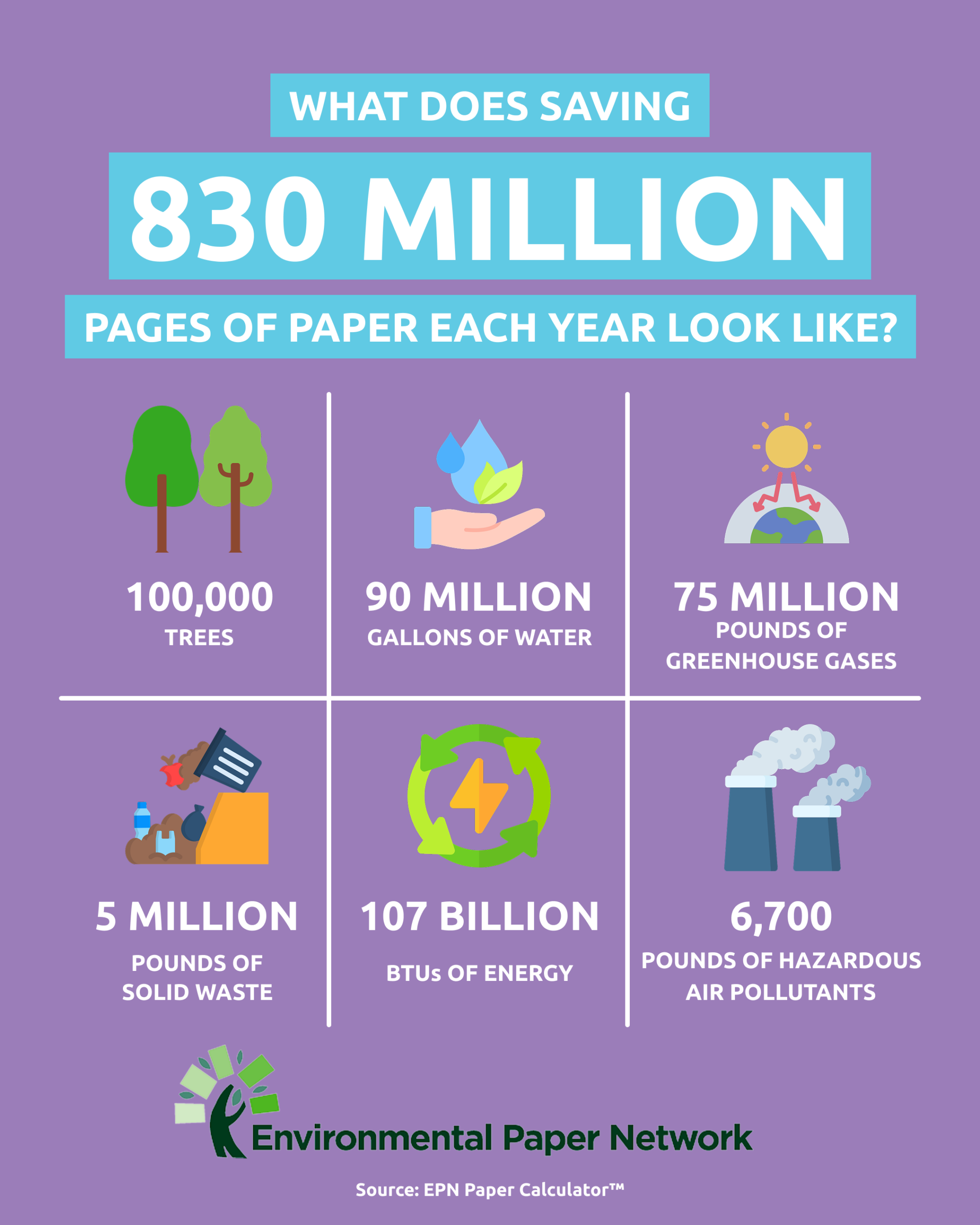
EPN used the Paper Calculator™ to assess the environmental impacts associated with that paper use. If these sheets were avoided each year, the estimated benefits would be:
- 101,000 trees
- 90 million gallons of water
- 75 million pounds of greenhouse gas emissions
- 5 million pounds of solid waste
The Paper Calculator also estimates that avoiding this paper production would save approximately 107 billion BTUs of energy and reduce 6,700 pounds of hazardous air pollutants annually.
A Better Default, Without Taking Away Choice
The proposal is important because it does not frame paper and electronic communication as an either-or choice. It changes the default while preserving choice.
Paper remains valuable when it serves a purpose and is the preferred format for some investors. For investors who lack reliable internet access, have accessibility needs, or simply prefer paper, the ability to request paper delivery remains an important safeguard.
But requiring paper to be the default for everyone means producing and mailing documents to people who may never need or want them in that format.
A digital-first approach recognizes how many people already access information while keeping paper available for those who need it. Choice does not require paper to remain the default.
The goal isn’t less access to information. It’s a more efficient way to deliver it.
The Benefits Go Beyond the Environment
Modernizing delivery requirements will also reduce the costs associated with printing, processing, postage, storage, and administration of hundreds of millions of paper documents. The Investment Company Institute (ICI) estimates that default electronic delivery could generate $589 million to $797 million in annual savings for funds and their shareholders, or $3 billion to $4 billion over five years, by reducing the costs of printing, processing, and mailing paper documents that investors may not need or want to receive in that format.
The SEC itself anticipates that the proposed framework could provide cost savings to issuers, market intermediaries, investors, and other recipients. Electronic delivery can also provide investors with faster, more accessible ways to receive and manage information. The SEC notes that electronic disclosure can offer more personalized, interactive, timely, and efficient experiences, along with accessibility and retention benefits.
What’s Next
The SEC’s proposal is now part of the formal federal rulemaking process, with a 60-day public comment period running through September 21, 2026.
EPN supports the proposal and will continue working with partners to encourage modernization of outdated paper delivery requirements. We also encourage organizations and individuals who support greater flexibility in how investor information is delivered to participate in the public comment process.
The SEC’s proposal, together with the U.S. Department of Labor’s recently proposed modernization of electronic disclosure for ERISA-covered group health plans, presents an important opportunity to rethink outdated paper requirements across two major sectors of the economy.
Modernizing how required information is delivered is a practical step that can benefit investors, businesses, and the environment.
Back to News