
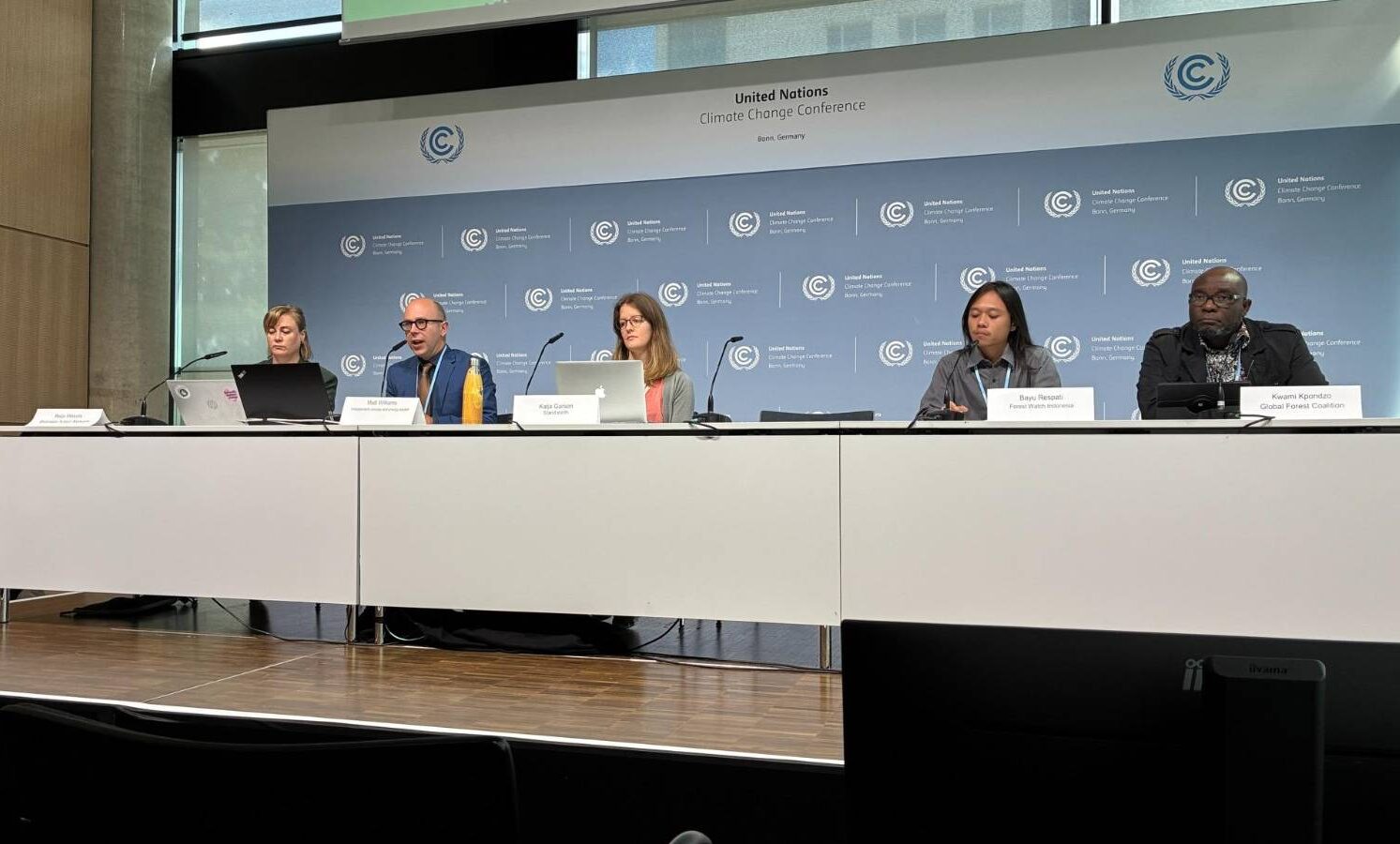
The Biomass Action Network’s COP Biomass Taskforce recently completed two weeks of intensive advocacy at the UNFCCC SB64 intersessional climate negotiations in June 2026, held in Bonn, Germany. The Taskforce’s primary goal is to increase pressure and drive action to ensure biomass energy is excluded as a method for meeting international climate targets. Their efforts focused on raising awareness among Parties and stakeholders about the significant risks to climate, nature, and society posed by including bioenergy in UNFCCC policies and frameworks. During the Bonn negotiations, BAN’s specific objectives were to:
- Direct media and political attention to the critique of including biomass in Nationally Determined Contributions (NDCs), supported by new evidence showing negative impacts on local communities.
- Highlight the need to address the carbon accounting loophole, emphasising the open letter from international scientists to IPCC members.
- Encourage Parties and Civil Society Organizations (CSOs) to adopt the position that bioenergy is a false solution and to recognise its role as a critical link between the TAFF and Forest roadmaps.
- Raise awareness of the human rights impacts associated with the biomass industry.
A full round-up of BAN’s activities at Bonn can be found here, including photos and videos of side events and press conferences. Below are some key reflections as Bonn draws to a close:
Bioenergy should not be included in national climate plans.
According to a forthcoming report by the Royal Society for the Protection of Birds (RSPB), half of all national climate plans (NDCs) reference bioenergy in some capacity. This proportion rises to 83 percent in more detailed Long-Term Strategies. Notably, only six countries have concrete plans to implement Bioenergy with Carbon Capture and Storage (BECCS), yet these countries alone may require up to 95 million hectares of land – more than twice the size of Germany – to grow enough biomass for BECCS. We emphasised this concern in a press release and press conference. The data clearly demonstrate the far-reaching implications of depending on bioenergy for emissions reductions. As we approach COP31, we aim to further highlight this perspective, especially as more precise data on currently unaccounted-for bioenergy emissions becomes available. Read more.
The forest roadmap needs to properly define and tackle forest degradation and false solutions.
During the first week in Bonn, there were several events on the COP30 Presidency Roadmap for Halting and Reversing Deforestation and Forest Degradation by 2030, both by the Presidency itself and by CSOs. We noticed several alarming issues:
- Forest degradation is not properly defined and considered in the roadmap.
- Bioenergy is often considered to refer mainly to liquid fuels, and biomass for energy use is assumed to include only residues, rather than roundwood or whole trees.
- Sustainable Forest Management, a proxy for intensive logging, is considered a climate mitigation solution which also prevents forest loss and degradation.
These assumptions and oversights must be strongly refuted. Extensive logging – often driven by biomass extraction – significantly reduces carbon stocks and biodiversity. Despite this, such activities are not classified as deforestation, even when clear-cutting occurs. Deforestation is currently defined only as permanent land-use change, so land retained by forestry companies or owners is excluded, regardless of the intensity of timber harvest. Yet, greater forest biodiversity correlates with higher carbon stocks and increased ecosystem resilience. Repeated harvesting undermines both, further compromising climate efforts and hindering biodiversity protection. The lack of recognition for forest degradation is a major obstacle. It is essential that the forest roadmap properly defines and addresses degradation. The impacts of intensive logging and so-called Sustainable Forest Management must be accurately identified, monitored, and prioritised for action by countries.
Much of the wood burned for energy is roundwood – whole trees – not residues, as is often claimed. In many cases, it is even sourced from primary and old-growth forests. Sustainable Forest Management (SFM) exacerbates this problem, as the current forestry model in the Global North is based on clear-cutting practices in which harvested biomass is falsely referred to as “residues” from so-called sustainable forestry. The inclusion of a clear definition of forest degradation and the exclusion of large-scale sourcing of wood from forests for bioenergy are critical to the success of the forest roadmap.
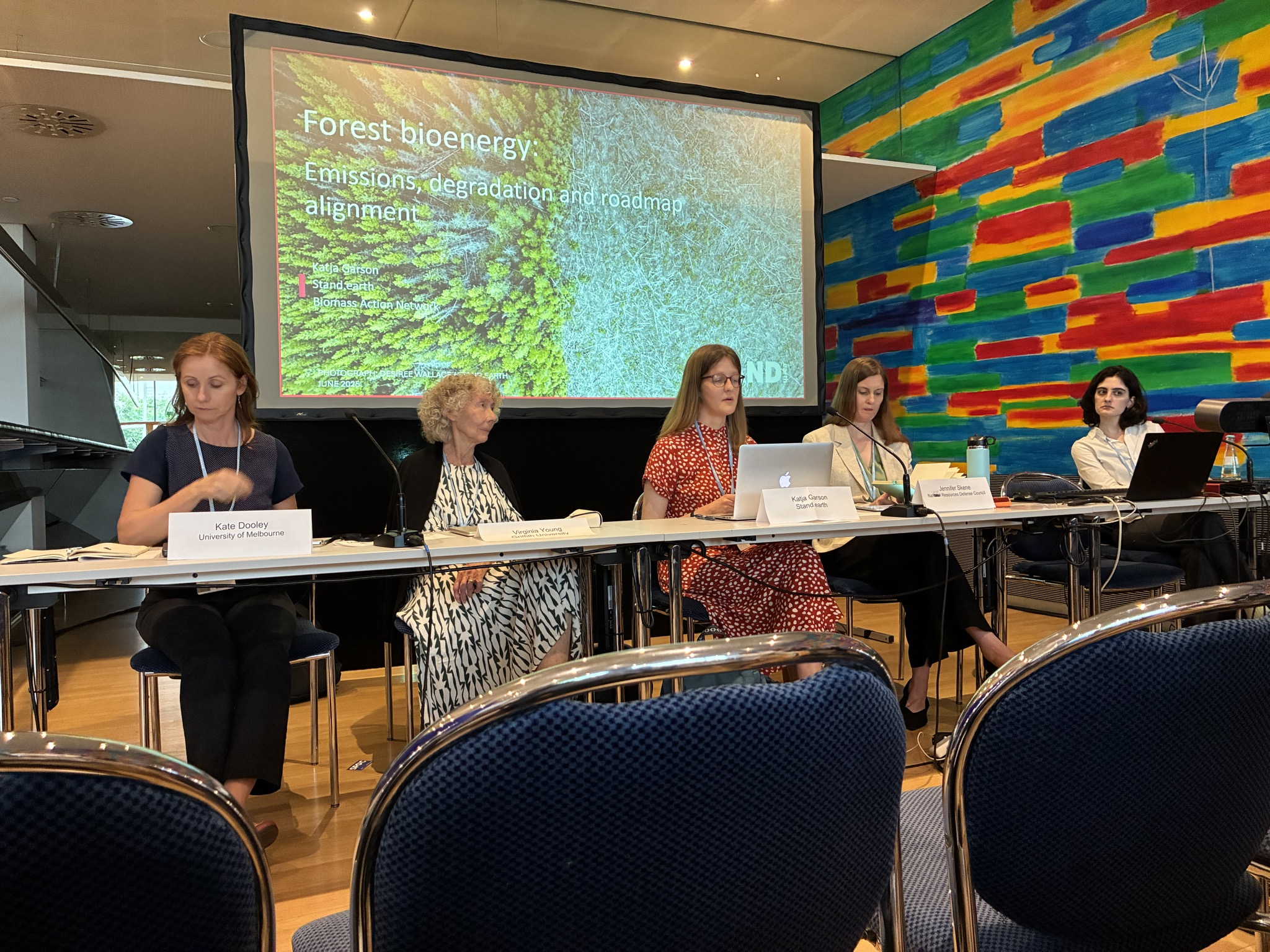
Katja Garson from Stand.earth on the Carbon Accountability Gap Session.
Burning wood for energy needs to be excluded from the transition away from fossil fuels
Current international carbon accounting rules allow biomass energy to be subsidised and the industry to expand, even when it fails to reduce emissions, or actually increases them. Emissions from biomass energy are counted only in the land sector, based on the assumption that regrowing trees will re-absorb them, but forests take decades or even centuries to re-absorb these emissions. Further, burning wood for energy produces at least as much CO2 as burning coal per unit of energy produced, and usually more. As a result, the true emissions are not accurately accounted for. To achieve meaningful reductions in emissions during the transition away from fossil fuels, wood biomass for energy must be excluded, and all carbon fuels should be phased out. The transition must move toward 100% genuine renewables while protecting forests and local communities. Importantly, it cannot simply replace one extractivist system with another. The uncomfortable reality is that this transition cannot succeed without reducing overall consumption.
The need to reject extractivist practices and false solutions is widely recognized among civil society organizations (CSOs), though further awareness-raising about the problems of burning wood for energy remains necessary. Misconceptions and unfounded assumptions about bioenergy, its emissions, and its impacts on people and nature persist among Parties and researchers. Bioenergy continues to feature in countries’ nationally determined contributions (NDCs) and in emission-reduction scenarios, revealing ongoing misunderstandings about the flaws in carbon accounting despite years of critique. Recently, scientists sent a letter of concern to the IPCC, which we shared with researchers and Party representatives. Moving forward, we hope for broader support for accurate accounting of forest bioenergy emissions. Many recognise the loopholes, but the real political challenge is confronting entrenched rules that support deeply defended – often unjustified – approaches to biomass harvesting and use.
Emerging themes towards COP31
The COP31 Presidency (Turkey and Australia) announced an electrification target of 35% share of global energy demand from electricity by 2035. This goal is based on IEA and IRENA analysis, which includes bioenergy as a renewable energy source when modelling total primary energy supply for electrification. The analysis also proposes managing residual fossil fuel using sustainable biofuels in aviation and shipping. Additionally, the modelling maps a “progressive transition away from traditional biomass use toward modern and cleaner bioenergy” in Africa, aiming for 50% electrification by 2050. As we approach COP31, it is crucial to clarify that electrification should mean 100% genuinely non-emissive renewables and specify what should be excluded. It is also important to highlight that bioenergy for electricity is at least twice as costly as genuine non-emissive renewables such as wind and solar.
The Belém Commitment for Sustainable Fuels (Belém 4x), launched by Brazil during COP30 under the Action Agenda, calls for a fourfold increase in global use of so-called sustainable fuels. The pledge received limited support at COP30, yet the COP30 President delivered a prominent speech at SB64 during a World Bioenergy Association event – demonstrating ongoing risk that Brazil and others may continue to push this initiative under the Action Agenda. Scaling up these technologies will drive further extractivism, especially in the Global South, where expanding bioenergy crops and encroachment into natural ecosystems threaten socio-economic wellbeing, human rights, and the climate. Read more.
All in all, BAN once again had a great team on the ground and we look forward to continuing to work towards COP31 in Antalya. Stay tuned!
Back to News