
This is Part 2 of a story documenting EPN International Program Coordinator, Sergio Baffoni, during his month-long journey across Brazil, where he met with communities defending their customary rights and seeking support to make their struggles visible.
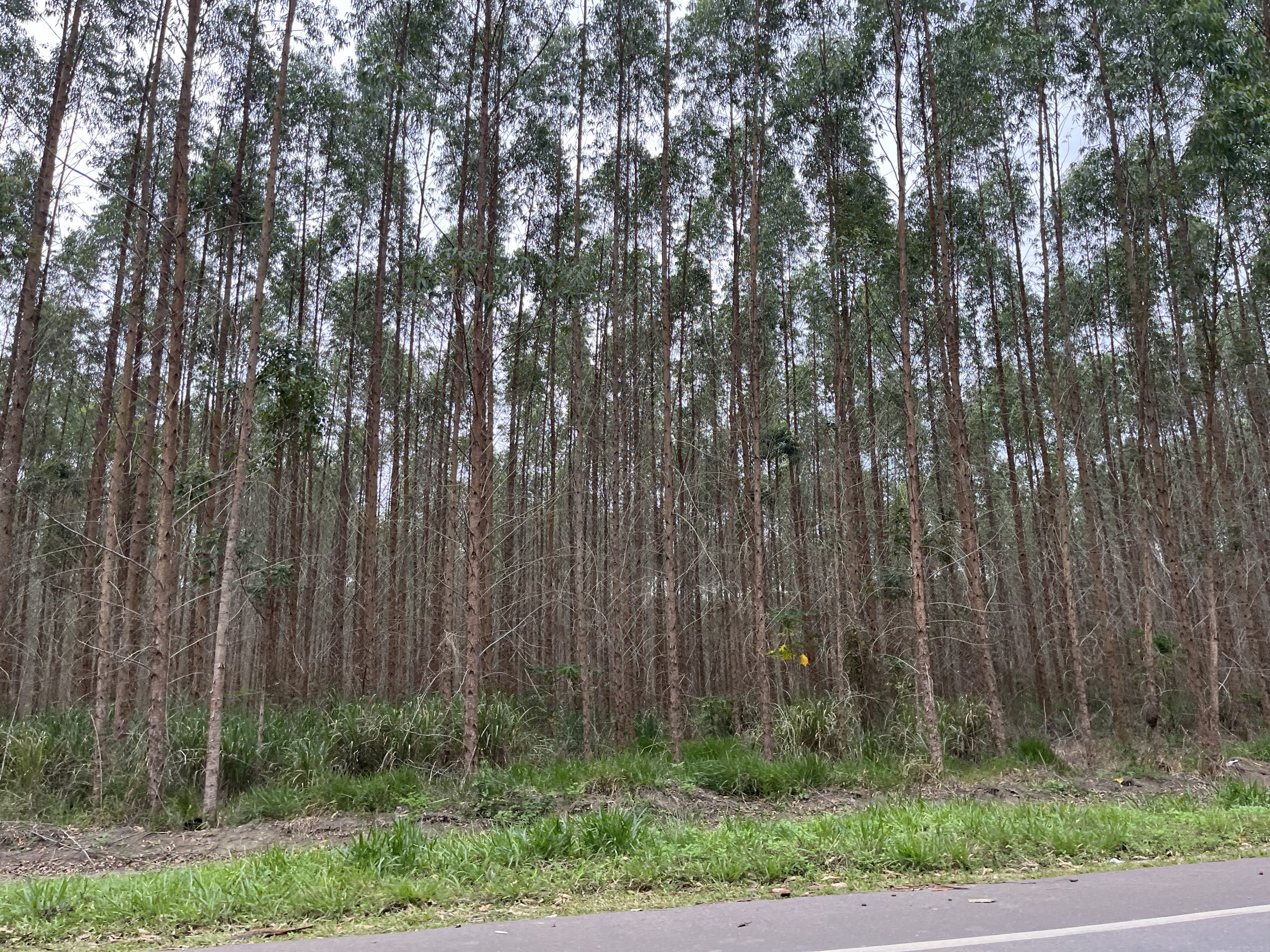
 The road stretches on for miles, hemmed in by two dense walls of sickly-looking trees. Endlessly. These are the eucalyptus plantations that blanket the entire municipality of Conceição da Barra. three quarter of all agricultural land belongs to a single company: Suzano. 53,000 hectares of plantations in that municipality alone. Ironic signs urge respect for nature, right here where over forest have been converted into fast-growing industrial plantations, despite local legislation prohibits a concentration of more than 20% of agricultural land.
Worse still, many of the property titles used to evict traditional inhabitants were fraudulent. In the 1970s, the pulp and paper industry arrived in the state of Espírito Santo under the name Aracruz Celulose, later incorporated into Fibria and ultimately Suzano. During that period, the company expanded onto the lands of traditional communities, making it impossible for them to continue their way of life. In August 2013, a court ruling convicted Suzano for appropriating public areas, approximately 50,000 hectares, that belonged to the Quilombola communities of São Mateus and Conceição DA Barra. (According to the National Registry of Social Security Information, the company orchestrated mass transfers of public land to its own employees, presented as landless peasants. These individuals then transferred ownership to their employer just days after obtaining the land titles.)

The hut of Mr. Mateus Dos Santos, in the background eucalyptus still dominate the landscape.
The Quilombola are descendants of enslaved Africans brave enough to escape from plantations and mines and sought refuge deep in the forest. There they lived by farming—mainly cassava and beans—and by gathering fruit from the forest. Over time, their territories, known as quilombos, attracted freed slaves and others persecuted by the Brazilian state. The Quilombola became highly skilled farmers. Entire towns depended on them for food, transported by mule or canoe. Until the paper industry arrived, stole their land, dried up their rivers, and poisoned their water with pesticides.

Dona Miúda, Quilombo Linarim
“We had everything,” says Elda Dos Santos, known to everyone as Dona Miúda. “There were no doctors, there was nothing. But we had the forests, we had everything we needed, we treated ourselves with herbs, we bathed, we washed ourselves with running water, we grew everything. Then this company came along.”
Land grabbing by falsification of property titles was proved, and sentenced by the 1st Federal Court of São Mateus, Espirito Santo, which ruled on the expropriation of the land, convicting Suzano in the first instance to pay a fine. Dona Miúda recalls how company representatives had methodically tried to scare them. “You have to leave,” they said, “you can’t stay here. You won’t be able to grow anything anymore.”
 In that, they were right. They really had little left to cultivate.
“They don’t cut the trees down—they rip them out,” she says. “Two machines with long arms take everything away. The trees, which were our medicine. The water. Even the houses. We were left with nothing.”
Donna Muilda shakes her head. “Eucalyptus is not a tree, it is not from here. We know this well. And they planted eucalyptus trees, didn’t they? Where there had been the forests and lagoons. Even the names of places disappeared, the names of where people lived. And we could no longer plant, there was no water. There was no longer the forest, which brought the wind and rain. There was no river. There was nothing. Everything dried up. And the poison. And the poison—they sprayed it in front of us. First with airplanes, now with drones.”
“And we young people said: we’ll go back, we’ll go in and we’ll cultivate our land. It already belonged to us, didn’t it? Of course, it was our land. For centuries, our drums played there. The drums of us black people.”

Police operation in Angelim 3 in a photo from the time
Without their territory, unable to produce food and facing starvation, the Quilombola did not give up. They fought to reclaim their land. They were arrested, beaten, even killed—but they persisted. “And then there was the police, and arrests. When the struggle began, it took off immediately, and it was prison. Because people had remained silent for too long, unable to claim their rights. They burned down my aunt’s house. But by then we were no longer afraid. The women and men were no longer afraid. How many days did it last? Twenty-five days. They carried out a raid, but we continued. Then they came back with horses, weapons, and dogs. It was hell. But we resisted. We had to flee, or it would have been a bloodbath. But we resisted, and in the end we mapped our territory, the whole community signed it, we submitted it to the authorities, and since then, since 2002, we have been waiting for it to be registered. It’s not for us, it’s for our children. Demarcated land cannot be sold. But now we can grow chili peppers, cassava, coffee.”

Corego da Lama – where the water came back
The demarcation of Quilombo de Angelim 3 has not yet been fully recognized, and eucalyptus continues to dominate the landscape. Yet it is not too late to reverse the damage. In the areas that have already been recovered, since the eucalyptus was removed, water has reappeared. In areas that have already been recovered, water has returned. The community points to a large pond that had dried up when eucalyptus surrounded it. Now the water bubbles again, native trees are growing, and life has returned.
Today, cassava, beans, peanuts, and coffee are growing again, providing food, income, and a dignified life.
Meanwhile, the eucalyptus frontier has moved on to other regions, such as Mato Grosso do Sul, driven by growing demand for disposable packaging—products destined to be thrown away just hours after reaching the consumer.