
Identifying Environmentally Responsible Paper

The Paper Steps

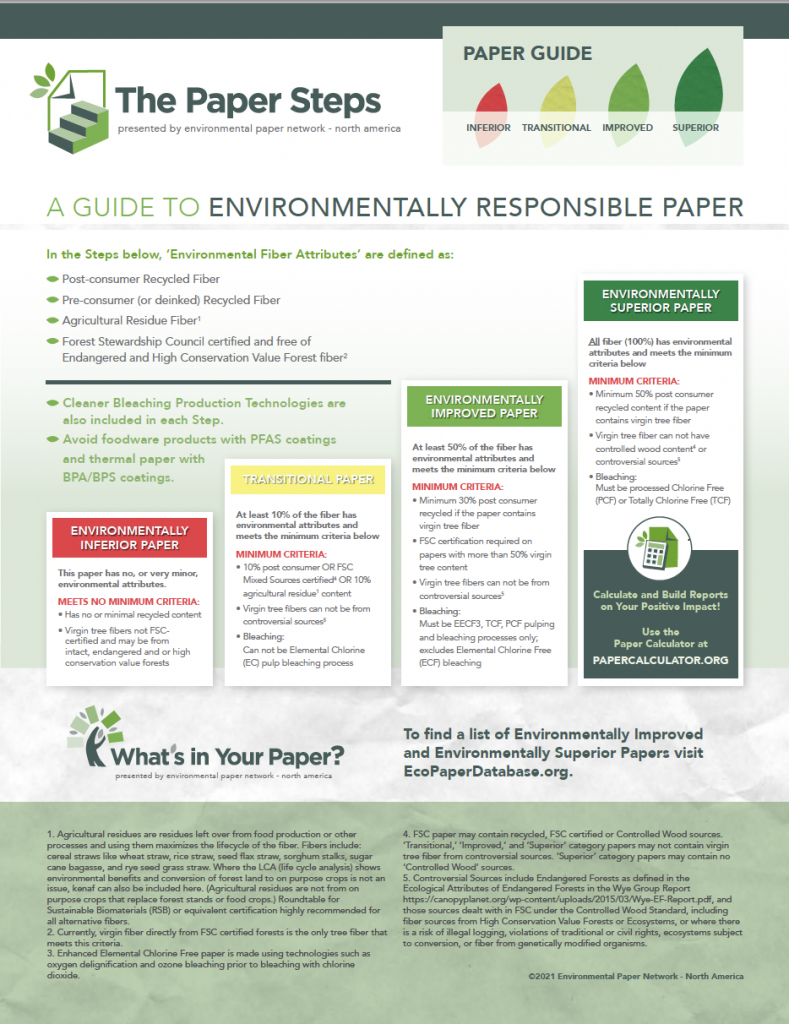
The Paper Steps is a practical guide to choosing more environmentally responsible paper. This resource provides a clear framework for evaluating paper products based on their fiber sources and manufacturing practices, helping purchasers identify opportunities to reduce environmental impacts and make more sustainable purchasing decisions.

Use the Paper Steps to see where the paper you currently buy falls within the hierarchy, then set goals for moving toward higher-performing products over time.

You can also use the EcoPaper Database, a joint project of Canopy and Environmental Paper Network, to identify products that meet the Paper Steps criteria, and the Environmental Paper Network’s Paper Calculator™ to quantify the environmental impacts of reducing paper use and choosing recycled-content papers.
Step One

The first step is to evaluate a paper’s fiber content. Look first for post-consumer recycled fiber, then consider pre-consumer recycled fiber and agricultural residue fiber. When virgin fiber is used, it should be Forest Stewardship Council (FSC) certified and free of Endangered and High Conservation Value Forest fiber. Different combinations of these fiber attributes determine where a paper falls within the Paper Steps.


Step Two

In addition to meeting fiber requirements, each Paper Step has minimum environmental criteria for pulping and bleaching processes. These requirements help ensure that paper production minimizes harmful environmental impacts.

The Paper Steps are intended as a practical guide. Every purchasing situation is different, but they can help organizations make informed decisions and continually improve the environmental performance of the paper they buy.

Additional Resources

Explore these tools to help you identify environmentally responsible paper products and measure their environmental impacts:

  • EcoPaper Database – A joint project of Canopy and Environmental Paper Network, the EcoPaper Database helps you identify paper products that meet the Paper Steps criteria.
  • Paper Calculator – Environmental Paper Network’s Paper Calculator quantifies the environmental impacts of different paper choices, from reducing paper use to selecting recycled-content papers, measuring savings in wood, greenhouse gas emissions, water, energy, and solid waste.
  • ForestMapper is a mapping tool from Canopy that incorporates geospatial data from scientific experts to assist companies and consumers transitioning to more sustainable fibre supply chains and to help identify areas of potential sourcing risk.