
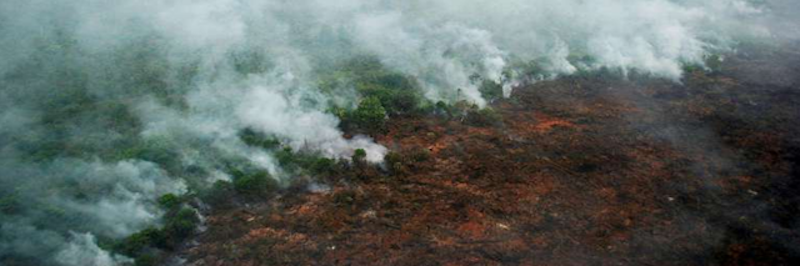
Fire brigade helicopters fly back and forth, but are unable to stop the columns of smoke rising from Ogan Komering Ilir, in the Oki district on the island of Sumatra, Indonesia. In the same district stands the massive paper mill of the paper giant Asia Pulp & Paper (APP), also called ‘Oki’, which is at the root of what is happening.
Before the APP converted them into plantations, the entire district was covered by extensive swamp rainforests, a paradise of flora and fauna. All this has disappeared. In its place, all that now remains is an expanse of scorched earth.
Fires in paper plantations produce few flames. In fact, it is the earth that burns, even before the skinny industrial trees. The soil in fact consists of peat, which once drained to make room for the plantations, burns like real fuel, emitting a thick black smoke. A burning peatland looks like the image of a circle of hell. The fire, which spreads in the peaty subsoil, is virtually impossible to extinguish or even to contain
In just one day, September 2th 2023, 83 fire hotspots were recorded in South Sumatra. From 1 January to 31 July 2023, approximately 1,178.50 hectares of land were burned in the province. These are the data recorded by the local organization HaKI, monitoring the area. And it is not the first time. In 2015 and 2019 other waves of forest and peat fires ravaged the area, coming from the pulpwood plantations. Fires occur in the same locations, showing that no effective prevention measures have been undertaken by the company.
As a result, the air quality in the province’s capital deteriorates, with PM 2.5 concentrations in the air at a level of 150 µg/m3, while concentration of 35 µg/m3 is already considered to be unhealthy.. Researchers reported that after the forest and peat fires in Indonesia in 2025, fetal infant and child mortality surged, leading to 15,600 missing children in the country.
Most of the fire hotspots, as repeatedly highlighted by local NGOs, start in the pulpwood or oil palm plantations, especially in those that have been developed by draining the peat bogs. The region around the Oki pulp & paper mill is dominated by APP and its suppliers. The company in 2021 announced it would triple the mill production capacity from 2.45 millions to 7 millions tons of kraft pulp per year. This expansion implies a corresponding expansion of the plantations that provide the mill with wood. This increased demand will increase the pressure on the region, and further increase the fire risk. For what? To produce more and more throw-away single use packaging.
APP is not the only actor bearing responsibility on the recurring fires. Members of the European Parliament that next week are going to vote on a package of measures aimed to reduce vaste by containing single-use packaging, should be aware that their choices can preserve the world’s remaining forests, or transform them into a living hell.
Back to News