
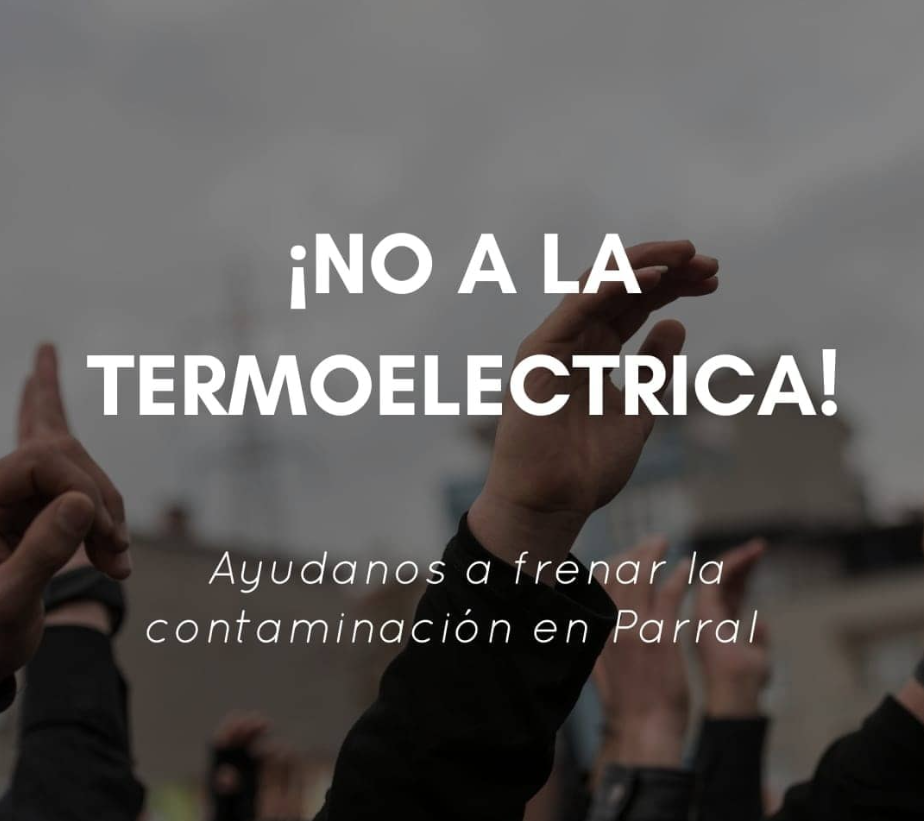
Image: “No to power stations – Help us to stop contamination in Parral” from the “No a la thermoelectrica Parral” community campaign.
Guest Post by Daniel Santander Urrutia, Geophysicist and member of Colectivo Viento Sur, Defensores Medioambiente Parral and EPN’s Biomass Working Group.
In 2021, construction of La Gloria biomass incineration power plant began in the Parral commune of the Maule Region in Chile. The plant is located in the rural area of Talquita, close to a small school, a rural health clinic, and an important biological corridor consisting of the Perquilauquén River and the Zanion and La Vega wetlands. The plant is owned by the Chilean company, GRUPO BIBA, and managed by C&E Consulting and Energy. It has a capacity of 3.7 MW for generating electricity.
Community opposition to the development
The power plant, which is expected to begin operating in 2023, will allegedly burn agricultural and forestry waste, including from two nearby rice grain drying plants. However, the local community has criticised this plan, in part due to the high chemical traces of pesticides and agro-toxins present in these residues, which can cause environmental toxicity in both livestock and humans.
Concerns about the potential impacts on the community led to the creation of the campaign “No a la termoeléctrica” and the organisation of protests against the power plant, including road blockades and street protests (pictured below).
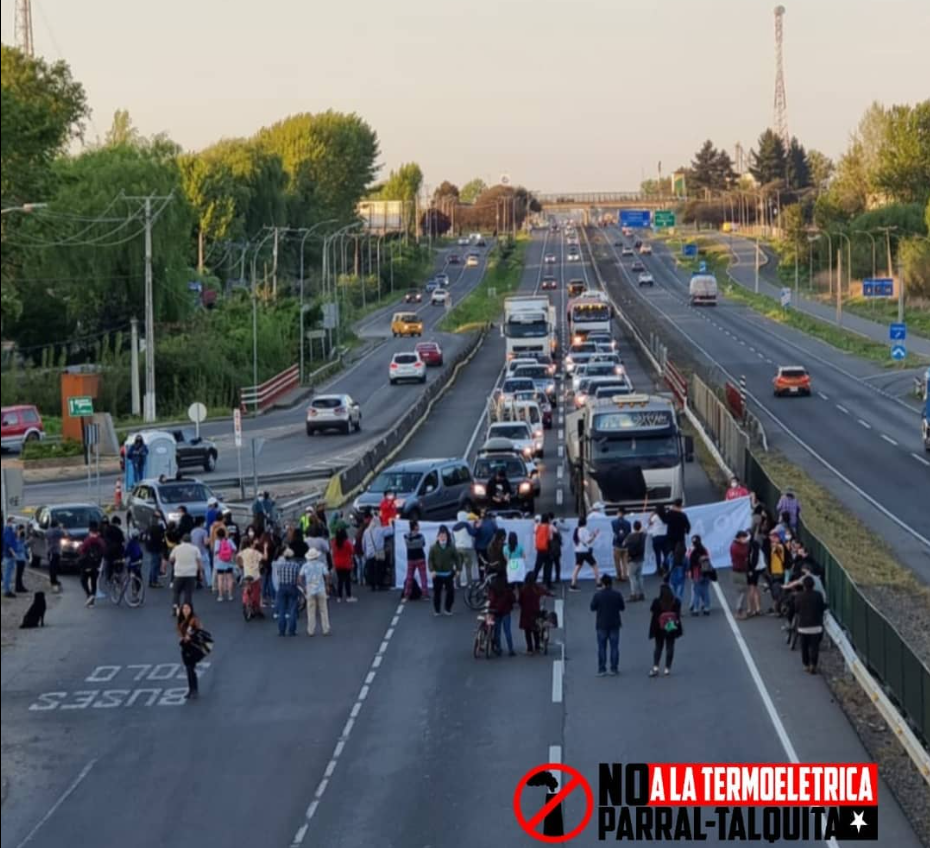
Image: October 9th, 2021. Citizens of Parral mobilize against the biomass powerstation and block traffic on the highway after a large assembly in the central square.
Local residents cannot see that there will be any benefits to them from the power plant: “It seems shameful to me” said Marisa in an interview, who lives 1,800m from the plant “that we do not have energy problems here and they (the energy company) want the energy to sell it to other parties.” Instead, local residents foresee only negative impacts to their health and environment.
In order to build a solid case, the No a la Termoelectrica Parral campaign is working with an interdisciplinary research team to prepare a review of the effects of biomass burning on human health. The team includes María Elisa Quinteros, who won an international award for “Thesis of the year” in 2018/19 with the study “Impact of Wood Burning Air Pollution on Preeclampsia and other Pregnancy Outcomes in Temuco, Chile.”

Image: The sign reads “Since I was a month old, I have been fighting asthma. Today at 3 years old, my crisis is difficult to control. I am Vincente Agurto, living in Talaquita and I say no to La Gloria Biomass” Kind permission to use this photo was given by Estefania Clemente Retamal, mother to Vincente.
Fears of expansion
There are also fears that, once established, the power plant will expand and the demand for feedstock to fuel it will grow. The Mayor of Parral, who is sceptical of the scheme said in an interview “They (the energy company) bought 5 hectares from us, but only declared 1 hectare and you realise that this is going to grow. At the beginning it will be more agricultural waste, after which they will move to other sources.” The community is worried that the project will eventually turn the area into a sacrifice zone.
A false solution for reducing GHG emissions
The La Gloria project was initiated with a subsidy from the Japanese government under the Joint Crediting Mechanism (JCM), which received US$4 million in financing through the Global Environment Center Foundation (GEC). However, the project has been denounced as a “false green solution” by local campaigners. This is because, although it claims to mitigate emissions that would be generated if the agricultural wastes (such as rice husks) were burned by farmers, in practice, many people actually compost this biomass, improving water retention and soil regeneration. Globally, the biomass industry has been widely criticised for its misleading claim that burning biomass is carbon neutral, when it is not.
Taking a legal stand against the power plant
Together with the Municipality, the campaign against Parral Thermoelectric Plant has filed a legal action against the company before the environmental court. The community is demanding a new evaluation process for the project, which takes into consideration the adverse effects on the community’s health and welfare, as well as the climate and ecological crisis affecting the Maule Region in Chile. The impact of climate change is a global concern, and the community is calling for a more sustainable approach to energy production. They are still waiting for responses to their complaints.
You can watch the news piece below:
Sources
- (Social networks): @NoalaTermoelectricaParral (Instagram) and https://www.facebook.com/NoalaTermoelectricaParral/ (Facebook).
- (News) Residents of Parral oppose, mobilized, the construction of a mini thermoelectric plant Cooperativa.cl
- (News) Neighbors oppose “biomass” thermoelectric plant in Parral #ReportajesT13 Youtube – Tele13
- (News) Community and social organizations oppose the installation of a biomass thermoelectric plant in Parral – OLCA.cl
- (News) Neighbors present a new expiration appeal for the installation of the biomass thermoelectric plant “La Gloria” – LinaresenLinea.cl
- (News) Chilean company seeks to generate renewable energy from rice husks Terram.cl
- (Financing report) La Gloria Mini Biomass Power Plant. C&E Consulting and Energy, 2021.
- (Academic) A systematic review of the physical and chemical characteristics of pollutants from biomass burning and combustion of fossil fuels and health effects in Brazil. Beatriz Fátima Alves de Oliveira (2011).
- (Academic) Health impacts of anthropogenic biomass burning in the developed world. Torben Sigsgaard , et. al. (2015). European Respiratory Journal 46: 1577-1588; DOI: 10.1183/13993003.01865-2014.
- (Academic) Significance of biomass open burning on the levels of polychlorinated dibenzo-p-dioxins and dibenzofurans in the ambient air. Shun-I Shih a, et. al. (2008). Journal of Hazardous Materials 153) 276–284.
- (Academic) Enfermedad pulmonar obstructiva crónica por exposición al humo de biomasa. Matías Lopez, Nicole Mongilardi, William Checkley. 2014
- (Academic, Health and dioxins repercussions). Dioxinas y Salud. Manolis Kogevinas y Gemma Janer. Elsevier, 2000. DOI: 10.1016/S0025-7753(00)71679-4. Unitat de Recerca Respiratória i Ambiental. Institut Municipal d’Investigació Médica (IMIM). Barcelona
- (Academic) Risks for public health related to the presence of furan and methylfurans in food. EFSA Journal 2017;15(10):5005
- (Academic, Health and PM 2.5 repercussions). Environmental Protection Agency. 2008. Region 4: Laboratory and Field Operations – PM 2.5 (2008).PM 2.5 Objectives and History. U.S.
- (Academic) J.R. Balmes, J.M. Fine, D. Sheppard (1987) Symptomatic bronchoconstriction after short-term inhalation of sulfur dioxide Am. Rev. Respir. Dis., 136, p. 1117
- Pollution Particles Lead to Higher Heart Attack Risk. Bloomberg L.P. 17 January 2008.
- (Academic) U.S. EPA. Integrated Science Assessment (ISA) For Oxides of Nitrogen – Health Criteria (Final Report, 2016). U.S. Environmental Protection Agency, Washington, DC, EPA/600/R-15/068, 2016.
- (Academic). Nox-4–Dependent Nuclear H2O2 Drives DNA Oxidation Resulting in 8-OHdG as Urinary Biomarker and Hemangioendothelioma Formation Gayle Gordillo, et al. 2010. doi: 10.1089/ars.2009.2917