
Skip to Content

EPN Reports & Publications

Welcome to the Environmental Paper Network’s Reports & Publications page.

Find all reports, briefings, factsheets, and other publications authored, or co-authored, by the Environmental Paper Network or the Biomass Action Network. For additional resources on biomass, including from partner organisations, please see our Biomass Info Library.

If you have any suggestions for resources we should have in this library or any comments about it, please contact us.

Flushing the Climate 2023: A Follow Up Scorecard on Which U.S. Stores are Still Selling the World’s Most Destructive Toilet Paper

A 2023 follow-up scorecard tracking which major U.S. grocery stores and retailers continue to carry Fiora, LoCor, and Livi tissue products manufactured by Solaris Paper using fiber supplied by Asia Pulp and Paper. Ten years after APP’s Forest Conservation Policy, documentation confirms ongoing deforestation, climate harm, and social conflict in Indonesia — and too many retailers have yet to act.

Topics: Indonesia, Reduce Greenhouse Gases, Responsible Virgin Fibre, Social Responsibility, Transparency and Integrity

Flushing the Climate: Which U.S. Stores are Still Selling the World’s Most Destructive Toilet Paper?

Nine years after Asia Pulp and Paper’s highly publicized Forest Conservation Policy, monitoring by Indonesian and international NGOs documents ongoing failures. EPN-North America and partners contacted 27 major U.S. retailers selling Fiora, LoCor, or Livi branded products — manufactured by APP-affiliated Solaris — urging removal of these high-risk products until meaningful reforms are implemented.

Topics: Indonesia, Media Release, Reduce Greenhouse Gases, Responsible Virgin Fibre, Social Responsibility, Transparency and Integrity

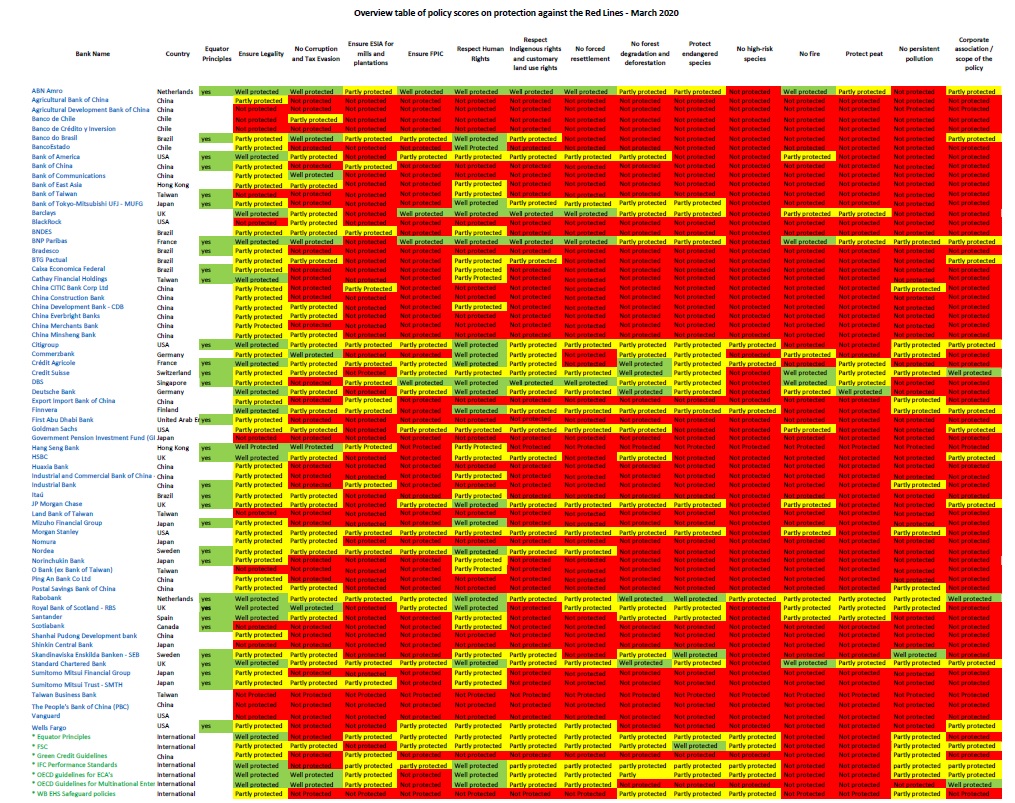
In the Red 2020

EPN evaluated the policies of 68 major financiers of the pulp and paper industry against 14 absolute minimum criteria — the “Red Lines” — that all financial institutions should require of their clients to reduce social and environmental risk. The assessment finds that most Red Lines remain very poorly protected, with only 6% of banks scoring “well protected” on average, though some improvements were recorded since the first assessment in 2017.

Topics: Deforestation, Finance, Human Rights, Responsible Virgin Fibre, Transparency and Integrity