
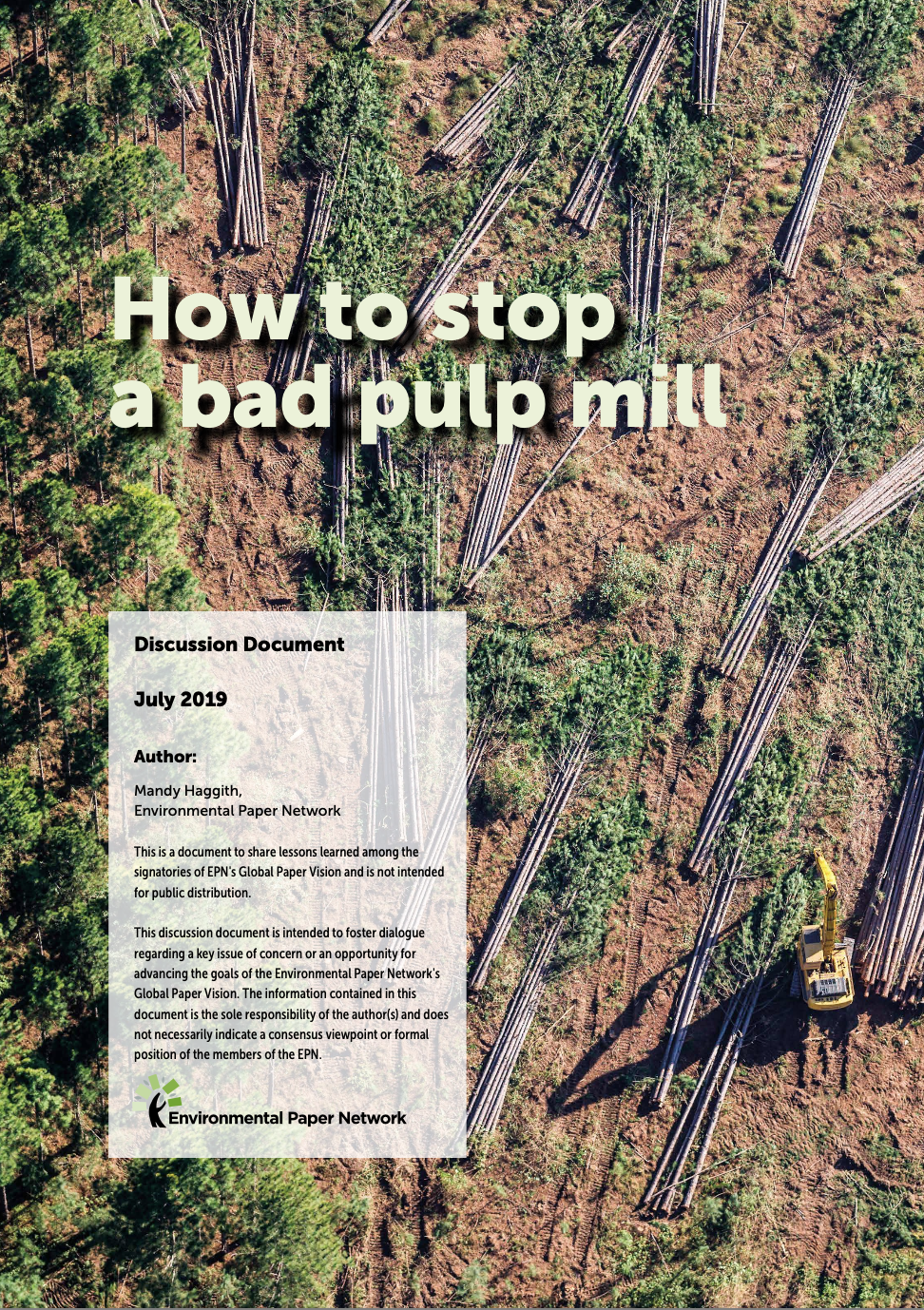
A guide for campaigners worldwide on how to stop a planned pulp mill where you live. This report includes 4 case studies, lessons learned, and some tips and tools that activists can use. Do you want to access it? Reach out to us to ask for access.
A bad pulp mill can be like a slow bomb at a landscape scale. It is a vast mechanical and chemical engineering complex, designed to operate for decades. Each year it is fed millions of tonnes of raw material (usually wood) by the work of a few hundred employees to produce fibre, heat and solid, liquid and gaseous waste. Unless it is surrounded by a very well-managed supply of forest or plantation timber, it will create a circle of forest devastation that will grow in radius every year, like an impact crater radiating out from a point of explosion. Community after community, each more distant from the mill, will feel its impact getting closer as each year goes by until they find their neighbouring forest being destroyed, their land denuded, their water poisoned, their air stinking.
To tackle a pulp mill we need to understand that its material inputs and outputs are merely the means for the conversion of capital into profit. A pulp mill costs upwards of 2 billion euros or dollars to build, a financial input provided usually by banks, and it generates cash by selling pulp into a process chain that eventually turns paper products into money from consumers.
For years we have successfully campaigned, through markets, to force pressure back down the process chain to pulp suppliers to send financial signals that paper consumers do not want the products of deforestation. This market campaigning is crucial work, yet it is about stopping existing deforestation, rather than preventing it before it happens. Even when the campaign is successful, deforestation, land-grabbing, pollution and other harms may have already occurred. The only way to prevent those impacts is to stop the mill before it has even started.
We have stopped some of the world’s worst mill plans, so the top-level lesson is that we can prevail! People power really does work! We also have an up-to-date map of the threat of new mills. Thanks to our efforts of diplomacy, we have also got relationships with bankers who are willing to listen.
Here you will find four short case studies of mills we have tried to stop, three of which were successful, followed by some lessons we have learned over the course of the past five years of work.