
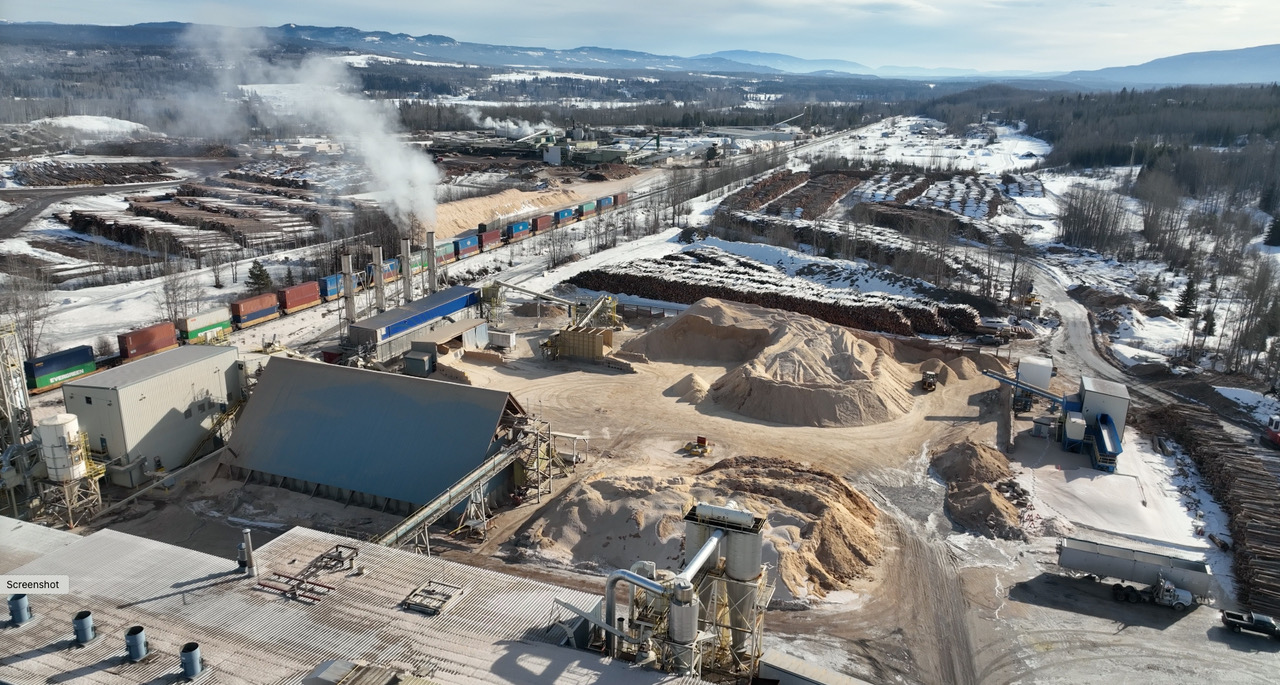
Photo: Drax wood pellet mill in Smithers, B.C., Canada Feb. 2022, photo credits to Bulkley Valley Stewardship Coalition
by Ruairi Brogan, RSPB, United Kingdom, and active member of the Biomass Action Network team at the climate talks
Question: Which source has the biggest share of renewable energy in OECD countries primary energy mix?
Answer: If you said bioenergy, you get an A+. In these industrialised countries, many large-scale, centralised energy generators are now burning wood to replace coal.
At the meetings of the Subsidiary Bodies to the UN Framework Convention on Climate Change (UNFCCC), Parties to the Convention have been showcasing their efforts to meet the ambition levels identified at the 28th Climate Conference of the Parties in 2023 (COP28) as they take part in the first ever Global Stocktake Dialogue (GST). In their efforts to firm up the third round of Nationally Determined Commitments, which they will have to publish the coming year, Parties will run into para 28 of the COP28 outcome document and its goal to triple renewables capacity by 2030.
The International Energy Agency report on Tripling Renewable Capacity that was published early June found that Parties are not on track to meeting these targets (see Wednesday 5th June’s ECO article on Light and Shadow by the IEA – Close the 3000GW Renewables Gap).
As Parties rush to cram for their final exams in terms of making the Nationally Determined Commitments deadline, we are seeing some hard calculations on how to deliver this target, and investment in false solutions like centralised big biomass energy are at risk of increasing. With a roadmap published by the Food and Agricultural Organisation expecting a doubling of solid biomass by 2030 and a tripling by 2050, the issue has become a big one which entails the logging of vast swathes of natural forests and expanding monoculture plantations.
So, the biomass report card is failing to impress. Will it get an A, top of the class? Or an F for fail?
Climate – F: Unsuitable and outdated reporting rules by the Intergovernmental Panel on Climate Change create the mirage of bioenergy being a zero-carbon source in the energy system, as it’s emissions are included in the Land Use, Land Use Change and Forestry (LULUCF) reporting instead. They are also often pushed to the country of production, which implies the countries using bioenergy as an energy source are off the hook. Be aware that per energy unit, woody biomass (trees) is on par with or higher than coal in terms of carbon emissions.
Nature – F: Destructive logging for wood pellets threatens biodiversity and climate resilience, harming forests’ ability to deliver ecosystem services like clean drinking water, flood protection, and clean air.
People – F: From exacerbating conflicts over land forest resources, to emitting harmful particulates, vulnerable communities often bear the brunt of industrial bioenergy’s poor performance on human rights, health and wellbeing.
The results are out, using industrial biomass has no place in a climate safe, just, equitable and sustainable energy transition. The evidence shows we need to exclude the use of woody biomass from forests to meet NDC energy targets. We cannot burn our way out of the climate crisis.
Please note the original version of this blog was published in the Climate ECO: https://climatenetwork.org/resource/eco-7-sb60/
Back to News