
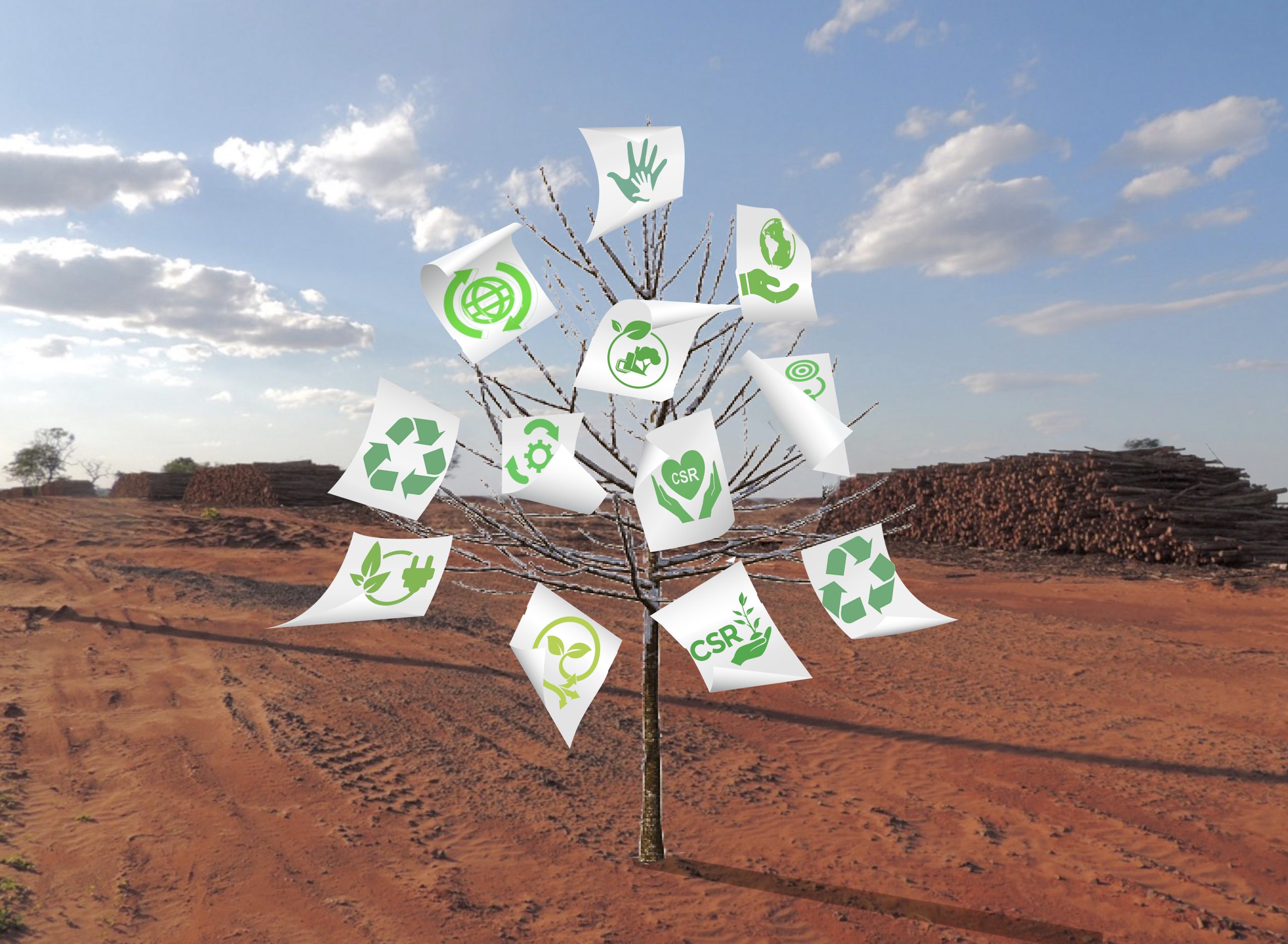
A new report by Environmental Paper Network International debunks the story that paper is ‘green’ and ‘renewable’. Evidence piles up on the ecological and human impacts of the pulp expansion frenzy.
16 July 2024 – Today, the Environmental Paper Network International has launched a daunting report on Suzano, the world’s largest producer of eucalyptus pulp and one of the major paper producers in South America. The report exposes the devastating impact of Suzano’s operations on South America’s environment and local communities. Suzano is a major landholder, controlling 2.7 million hectares across seven Brazilian states and three crucial biomes.
Suzano’s sustainability statements are confronted with concrete cases of land grabbing, violent conflicts with leaders of indigenous communities, as well as the actual impact on water resources from eucalyptus plantations, the chemical poisoning of subsistence agriculture due to the use of pesticides putting in question whether this company should be eligible for green finance.
“Despite Suzano portraying itself as fundamentally ‘green’, socially responsible, and ecologically sound, facts on the ground unveil a different picture.” explains Sergio Baffoni, campaigner at the Environmental Paper Network International, “Suzano’s history, its present, and its plans all reveal a company that places a heavy burden on local communities, forests, and the planet”
The report, among other cases, describes that of Antônio Sapezeiro, a Quilombola leader who was arrested by military police after being attacked by a private guard dog. This case shows the confronting or criminalising nature of the company’s action towards community members trying to assert their rights.
‘No Deforestation, Green Finance’, they said?
Nowadays, Suzano claims only to plant on previously degraded land. However, before they merged in Suzano’s paper conglomerate, its subsidiaries used to deforest the coastal forests to make space for pulpwood plantations. The pulp and cattle sectors work in a mutually supporting cycle, whereby ranchers often sell their land to the pulp and paper industry and use the profits to purchase new land at a forest frontier. While deforestation has increased, according to one study, Brazil’s total land under pasture has barely changed in the last 20 years. Cattle ranchers may be an instrument of deforestation, but it is often the pulp and paper industry which is the engine.
Despite facing 295 possible and probable civil and environmental proceedings and the company’s impact on biodiversity, water, air, soil and the climate, Suzano receives billions of dollars in ‘green’ financing, constituting 39% of the company’s total debt. This has been possible partly because of Suzano’s success in achieving its environmental, social, and governance (ESG) performance accolades. In March 2024, Suzano received a sustainability-linked loan of USD $780 million, although the details and objectives of this loan remain murky.
EPN International has laid out a comprehensive set of demands to the Brazilian pulp and paper industry, their investors and business partners in Scorching the earth. The impacts of pulp and paper expansion in the Três Lagoas region, Brazil. The paper presents specific measures to respect the traditional land rights of Indigenous and other local communities, mitigate environmental impacts on forests, climate and water table, and embrace transparency. Suzano should implement these changes in full. To ensure this happens, public and private financial institutions should investigate and engage with Suzano around these demands and suspend financial services to the company in the meantime.
The report is available in English and in Portuguese, in Chinese, and a briefing is available in Dutch *.
Contact info:
Sergio Baffoni, EPN, http://www.environmentalpaper.org, +49 162 3812528 (CEST)
* ABN AMRO response:
’ ABN AMRO changed its strategy in 2020 by focusing on customers in north-western Europe. As a result of this decision, a large proportion of customers outside Europe have been parted with in the period since then (link).’
The figure of EUR 450 million mentioned by us on our website and in the document ‘The Dutch cash flows to Brazilian paper company Suzano’ dated 16 July 2024 covers the period from 2017-2023. In 2023, according to the Forests and Finance database, ABN AMRO was related to Suzano for a rounded USD 60 thousand. This does not seem to put ABN AMRO among Suzano’s top Dutch financiers today.’