
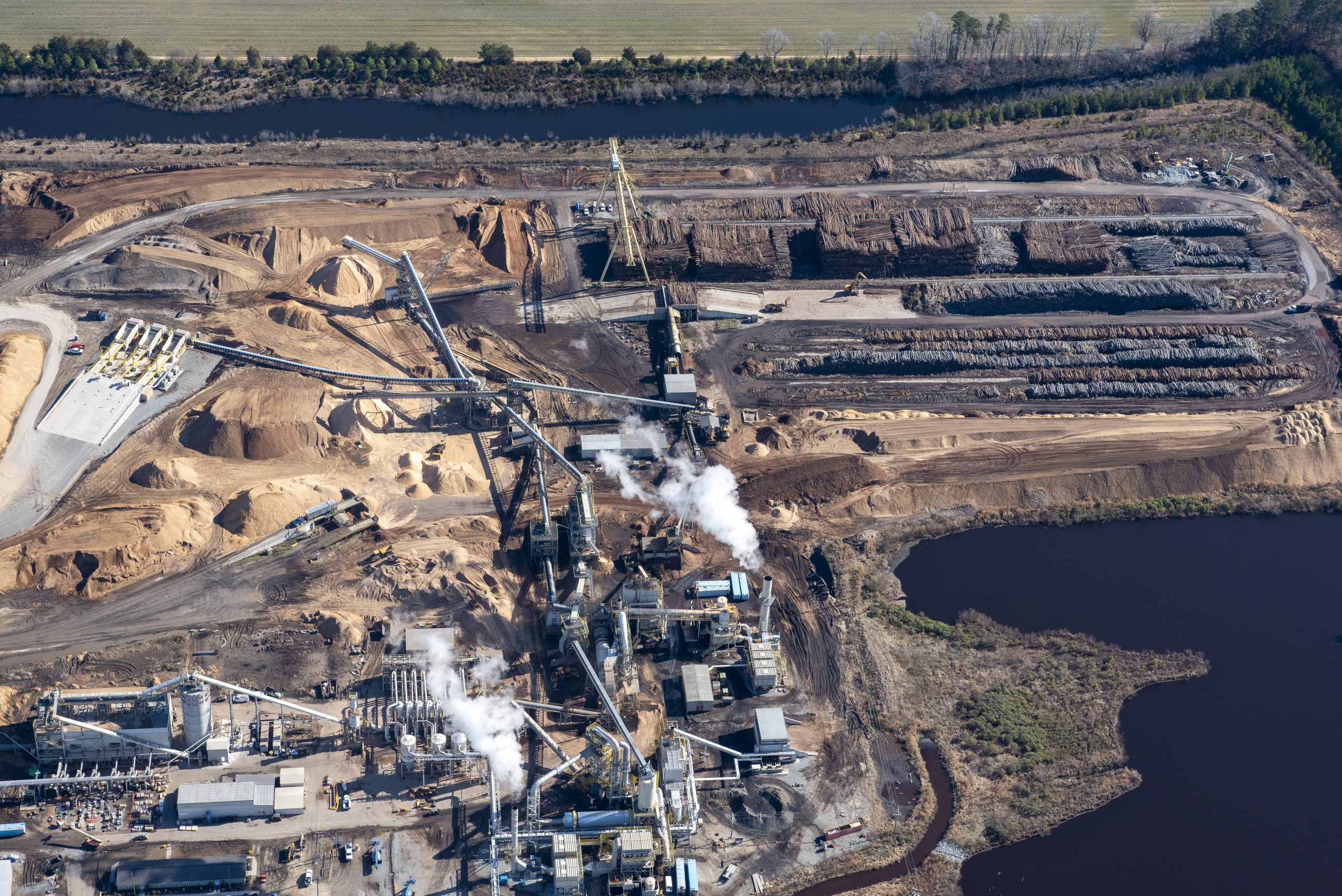
Photo credits: Tom Brennan
– FOR IMMEDIATE RELEASE –
At COP28 civil society calls for exclusion of big biomass from global renewable energy target
Large-scale biomass energy undermines international climate ambition at the United Nations summit
8 December, 2023
DUBAI, United Arab Emirates – As COP28 enters its second week, civil society organizations from around the world gathered today to sound the alarm on big biomass energy, calling for its exclusion from what must be an ambitious Global Renewable Energy target.
The Biomass Action Network, composed of 283 CSOs across 59 countries convened by the Environmental Paper Network, outlined that burning biomass is as emissive as coal per unit of energy produced – while the industry drives forest destruction and subjects communities to harmful pollution, land grabbing and environmental degradation.
Over 100 countries joined a pledge in the first days of COP28 to triple renewable energy expansion by 2030. But both climate and forest advocates are warning that this pledge would be severely undermined by the inclusion of the false solution of biomass energy.
“This COP will be a success if it delivers an outcome that triples renewable energy deployment, doubles energy efficiency, and secures a fair, fast, full, funded phase out of all fossil fuels,” said David Tong, Global Industry Campaign Manager for Oil Change International and Co-coordinator of the Energy Working Group of Climate Action Network International. “But let me be very clear: Burning forests for electricity is a disaster for climate, for ecosystems, and for people and communities. That’s not renewable energy.”
Biomass sourcing and wood pellet production is also extremely harmful for communities around the world. The insatiable demand for biomass – artificially propped up by subsidies intended to support the expansion of genuine renewables such as wind and solar– causes air pollution that is harming human health.
“It is imperative that the UNFCCC recognizes the human rights injustices of wood pellets manufacturing and stop treating wood bioenergy as a viable climate solution,” said Katherine Egland, Co-founder of the Education, Economics, Environmental, Climate and Health Organization (EEECHO) and Chair of NAACP Environmental and Climate Justice Committee. “The U.S. is the largest exporter of wood biomass. People in the southeastern United States cannot breathe due to the air pollution. They are being sacrificed, and suffering from sleep deprivation from the noise pollution and respiratory diseases and other environmental health deteriorations in a failed, misguided effort to reach 1.5°C.”
Deploying biomass on a large scale leads to devastating land-use changes with far-reaching consequences, including forest and biodiversity loss, and violating the rights of Indigenous Peoples and local communities. Biomass expansion increasingly entails land grabs around the world, as forests are seized and logged for biomass and replaced with tree plantations, and agricultural land is also alienated to grow thirsty monoculture plantations to fuel power plants. The wood is increasingly shipped to the Global North to fuel large scale centralized energy generators.
“The change of the fossil energy system into a renewable energy system is inevitable, thus communities should be in the center of the transition. In this transition process, biomass energy is being pushed more than ever to Africa. The examples on the ground show that communities have been displaced and their lands taken over to plant timber for energy production,” said Kwami Kpondzo, Global Forest Coalition and Coordinator Africa working group of Biomass Action Network. “Leaders have to and must protect people and communities’ rights over the interests of companies that promote biomass.”
Scientific evidence shows that burning biomass emits as much or more carbon at the smokestack than coal, including a recent report from Solutions for Our Climate analyzing South Korea’s biomass emissions at the point of combustion. However, flawed UNFCCC carbon accounting rules have created a dangerous incentive to burn forests for energy – while providing cover for continued coal power generation via converting generators to co-fire wood with coal.
“Co-firing coal with biomass as a so-called form of ‘abatement’ of coal is a dangerous scam,” said Peg Putt, Co-coordinator of the Biomass Action Network. “Burning coal is entrenched while emissions are not reduced at all, air pollution from the smokestack continues, and the ability of forests to contribute to combatting the climate and biodiversity is undermined during the crucial period for emissions reductions.”
Follow the Press Conference on 8th December at 11:30 UTC here
Media contacts:
(In Dubai) Katherine Egland, Co-founder, EEECHO and Chair, NAACP Environmental and Climate Justice Committee; +1 (228) 617-0891
(In Dubai) Kwami Kpondzo, Global Forest Coalition and Coordinator Africa working group of Biomass Action Network; kwadodzi@gmail.com; +228 98 22 14 57
(In Dubai) David Tong, Global Industry Campaign Manager, Oil Change International and Co-coordinator, Energy Working Group of Climate Action Network International; david.tong@priceofoil.com; +64 21 250 6375
(In Dubai) Peg Putt, Co-coordinator of the Biomass Action Network; peg.putt@gmail.com; +61 418127580
Additional contacts:
(In Dubai) Somang Yang, Lead, Bioenergy & Land Use, Solutions for Our Climate; somang.yang@forourclimate.org; +82 10 4461 9770
(In Dubai) Tegan Hansen, Senior Forest Campaigner, Stand.earth (Canada); tegan@stand.earth; +1 (250) 354-3302
Resources and background information:
Media Guide – Forest Biomass Resources for Media at COP28: Background Materials and International Experts | Stand.earth and contributing organizations
Fact Sheet – How a Carbon Accounting Problem Is Driving the Biomass Delusion | Environmental Paper Network
Report – Subsidized Deforestation: 10 Years of Biomass Power in South Korea | Solutions for Our Climate
Information on emissions and accounting:
- Biomass emits as much carbon dioxide (CO2) per unit of energy as coal, and more than oil, or gas. These high emissions are attributed to the low calorific value of wood, which makes it an inherently inefficient fuel source.
- Biomass emissions at the point of combustion are accounted for in the Land Use, Land-Use Change, and Forestry (LULUCF) sector, instead of the Energy sector, as per the guidelines from the Intergovernmental Panel on Climate Change (IPCC). This unresolved peculiarity in international carbon accounting creates the misleading impression that biomass is zero-emission energy, despite the IPCC’s clarification that this technicality does not automatically render biomass as carbon-neutral.
- In practice, the global warming effect of GHGs from biomass is comparable to that of fossil fuels. Burning biomass, in itself, is fuel combustion emitting carbon and cannot be equated to a ‘clean’ or ‘zero-carbon’ source of energy like solar or wind power.
Recent analysis on emissions at point of combustion
- A December, 2023 report Subsidized Deforestation: 10 Years of Biomass Power in South Korea” from Solutions for Our Climate estimates that biomass for electricity in South Korea emitted approximately 11 million tCO2 in 2022 alone, which exceeds all the annual forest carbon sink enhancements the government has committed to achieving by 2050, effectively nullifying the government’s net-zero commitments in the forest sector.
“Since more than half of all biomass fuels are imported and not accounted for in South Korea’s LULUCF sector but in source countries, this level of emissions effectively cancels out the government’s forestry sector net-zero goals at the expense of developing countries’ mounting mitigation burden” said Somang Yang, Head of the Land Use & Bioenergy Program at Solutions for Our Climate