
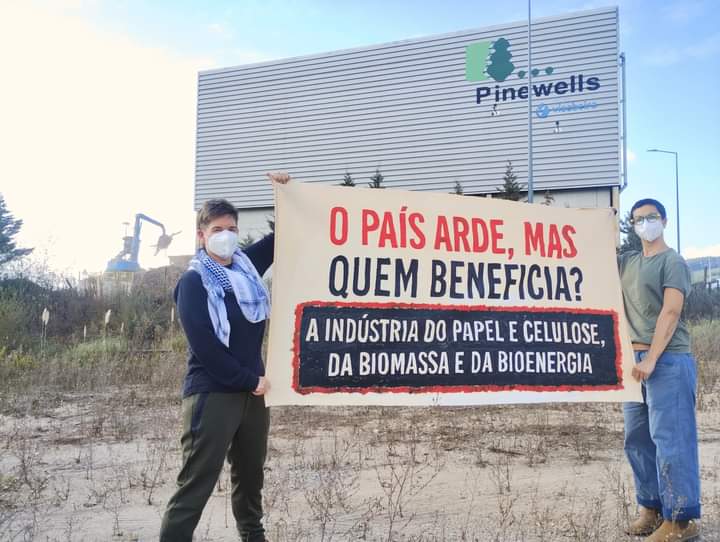
This was the slogan on a banner at one of many protests taking place throughout Portugal on Sunday 22nd of September, in response to wildfires which ravaged parts of the country during the previous week (15th – 19th). The protests were called by Emergência Florestal, a decentralised network of organisations and individuals located throughout Portugal’s fire-prone regions. The organisers of the nationwide call to action are demanding that Portugal’s rural areas are “pulled out of the hands of the eucalyptus and biomass industries” and here at EPN International, we stand in solidarity with the communities affected by Portugal’s recent forest fires and echo this demand.
Wildfires are one of Portugal’s biggest environmental, social and political problems, particularly in northern and central regions where they are most frequent. The biggest fires on record occurred in 2017 when over half a million hectares burned and more than 100 people lost their lives. Now, this month, in the space of less than a week, over 120,000 hectares burned, resulting in another seven fatalities.
It is no coincidence that Portugal has proportionally more eucalyptus plantations growing across its landscape, than any other country in the world. Eucalyptus plantations are fire-prone and allow fires to spread quickly and with a high intensity across large areas. They also place significant strain on water resources, exacerbating the severe drought conditions that are already being experienced more frequently due to climate change.
During a visit to the country in September 2022, The United Nations Special Rapporteur on human rights and the environment commented that: “I saw extensive monocultures of Eucalyptus trees during my visit [to Portugal] and recommend taking steps to reduce the area of land covered by this species. Experts recommend substituting native species that are more fire resistant, such as oak, cork and chestnut trees, and creating more diverse landscape mosaics.”
However, the extensive lobbying power of Portugal’s pulp and paper industry continues to exert a strong influence over forestry-related decision-making. Decades of privileged access to successive Portuguese governments has resulted in the dismantling of forestry regulation, the unimpeded spread of highly impactful eucalyptus plantations and vast public subsidies and support mechanisms directed towards the sector.
Portugal’s pulp and paper sector primarily uses eucalyptus to produce pulp and manages around a quarter of the extensive eucalyptus plantations that are concentrated in central and northern regions of the country. In addition, over 70% of all biomass burned for electricity generation in Portugal in 2021 was classed as eucalyptus residues.
Pulp and paper is big business in Portugal and the sector has seen unprecedented profits in recent years. Portugal’s biggest pulp and paper producer, The Navigator Company, saw profits of almost €400 million in 2022, up almost 130% on the previous year. The second largest producer, Altri, saw profits up almost 300% in 2021, with this upward trend continuing in 2022.
Biomass electricity is increasingly contributing to the profitability of these companies as they diversify into other areas of the bioeconomy and take advantage of strong policy support for burning biomass. Between them, Portugal’s pulp and paper sector account for almost 80% of the biomass electricity generated in Portugal each year.
Despite the introduction of a law banning the establishment of new eucalyptus plantations in Portugal, the pulp and paper and forestry industries have continued to lobby strongly for an increase in plantation areas. The President of Portugal’s National Association of Forestry, Agricultural and Environmental Companies (Associação Nacional de Empresas Florestais, Agrícolas e do Ambiente) called for new tree plantations to be established in order to fulfil demand for biomass for energy generation, and in recognition of the fact that there is insufficient residual biomass to satisfy demand.
Portuguese NGOs such as Quercus have been campaigning against the impacts of extensive plantations across the Iberian Peninsula for many years. In January 2022 Quercus and other Portuguese NGOs criticised the Portuguese government for “giving in to pressure from the pulp and paper industry” through its plans to increase the limits set for eucalyptus plantations across the country, effectively giving the green light to nearly 40,000 additional hectares.
Enough is enough. The planting of eucalyptus monoculture plantations to satisfy the greed of the Pulp, Paper and Biomass companies is quite literally costing people their lives. EPN International stands in solidarity with the communities affected by Portugal’s recent forest fires and calls on the Portuguese government to ensure that no new eucalyptus plantations are licenced and to commit to an immediate and significant reduction in plantation areas.
Notes: This article is based on a 2023 EPN report which looked at the impacts of the pulp and paper industry’s domination of the biomass electricity market in Portugal, available here: https://environmentalpaper.org/wp-content/uploads/2023/03/pulp-biomass-portugal-2023-EN-1.pdf