
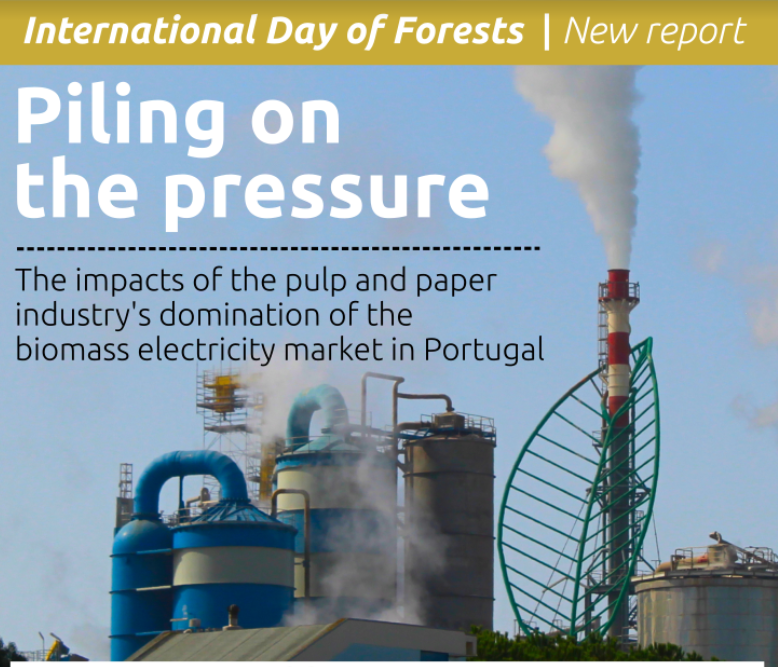
National and international organisations demand the end of subsidies for burning forest biomass in pulp mills in Portugal
A report released on the International day of Forests (21st March) exposes the impacts of burning huge quantities of wood in power plants attached to Portugal’s pulp mills each year. This has implications for tackling wildfires in the country, and therefore significant consequences for human health.
Burning biomass at power plants associated with pulp mills is increasingly contributing to the profits of Portugal’s two big pulp and paper companies, The Navigator Company and Altri. Although they claim that biomass electricity helps to fight climate change and reduce the risk of wildfires, a new report [1] published today by three Portuguese and two international NGOs [2] disputes these claims, and highlights the significant impacts on the climate and environment that are being ignored by the industry.
According to Alexandra Azevedo, President of Quercus, “The pulp and paper industry has always burned some of its industrial waste products to produce energy, but in recent years lucrative public renewable energy subsidies have encouraged the construction of big and inefficient electricity-only biomass power stations next to pulp mills, and the replacement of fossil gas CHP plants with biomass-burners. These plants need far more wood than is produced as by-products and waste by the pulp mills, requiring large quantities of additional wood to be brought in directly from forestry operations. The subsidies have effectively decoupled biomass-burning at most of Portugal’s pulp mills from industrial waste streams.”
The report shows how the pulp and paper sector is now burning more wood to produce energy than any other sector in Portugal. In 2021, it generated 80% of the electricity produced in Portugal through burning biomass in combined heat and power (CHP) and electricity-only biomass power stations, and owned over half of the dedicated biomass electricity generating capacity. Put together, the sector burned nearly 3 million tonnes of wood in 2021, almost 60% of which was sourced directly from forestry operations, most of it from Portugal’s extensive monoculture eucalyptus plantations.
Sophie Bastable from the Environmental Paper Network states that: “Globally, incentives for biomass electricity such as renewable energy subsidies have opened up a new income stream for the paper and pulp industry. This income incentivises further intensification of logging and the expansion of monoculture tree plantations, often in the place of natural ecosystems. We are seeing this worrying trend develop not just in Portugal but around the world – from South America to South Africa.”
Two big new developments are highlighted in the report as being emblematic of the problems caused by the large-scale burning of biomass for energy generation. The first is the Figueira da Foz II electricity-only power station at Altri’s CELBI pulp mill (operated by GreenVolt, an Altri subsidiary), which is entirely dependent on wood that comes directly from forestry operations and according to the report operates at an alarmingly low efficiency of around 22%. The second is The Navigator Company’s new biomass boiler, also in Figueira da Foz, which replaced a fossil gas CHP plant and requires almost half of the biomass it burns to be sourced directly from forestry operations.
Oliver Munnion at Biofuelwatch states: “Rather than biomass-burning at pulp mills being an example of a circular economy, as the industry claims, it is a destructive one-way process. More and more wood is being burned at very low efficiencies, which is pumping more and more carbon into the atmosphere. According to the IPCC, burning biomass results in immediate carbon emissions that are higher than fossil fuels such as coal, oil and gas, and these emissions have a significant climate impact over long periods of time no matter what type of biomass is being burned. This cannot possibly be considered green or renewable”.
Campaigners also question the claims that burning forest biomass helps to reduce the risk of wildfires, which are a huge social and environmental problem each summer in Portugal. Paulo Castro, President of Acréscimo, states: “Over the past decade and a half there has been a substantial increase in the amount of biomass removed from forestry areas, both to burn in power stations and to turn into wood pellets. But, at the same time, the total area burned each year in Portugal has continued to grow, and in the last five years forestry areas have overtaken other types of land use such as unmanaged forests as being the most prone to burning. This pseudo-fire reduction strategy is clearly not working, quite the opposite is happening.”. Serafim Riem, from Iris, emphasises: “The over-extraction of biomass is reducing tree cover, making soils poorer, causing the loss of biodiversity and increasing the risk of desertification”.
Wildfires not only destroy whole ecosystems, but also have substantial impacts on human health – affecting air quality and causing respiratory diseases and, at their most tragic, leaving life long disabilities and claiming lives.
Campaigners have made three key demands of the Portuguese government. Firstly, they are calling for the introduction of an immediate moratorium on new biomass electricity capacity, and ending its eligibility for renewable energy subsidies. They are also calling for limits to be placed on biomass-burning at pulp mills, so that no wood directly taken from forests and tree plantations is used as feedstock for energy generation. Finally, they are asking that subsidies for biomass electricity generation be redirected towards genuinely renewable energy generation, energy efficiency measures and fire risk reduction techniques that incentivise the conservation and regeneration of soils and native forests.
Notes
[2] Signatories to the report are: Quercus, Acréscimo, IRIS, Biofuelwatch and the Environmental Paper Network (EPN)

Media Contacts
Paulo Castro, Acréscimo, +351 917 011 174
Domingos Patacho, Quercus,+351 937 515 218
Oliver Munnion, Biofuelwatch, +351 963 235 732