
Environmental Paper Network (EPN), Fern, BankTrack and the Estonian Council of Environmental NGOs (EKO) are jointly calling on European and international banks and investors not to finance Viru Keemia Grupp/VKG’s planned pulp mill in northeastern Estonia’s Ida-Viru County. A new report published today outlines the devastating effects this pulp mill could have on Estonian nature.
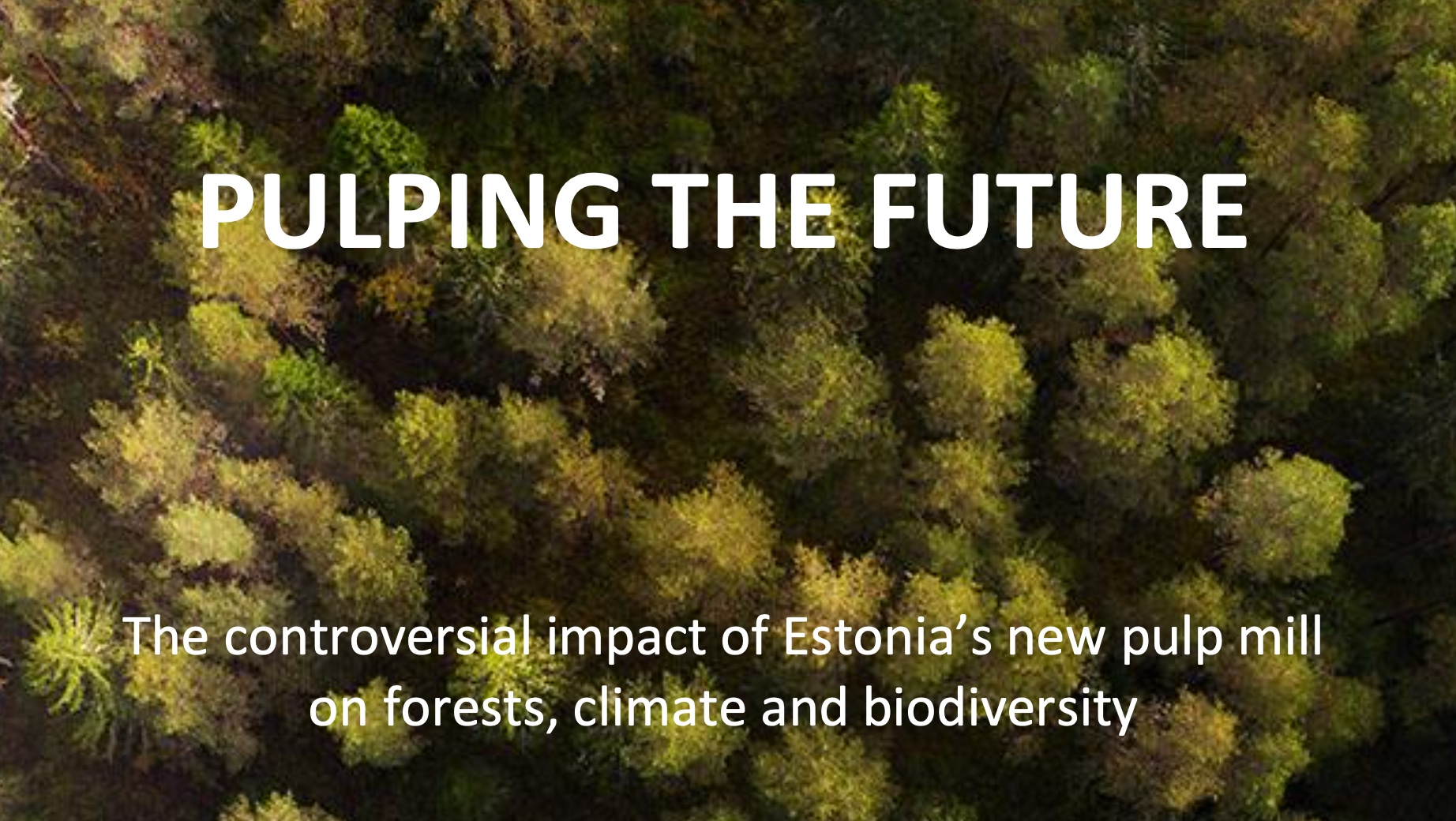
The new report ‘Pulping the future’, published by EPN and EKO, highlights that the so-called “bioproducts production complex” is, in essence, a traditional pulp mill that would consume around 2.25 million cubic metres of wood annually—roughly one-fifth of Estonia’s total yearly logging volume. The pulp mill would perpetuate and possibly accelerate Estonia’s unsustainable logging practices.
“Any public or private bank that claims to be committed to sustainability or nature protection should keep its hands off this project. The proposed mill, the largest private-sector investment in Estonian history at €1,3 billion, is a choice: to stay stuck grinding nature to pulp, or to build a future where people, planet, and business all thrive. Choose wisely.” states Ola Janus from BankTrack’s Banks & Nature Campaign.
The pulp mill would exacerbate forest degradation and biodiversity loss in the region. “Estonia’s forestry model relies heavily on clear-cutting, and logging volumes in recent decades have reached levels nearly four times higher than historical averages,” said Laura Uibopuu from Estonian Fund For Nature, a member of EKO. “As a result, only 1.9% of natural old-growth forest remains in the country today—a figure that continues to decline.”
Siim Kuresoo, a campaigner at Fern added that projects like this clash with EU goals. “EU Regulations such as the EU Land Use Land Use Change and Forestry (LULUCF) Regulation are meant to increase the European forest sink, but instead it is collapsing,” said Siim Kuresoo. “Estonian forests are increasingly unable to accumulate carbon due to unsustainable harvesting for wasteful consumption, building this mill would lock in this unwanted trend for decades.”
The report also warns that the project is being advertised with misleading language, erroneously marketing this as sustainable, in order to attract financing. The main output— pulp—would be used primarily to produce short-lived paper and packaging products. “The current surge in global demand for paper is largely driven by single-use packaging, often discarded the same day it’s purchased,” said Sergio Baffoni, of EPN. “We can’t destroy our beautiful forests just to feed a throwaway culture. Viable alternatives like reusable packaging already exist and work effectively: we do not truly need more pulp.”
The NGOs urge financial institutions to assess the project’s full environmental and social impacts before considering involvement. A previous attempt to develop a similar pulp mill near Tartu, in southern Estonia, was shelved in 2019 following opposition from communities, scientists, and environmental organizations.
Last week, the Estonian Fund for Nature filed an appeal with the Tartu Administrative Court to challenge the special spatial plan that granted approval for the construction of the pulp mill. The appeal highlights that while an environmental impact assessment has been conducted, it fails to address the ecological consequences of sourcing the vast volumes of wood required to operate the facility.
Download the report Pulping the Future: The controversial impact of Estonia’s new pulp mill on forests, climate and biodiversity
About the organizations
The Environmental Paper Network (EPN) is a global coalition of over 350 not-for-profit organizations dedicated to transforming the forest, pulp and paper, and biomass industries for a sustainable future.
Fern is a Brussels-based non-profit organisation that works to protect forests and the rights of people who depend on them, focusing on EU policies and their global impacts.
BankTrack is an international NGO that monitors the financial sector and campaigns to ensure banks and investors do not fund harmful projects that damage the environment or violate human rights.
The Estonian Council of Environmental NGOs (EKO) is a coalition of ten independent Estonian environmental organizations, each with its own focus but with a shared mission: to safeguard Estonia’s natural environment.
Media contacts:
Estonian Fund for Nature: Laura Uibopuu, +372 522 3121 laura.uibopuu@elfond.ee
Environmental Paper Network – International: Sergio Baffoni: +49 162 3812528 sergio.baffoni@environmentalpaper.org