
The financial sector has an unparalleled opportunity to shape a green future of the pulp and paper industry. These choices will not only influence the industry’s practices but also contribute to the broader global effort to protect our planet and its resources for generations to come.
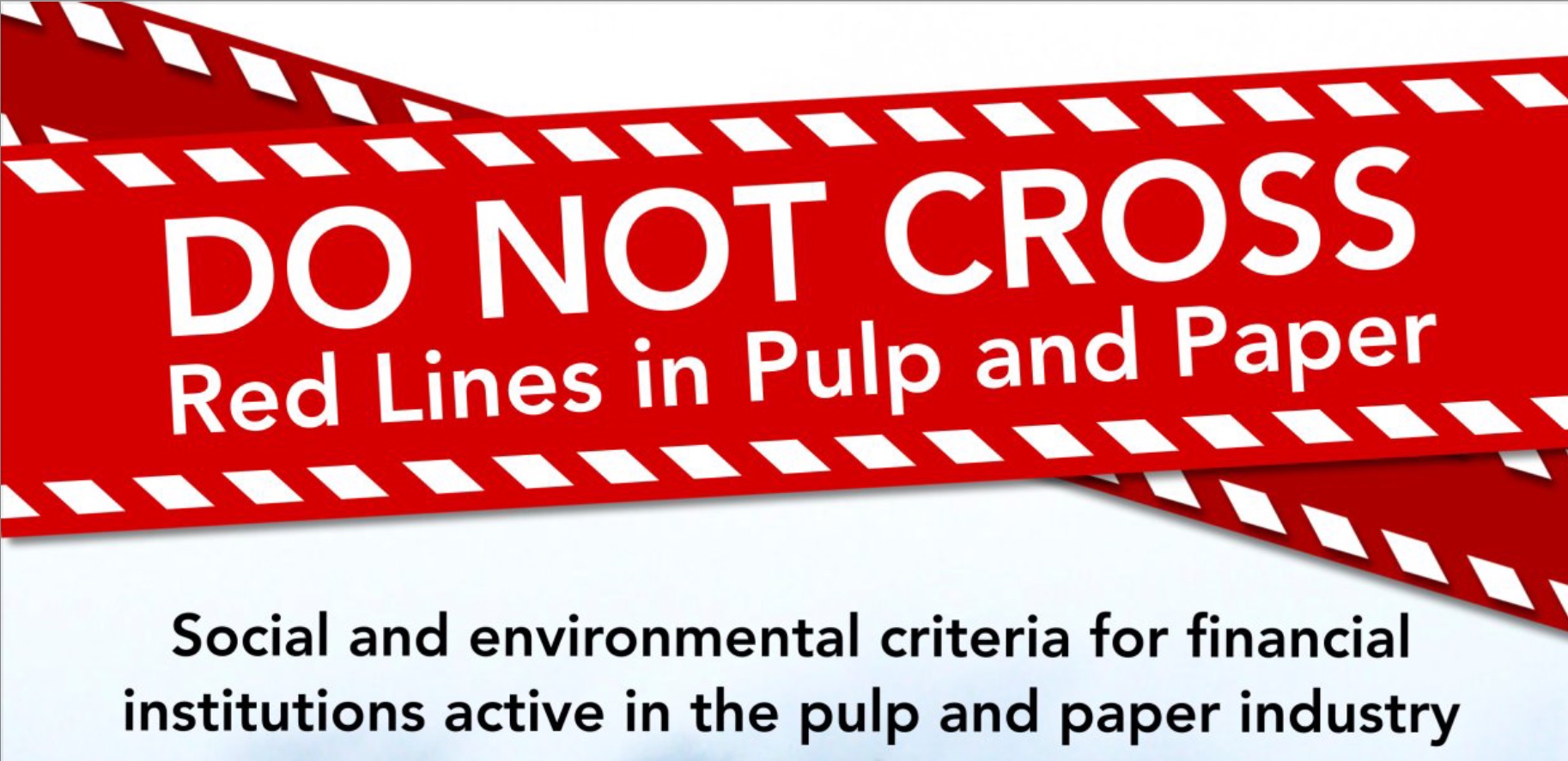
 As we are currently closing in on the first real ecological and climate-related tipping points, the time for financial institutions to act is NOW. EPN’s updated safeguard criteria document Do Not Cross: Red Lines In Pulp And Paper can be seen as an ‘easy-to-use do-no-harm handbook’ for financial actors aiming to reduce significant negative impacts of the pulp and paper industry on land and people.
The document provides an extensive list of social and environmental due diligence criteria for financial institutions active in the pulp and paper industry. These include (1) overall systemic criteria; (2) internal regulatory and governance criteria; (3) social requirements; and (4) environmental requirements.
Since the 1960s, global wood harvesting has increased by 65 percent, reaching a total of nearly 4 billion cubic meters in 2020—far more than what the world’s forests can sustainably regenerate. If pulp and paper usage continues to grow at the current rate, global paper production is projected to double again by 2050, reaching 870 million tons annually. This is a REAL threat to our global ecosystem and a significant additional driver of global warming.
In addition to the ecological damage, the livelihoods of people who for example depend directly on their forest land and whose land and/or water resources are lost to tree plantations is also threatened. Communities are often driven away from their traditionally owned lands in ways that are closely linked to human rights violations and lead to further social conflict in surrounding areas.
By adhering to strong social and environmental standards, financial institutions can lead the charge toward a more equitable, and resilient future. If any of these Red Lines are crossed, we expect financial institutions to divest, remove the client from its portfolio and/or refuse to invest in the project, activity or company. Any association with these activities will inevitably represent a serious reputational risk for the involved financial institution.
| Do Not Cross: Red Lines In Pulp And Paper was coordinated and prepared by Environmental Paper Network (EPN), a network of more than 350 non-governmental organisations across the globe. It was drafted by our Pulp Finance Working Group in consultation with our members and in collaboration with the Forests & Finance Coalition, the Banks & Biodiversity Initiative and BankTrack. |