
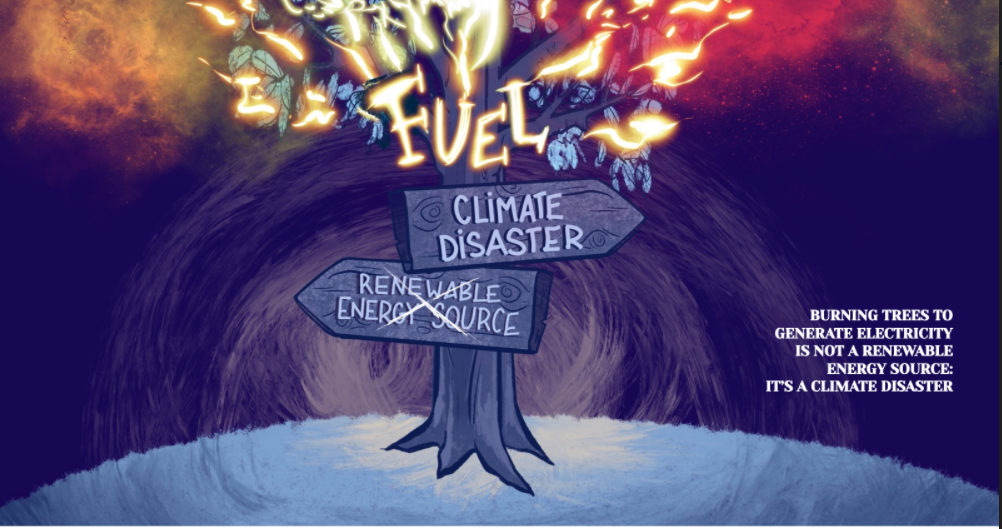
Blog post by Peg Putt and Simone Lovera (Biomass Action Network)
As we organise a push to highlight the appalling impacts of Big Biomass energy and seek change at COP 29, here is an update on key issues and events at the UN Climate Convention and the outlook for the next big meeting of Parties to the Paris Agreement.
Finance is a key issue
From the 3rd – 13th of June 2024, the 60th session of the Subsidiary Bodies to the UN Climate Convention took place in Bonn, Germany. The meeting was marked by a polarized atmosphere and long, often confusing fights over merely procedural matters. Similar to the Convention on Biodiversity talks that took place in Kenya one week before this meeting, the most controversial issue was finance. Countries in the Global South are rightfully frustrated that despite multiple legally binding commitments and other promises, countries in the Global North have not come up with the public financial support to assist them in a just transition to more climate resilient and climate friendly economies. This is particularly unfair since countries in the Global North have a greater historical responsibility for creating climate change in the first place, so there are legitimate reasons to compensate countries in the Global South for the loss and damage that they have suffered, and to help them adapt to and mitigate global warming. At COP 29 finance will be the dominating issue, but there’s not much optimism that a satisfactory commitment to supply public finance will be resolved here.
Finance for what?
While there is a united position among almost all NGOs and rights holder groups participating in the climate talks, that a demand for a genuinely ambitious New Common Quantified Goal on delivering public climate finance from North to South is justified, groups have also emphasized that there should be a discussion on the quality of the finance as well. After all, mobilizing trillions for climate change mitigation makes little sense if those trillions are used for activities that actually undermine the climate resilience of countries by triggering the loss of forests and other ecosystems, as highlighted by the Biomass Action Network during a discussion in Bonn on aligning financial flows with Article 2.1.C of the Paris Agreement. Public and private sector finance and subsidisation for bioenergy is a vivid example of this. The Biomass Action Network brought to the Bonn climate negotiations a position that big biomass must not feature in the Global Renewable Energy Target, nor in the Nationally Determined Contributions (NDCs) that Parties to the Paris Agreement must prepare to lodge next year to show how they will increase their efforts on climate action.
End harmful subsidies for biomass
The Global Renewable Energy Target to triple renewable energy is great in theory, but there is a huge problem with it: When asked about renewable energy, most people think of wind and solar. They don’t know that biomass is falsely classified as ‘renewable’ and accounts for a large share of countries’ energy mix, particularly in the Global North. Over half of renewable energy in the OECD is bioenergy, and in Europe it’s around 60%. Solid biomass, mostly wood, is the major component of bioenergy. In 2021, biomass was reported at 43% of all renewable energy supply in the EU (2020), 39% in the UK, 34% in Japan, and 27% in South Korea. It is dwarfing wind and solar and undermining their prospects by diverting subsidies that should be applied to these genuinely low emissions technologies.
Further, the so-called ‘modern’ biomass energy industry is undergoing a massive expansion in scale on a global level, with supply and demand having increased around 250% in the past decade. Wood pellets are the major internationally traded commodity feeding this industry, whilst domestic wood chip production at scale is another problematic input. The FAO’s modern biomass scenario published in late 2023 proposes this frightening scenario: a doubling of current high levels of use of solid biomass by 2030 and trebling by 2050 (from 6% total energy today, to 13% in 2030 and 18% in 2050). The International Energy Agency (IEA) expects that the world’s bioenergy capacity will double by 2030 and quadruple by 2050, with solid biomass as the major component.
The problem with burning biomass for energy
Such predictions ignore the huge problems with big biomass, including impacts on land use and ecosystems that adversely affect biodiversity, ecosystem functions and retention of carbon in stable, high carbon ecosystems, such as forests. It is estimated that land-use changes implied in national climate pledges amount to 633 million ha – an area nearly twice the size of India – and much of this is associated with biomass energy expansion and BECCS. Read more about the impacts of big biomass in our article here.
Nature de-prioritised in COP 29 Agenda
It is broadly recognized that forest protection and conservation, and the conservation of biodiversity in general, is a cornerstone of climate resilience. Moreover, the social groups that are most vulnerable to climate change, such as Indigenous Peoples and women, also tend to be the groups that depend most on forests for their daily livelihoods. They carry a double burden when climate policies, and the finance behind those policies, destroys biodiversity.
Pressure for a joint work program between the biodiversity and climate conventions has been increasing. At COP 28 the Global Stocktake emphasised “the importance of conserving, protecting and restoring nature and ecosystems towards achieving the Paris Agreement temperature goal, including through enhanced efforts towards halting and reversing deforestation and forest degradation by 2030, and other terrestrial and marine ecosystems acting as sinks and reservoirs of greenhouse gases and by conserving biodiversity, while ensuring social and environmental safeguards, in line with the Kunming-Montreal Global Biodiversity Framework”.
Imagine our dismay that, despite pressure on the UNFCCC to accept this program and a position focusing on biodiversity newly created in the Secretariat, the agenda shows that the current plan is to deprioritise nature at COP29! Nature will not be part of the World Climate Action Summit. NGOs and coalitions from around the world working across a wide range of sectors and issues are alarmed – Any COP that ignores nature’s importance will be an incomplete climate forum. The contradiction of logging and burning of forests in the name of climate action, must be addressed.
Just Transition
The proposed Joint Work Programme on Just Transition aims to address the injustices created by bioenergy expansion, but sadly the development of this programme has become stuck in procedural fights, as the US and other Global North countries try to marginalize it to a discussion on the labor transition of fossil fuel industry work forces only. Discussions on the impact of response measures, bunker fuels (which increasingly include biofuels), and non market-based approaches were equally obstructed during the talks. The only area where the US and others did seem to make progress was in closing a dirty deal on exceptionally weak rules for global carbon markets at the next Conference of the Parties of the Climate Convention, which will take place in November in Azerbaijan. Such a deal would be disastrous for the world’s forests, because there are more than 300 industrial bioenergy projects waiting to be financed under the Sustainable Development Mechanism if the Supervisory Body and the Parties to the Climate Convention agree on rules that allow such projects to be financed.
The time for change is now
The good news is that the actions, press conferences and side events organised by BAN and its members at the UNFCCC are demonstrating that a rapidly growing group of climate justice NGOs and rights holder groups are aware of the disasters industrial bioenergy expansion will bring. We are particularly pleased that the Climate Action Network International has adopted policy recommendations that oppose the expansion of big biomass in the global Renewable Energy Target and its inclusion in Nationally Determined Contributions, that will be submitted to the UNFCCC early next year. Further, the Scientists and experts who produced the Land Gap report have now published Land Use in NDCs: A Guide to High Ambition which recommends that big biomass energy and BECCS should be avoided.
As we approach the CBD and Climate COPs, we demand that the Parties stop taking advantage of carbon accounting scams to fake emissions reductions, and recognise that the time has come to leave biomass burning behind once and for all.
Back to News