
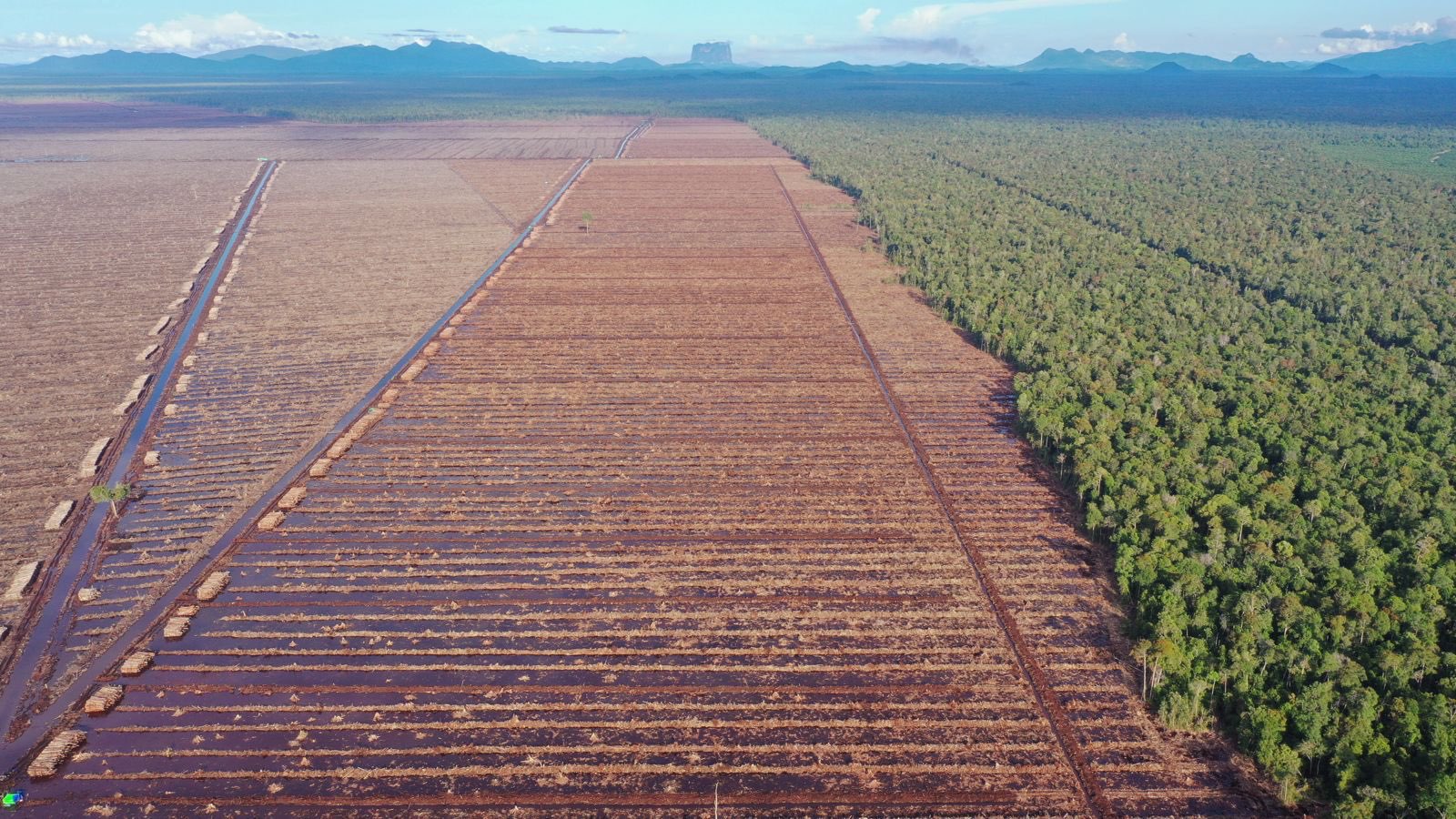
Aerial image showing deforestation on carbon-rich peatlands in PT Mayawana Persada’s pulpwood concession, July 2023 © Auriga Nusantara
The uncertifiable cannot be certified, this seems to be an obvious statement. It is not. Earthsight and Auriga released demands to the most recognized forest certifying scheme, Forest Stewardship Council (FSC) to terminate negotiations aimed at bringing a notorious conglomerate back into the certification fold over its continued links to deforestation.
The conglomerate in question is Asia Pacific Resources International Holdings Ltd (APRIL), the second largest Indonesian pulp & paper producer and one of the largest in the world. Over a decade ago, the forest certification scheme FSC had excluded APRIL from using its logo, as the company had been found deforesting large areas of tropical forest and violating the rights of indigenous and local communities.
In 2015, APRIL committed to stopping deforestation. FSC is now engaging with this company in a process called ‘Remedy Framework’ aimed at ending the ban and allowing APRIL products to be certified as sustainable. This, however, is not the happy ending that it might seem. In fact, the company has been recently, and repeatedly involved in a number of cases of further deforestation, exactly the kind of ‘unacceptable activities’ the FSC policy for association prohibits. According to that policy, this prohibition extends to all the companies in that corporate group, no matter if their connections are being hindered behind a network of shareholding companies incorporated in secrecy jurisdictions.
The most evident recent case linking APRIL to forest destruction is a large-scale deforestation operation in the middle of Borneo, where a company called PT Mayawana Persada has devastated over 33,000 ha of tropical forest since 2021, including the sacred land of the local indigenous Dayak communities and key habitat of critically endangered species like the Bornean orangutan. A report released in March 2024 by Auriga Nusantara, Environmental Paper Network, Greenpeace, Woods & Wayside, and Rainforest Action Network detailed a number of operational, personnel, and supply chain links between Mayawana Persada and Royal Golden Eagle (RGE), the mother company of APRIL. Sukanto Tanoto, founder and chairman of RGE, maintained majority ownership of Asia Forestama Raya via a holding company until July 2023, when his shares were transferred to a company domiciled in secrecy jurisdiction in the British Virgin Islands (which was in turn linked to RGE through the International Consortium of Investigative Journalists’ Offshore Leaks database).
RGE has denied any link with Mayawana Persada, but it did not deny its relationship with Asia Forestama Raya, nor provided any evidence to support the allegations being inaccurate.
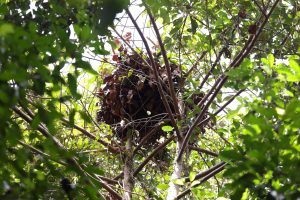
Orangutan nest in PT Mayawana Persada’s pulpwood concession, March 2024 © Auriga Nusantara
A few months earlier, a new mysterious mill started to be built in the eastern corner of Borneo. In-depth research by NGOs identified the Tarakan mill as secretly controlled by the same business group controlling APRIL. To feed this mill, the last rainforests remaining in the eastern corner of Borneo are being destroyed.
This is why in June 2024, a wide coalition of NGOs, including Earthsight, Auriga Nusantara, Environmental Paper Network, Greenpeace, Woods & Wayside and Rainforest Action Network, wrote to FSC demanding the immediate suspension of its remedy process with APRIL, referring to the wealth of published evidence connecting RGE with ongoing deforestation and social conflicts. In its response, FSC stated that it would review RGE’s corporate structure as part of its standard remedy framework but did not commit to any specific or immediate actions in response to the evidence presented.
In October 2024, an investigation by the Gecko Project reported insider testimonies alleging that six pulp and paper companies forming the ‘shadow group’ PT Borneo Hijau Lestari are in fact controlled by RGE. These companies are among the major deforesters in Indonesia’s pulp-wood business sector, and include PT Industrial Forest Plantation, which cleared almost 22,000ha of forest between 2016-2022.
RGE, again, has denied that the companies are under its control.
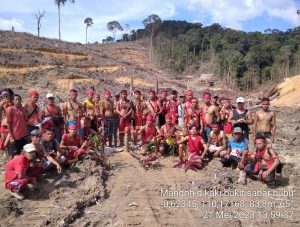
Protest by Indigenous Dayak community of Kualan Hili in the deforested area. © HO/Yayasan Link-AR Borneo
However, more companies controlled by RGE are also involved in deforestation. A recent report from Rainforest Action Network exposed an RGE subsidiary active in the oil palm business, Apical, for sourcing fruits illegally grown on land deforested in the protected Rawa Singkil Wildlife Reserve, a globally important biodiversity hotspot in Sumatra’s Leuser Ecosystem, home to the densest population of Sumatran orangutans on the planet. Apical has committed to investigating the allegations.
In light of mounting evidence, Earthsight and Auriga Nusantara called once again on FSC to terminate the remedy process with APRIL, at the very least until deforestation and rights abuses are halted and properly resolved across the entire RGE corporate group, including its network of shadow companies. “Continuing talks with APRIL to rejoin the certification body – they state – would amount to FSC’s complicity in one of the most egregious cases of corporate greenwashing ever seen in Indonesia”.
Back to News