
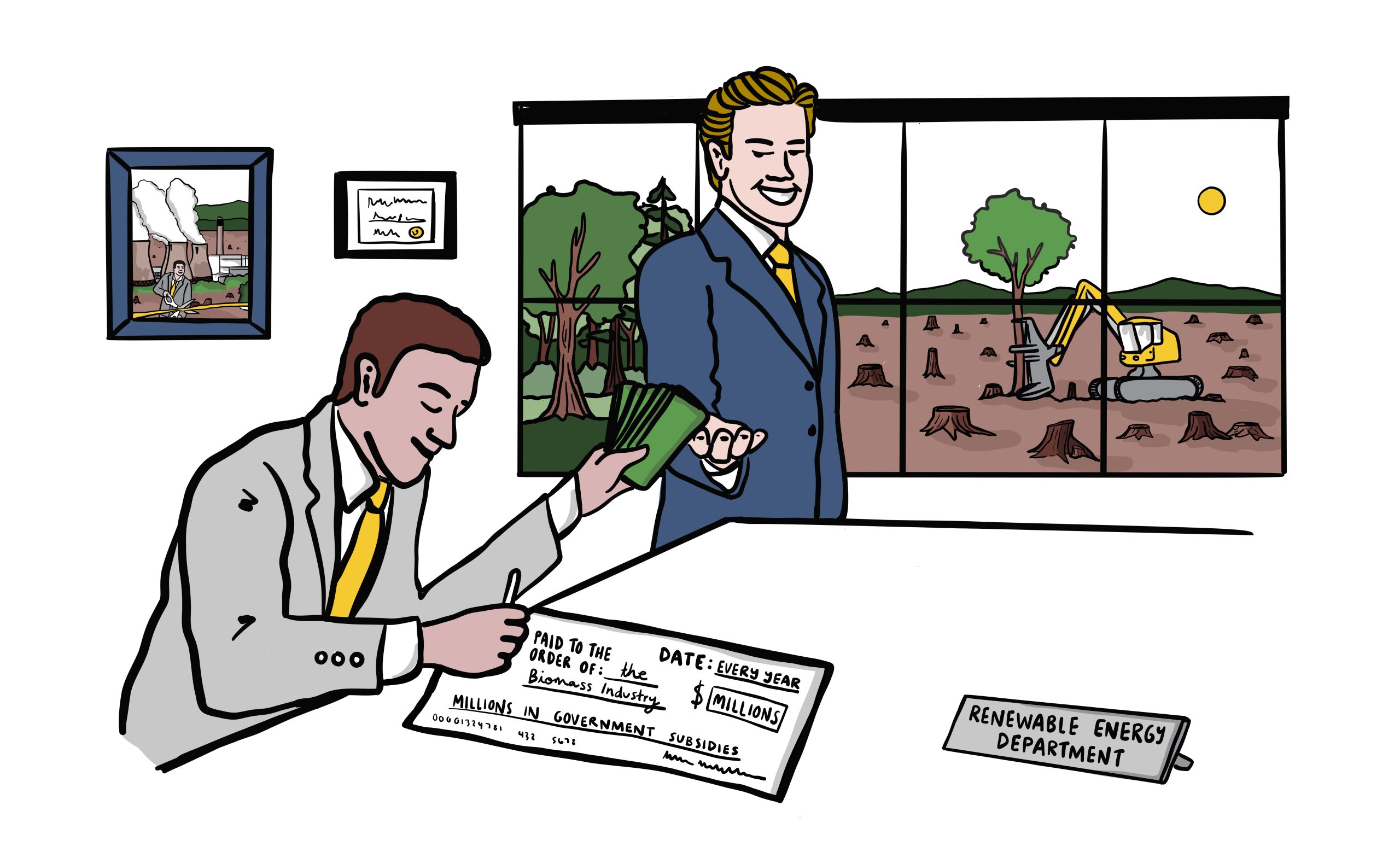
 ** A report released today shows that a handful of major economies spent nearly $250 billion on biomass subsidies over 22 years from 2002-2024.
** This is likely an underestimate: it does not cover all years, does not include all subsidies that might benefit biomass (due in part to flawed reporting and a lack of transparency), and has not been adjusted for inflation.
** Much of this money will have been given to energy companies burning trees for heat and electricity.
** The report shows that there is a direct link between biomass subsidies and increased logging of forests.
** The report is being released on 21 October 2025, the International Day of Action on Big Biomass.
The report’s authors say that, as the world approaches the COP30 climate summit, burning millions of tonnes of wood every year from forests will undermine climate and nature goals. The findings, released by the Biomass Action Network, show that governments are funnelling billions into burning trees at the expense of real renewables. These figures are incomplete and only cover a handful of major economies, meaning the true scale of global biomass subsidies is likely far bigger. Lack of transparency, plus incomplete and inconsistent reporting in the various jurisdictions covered, is also problematic.
Add to this the fact that burning trees for energy provides no climate benefit – biomass is labelled as carbon neutral only based on future potential regrowth of trees. But first it increases atmospheric carbon dioxide for decades and leads to clearcutting and forest degradation of some of the world’s most important forests for nature.
Hundreds of countries have signed up to Target 18 of the Global Biodiversity Framework – which is to phase out billions of subsidies that harm nature. This goal will never be achieved while tree-burning power plants are still receiving subsidies.
Industrial biomass production is turning areas around the world, such as the rural southern US and the rainforests of Indonesia, into sacrifice zones. From pollution to forest degradation, communities in regions such as these are burdened by an industry backed by billions of dollars in subsidies globally.
The billions spent on biomass could be far better spent on real renewables and energy efficiency, which would genuinely cut emissions, protect forests, and be far cheaper than woody biomass which is a highly expensive energy technology.
In contrast to wind and solar power, which thrived when subsidised and progressively reduced their costs, biomass energy has failed to innovate or reduce unit costs, is now being seriously outcompeted by them, and relies on subsidies for mere survival. In addition, there is a direct link between providing biomass subsidies to the energy industry and increased logging of the world’s forests.
Since the analysis only covers five major economies, the true extent of global biomass subsidies is likely much bigger. The estimate is also likely to be conservative since it is not adjusted for inflation and only covers years for which there is publicly available data on subsidies that could definitely be identified as for biomass.
Quotes
Peg Putt, Coordinator of Policy and Campaigns for BAN (Biomass Action Network), said: “We call on governments to cut subsidies, not forests. This call is sounding around the world on the International Day of Action on Big Biomass, as we collectively recognise that our forests are more valuable to the climate, communities, and web of life when left standing, not as burnt sacrifices.”
Matt Williams, Senior Advocate for NRDC (Natural Resources Defense Council), said: “Countries have promised to spend billions on helping the world’s most vulnerable adapt to climate change and on restoring nature. Instead it’s clear that some of the world’s wealthiest countries are wasting hundreds of billions of dollars on chopping down trees and burning them.”
Michél Legendre, Campaigns Director for Dogwood Alliance, said: “Governments continue to prioritize the destructive and inefficient burning of trees for electricity. These subsidies not only impact nature and community health, they also consider our communities and forests in the US South as disposable. But our communities are fighting back. They are demanding clean air, clean water, and standing forests, not more subsidies for the forest, climate and community destroyers.”
Joy Reeves, Director of Policy and Strategic Development at the Rachel Carson Council, said: “Communities, and taxpayers, should not be paying the price for the flawed energy scheme of burning woody biomass. Woody biomass only remains economically viable with subsidies—all while polluting communities and quietly undermining international decarbonization goals. We must cut subsidies for big biomass and finally learn from the past decade’s mistake.”
Peter Riggs, Director, Pivot Point, said: Energy systems have huge inertia, which makes change difficult. Even though it is clear that biomass power has failed as a low-cost solution – massively outcompeted by the falling cost of wind and solar power – countries continue to subsidize it. They haven’t caught up to the new economic reality of cheaper renewables. This inertia is the only reason that biomass power is still in the mix, but it’s time to stop throwing good money after bad.
Katsuhiro Suzushima, Planning and Research Division, Global Environmental Forum, said: Governments and businesses involved in large-scale biomass believe that the negative impacts of the industry can be mitigated by shifting supply chains to less controversial regions or obtaining proof of “sustainable” forest management in producing areas. This is a fallacy because the root cause of the problem lies in the sheer scale of the biomass industry itself, promoted by subsidies given globally to it in many different countries as illustrated in this report.
Almuth Ernsting from Biofuelwatch added: “Subsidies for biomass energy compete not only with wind and solar power but also with the development and scaling up of clean and climate-friendly heating such as large heat pumps. For example, a successful campaign against a coal-to-biomass conversion in Hamburg, Germany resulted directly in new river heat pump capacity that would not otherwise have been developed.”
————————
Notes:
The full report is available here
Media contact: peg.putt@gmail.com (UTC+11) and sophie@environmentalpaper.org (UTC+1)
Figures from the report:
UK: The National Audit Office found that from 2002-2023 £22 billion (US$29 billion) was spent on subsidies for biomass heat and electricity.
South Korea: In 2024 alone ₩900 billion (US$689 million) was spent on some biomass subsidies – it is likely that more were spent, and in previous years the amount was likely similar but public data not available. So the true total is likely much higher.
Japan: The subsidies predicted to be received by current biomass power plants (a total capacity of 4.7 million kW as of Dec. 2024), is ¥9.2 trillion ($62bn) under the Feed-in-Tariff (FIT) scheme, over a 20 year period (with subsidies being awarded for 20 years from the start of each plant’s operation.) So far biomass power plants have received ¥1.97 trillion, which is equivalent to US$13 billion, covering a ten year period from 2014-2024, although some data was unavailable, so this is likely an underestimate.
EU: From 2015-2021 €20 billion were given annually to biomass, and in 2023 €16 billion and €9 billion in 2024. These figures are likely an underestimate, but come to a total of US$193 billion.
Canada: In Canada annual funding for biomass was an average of C$346 million per year from 2021-2024, a total of C$1.3 billion (US$996 million).
*All figures in cash terms, not adjusted for inflation.
Back to News