
[et_pb_section fb_built=”1″ admin_label=”section” _builder_version=”4.16″ global_colors_info=”{}” theme_builder_area=”post_content”][et_pb_row admin_label=”row” _builder_version=”4.16″ background_size=”initial” background_position=”top_left” background_repeat=”repeat” global_colors_info=”{}” theme_builder_area=”post_content”][et_pb_column type=”4_4″ _builder_version=”4.16″ custom_padding=”|||” global_colors_info=”{}” custom_padding__hover=”|||” theme_builder_area=”post_content”][et_pb_text admin_label=”Text” _builder_version=”4.25.1″ background_size=”initial” background_position=”top_left” background_repeat=”repeat” global_colors_info=”{}” theme_builder_area=”post_content”]
A peculiarity of UNFCCC and IPCC carbon accounting and reporting methodology is leading to unfair attribution of emissions from large-scale bioenergy. What is emerging, is an unintentional but concerning example of climate colonialism. Download the full briefing here.
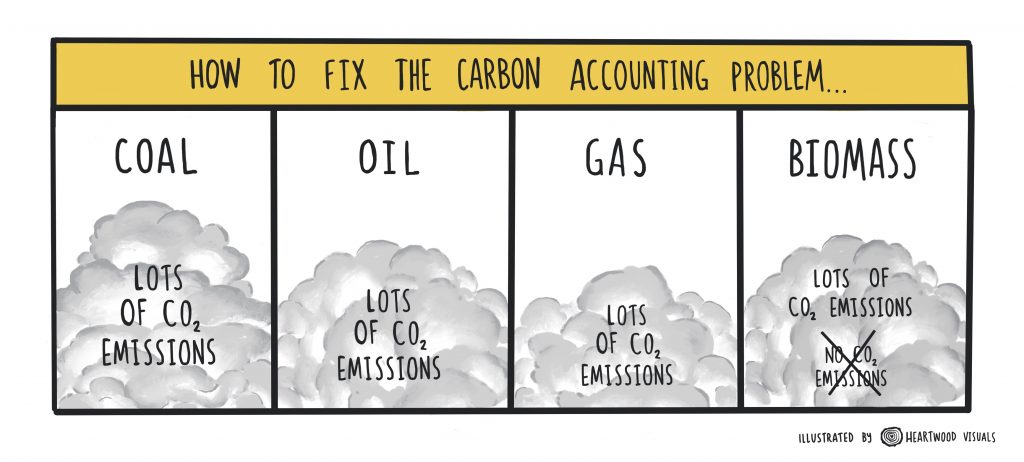
Burning wood for energy produces at least as much CO2 as burning coal per unit of energy produced, and usually more. Disturbingly, the emissions of energy generation using biomass are not currently the responsibility of those who generate and consume biomass energy but instead are the responsibility of the grower of the biomass, unlike fossil fuel energy sources where emissions are recorded in the energy sector of the country that uses it. Treating biomass differently has created a false impression of zero emissions for biomass energy in comparison to emissions from burning fossil fuels, and so its use has been escalating.
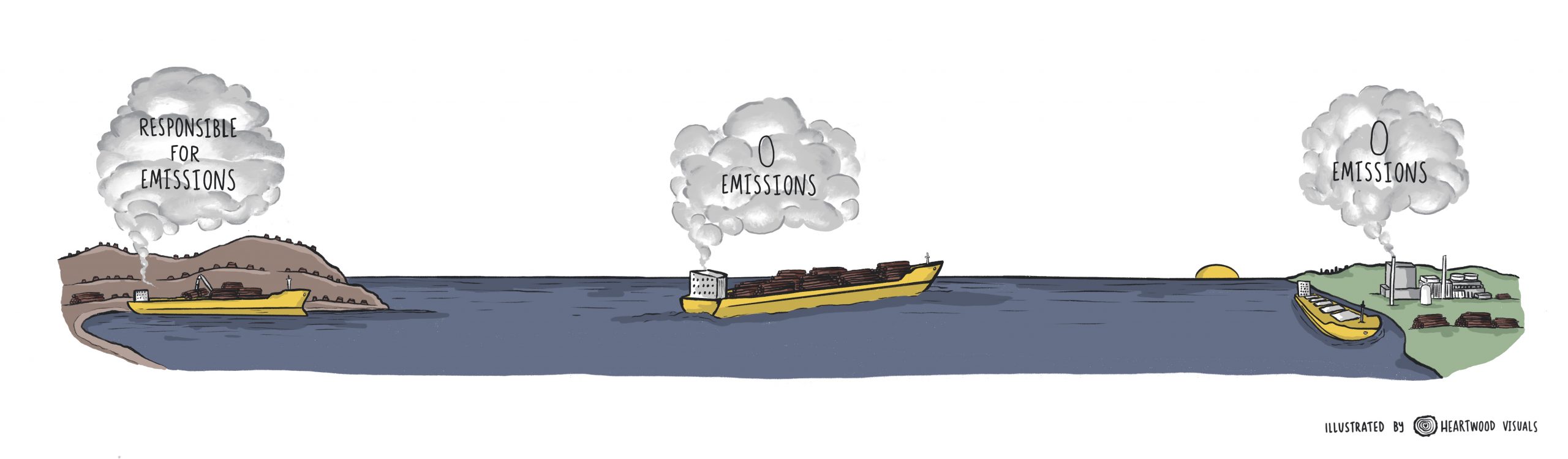
 Increasingly forest biomass is traded internationally for energy generation, meaning that responsibility for the emissions is left with the country that supplied the wood and not with the country that burnt it and used the energy it created. That country claims emissions reductions. As the use of, and trade in forest biomass grows, the wood required will increasingly come from developing countries.
Failure to account for emissions from burning biomass in the energy sector is resulting in: Dramatic expansion of the biomass energy industry with wood pellets comprising the major commodity supplying it. Having already doubled to 14 million tonnes in the preceding decade, global supply and demand for biomass will exceed a 250% increase by 2027, to well over 36 million tonnes.
Harm to the clean energy transition. Biomass energy dominates ‘renewable’ energy production, dwarfing wind and solar and undermining their prospects by soaking up subsidies and incentives that should be applied to genuinely low emissions technologies.
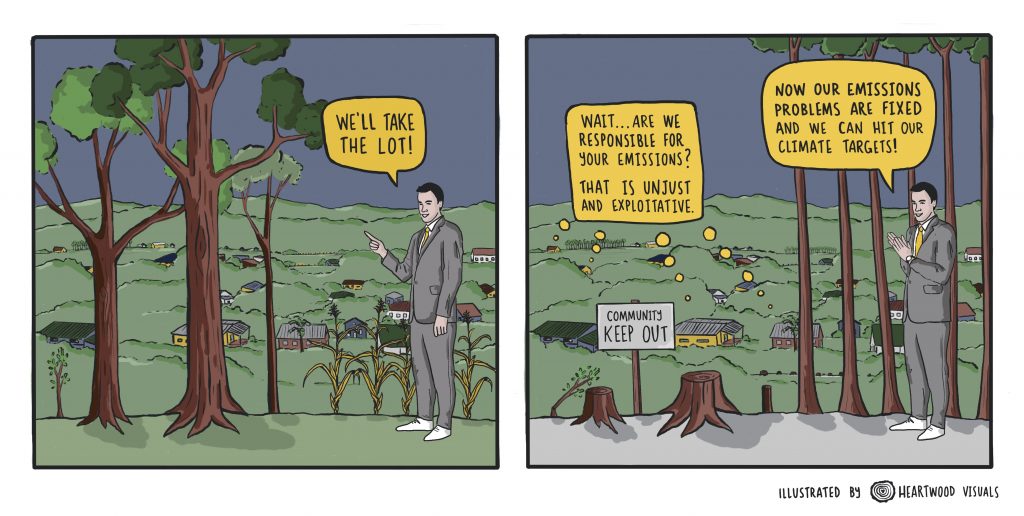
Global inequity and injustice. As outlined, when biomass is traded from one country to another, responsibility for emissions is externalised from the biomass consumer to the biomass producer. This trend will escalate as biomass is increasingly sourced from outside the big biomass energy consuming blocs of Europe, the UK, South Korea and Japan, and the Global South is drawn into the supply chain. In this situation, countries in the Global South will bear responsibility for the emissions from biomass burned in the Global North, who in turn will be able to claim emissions reductions.
How did this happen?
When the guidance on national greenhouse gas emissions estimation and reporting was developed in the 1990s biomass energy was mostly used in residential wood stoves and fireplaces, or as a waste stream from timber processing. It tended to occur locally and with limited international trade. For most industrialised countries the total emissions associated with biomass were negligible.
Under the guidelines, to avoid double counting of emissions in a country’s Land Use, Land Use Change, and Forestry (LULUCF) and Energy Sectors, CO2 emissions from combustion of biomass are not counted in the Energy sector at all.
Instead, total biomass emissions are implicitly counted by tracking the annual changes in the carbon pools of the land use sector. Forest growth contributes to the forest carbon pool, while harvest for wood products or land conversion diminish the forest carbon pool. It is assumed that biomass emissions occur in the country and year of harvest.
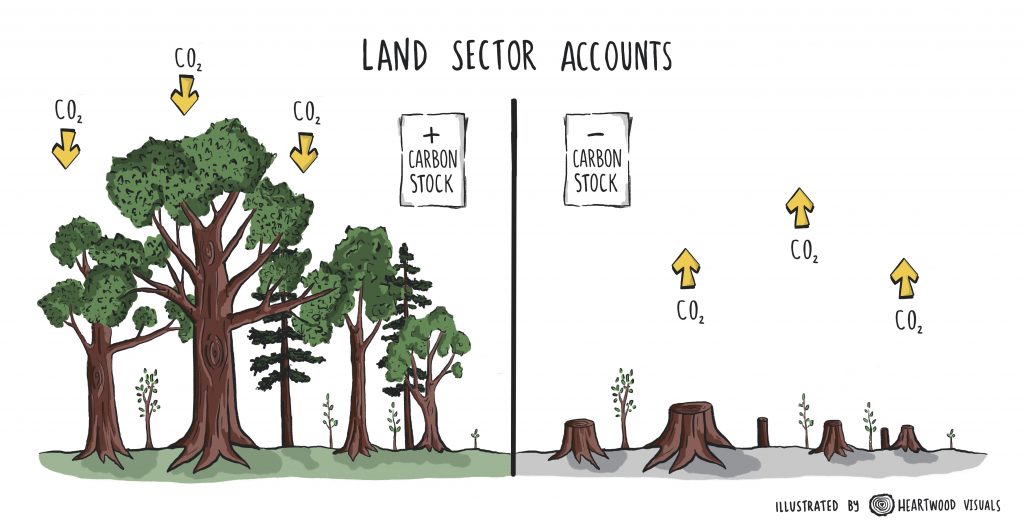
 As a result, the “wrong country” is penalised for increased use of bioenergy– that is, the country that produces it rather than the country that consumes it. No other fuel is treated in this manner.”
This made sense when biomass use was small and local, but production and consumption of densified woody biomass around the world has exploded over the last 10-15 years, motivated by an interest in transitioning away from fossil fuels. Many countries treat biomass energy as a zero carbon or carbon neutral, energy source – in part due to a mistaken impression created by accounting and reporting methodology.
When biomass is traded across borders the importing country does not report emissions from biomass fuels (or other harvested wood products) anywhere. As a result, the “wrong country” is penalised for increased use of bioenergy – that is, the country that produces it rather than the country that consumes it. No other fuel is treated in this manner.
In a recent publication three former authors of IPCC Guidelines and veteran national inventory report reviewers outline how this situation arose, the misconceptions created by the accounting practices, and a straightforward solution to resolve the issue[i]. They identify two main problems:
Incorrect attribution of CO2 emissions within National GHG Inventories when biomass is traded, and
Incongruity between methods of GHG reporting between biomass and all other fuels.
Together these can lead to problematic assumptions of “carbon neutrality”, and even give the impression that biomass has no emissions at all. We add a third emerging problem: Climate colonialism, which results when developed countries importing and burning biomass for energy escape responsibility for the emissions, and developing countries increasingly become part of the supply chain and take emissions responsibility for energy they never created or used.
 How to fix it
The expert authors present a proposal they believe would have been adopted if the original IPCC Guidelines for national GHG inventories had been drafted today.
They offer a straightforward solution: treat biomass as other fuels are treated. They say that there is “no overriding technical or data availability reason to prevent the reporting of emissions of CO2 from Biomass combustion for energy similarly as for all other fuels” (i, p186). They outline three steps to ensure that the Energy sector reflects the net impact of biomass use on GHG emissions and the LULUCF sector accurately reflect the situation. This is an excellent starting point for considering how the guidelines can evolve.
The current guidelines for biomass for energy use are no longer fit for purpose. National inventories are intended to track national emissions, and national accounts show progress (or otherwise) against national emissions reduction targets. Now that some Parties use imported biomass for energy as a major part of their decarbonisation strategies, implicit estimation of emissions in the LULUCF sector of producing countries creates confusion, obscures the fuel’s actual impacts, and in some circumstances allows an insidious element of climate colonialism.
Theoretical Example – Comparing Carbon Accounting for Biomass Energy and Fossil Fuel
Forest Biomass Export and Use: If Ghana exports wood to the UK and the UK burns the wood for biomass it is Ghana which accounts for the carbon in its carbon account, and not the UK. This makes it look like Ghana is releasing more carbon while the UK is reducing its carbon footprint, but in reality it is UK that burned the wood to release the carbon.
Fossil Fuel Import and Use: If Ghana imports Crude oil from Russia and burns it Russia will not account for it in their carbon accounting system but Ghana will.
[i] Tinus Pulles, Michael Gillenwater & Klaus Radunsky (2022). CO2 emissions from biomass combustion: Accounting of CO2 emissions from biomass under the UNFCCC, Carbon Management, 13:1, 181-189, DOI: 10.1080/1758004.2022.2067456
Other resources related to this topic: How UNFCCC carbon accounting has created a biomass delusion and is contributing to climate change and global inequality and How a carbon accounting problem is driving the biomass delusion (Visual)

For further information contact: Ms. Peg Putt, Network and Policy Coordinator for the Biomass Action Network
[/et_pb_text][/et_pb_column][/et_pb_row][/et_pb_section]
Back to News