
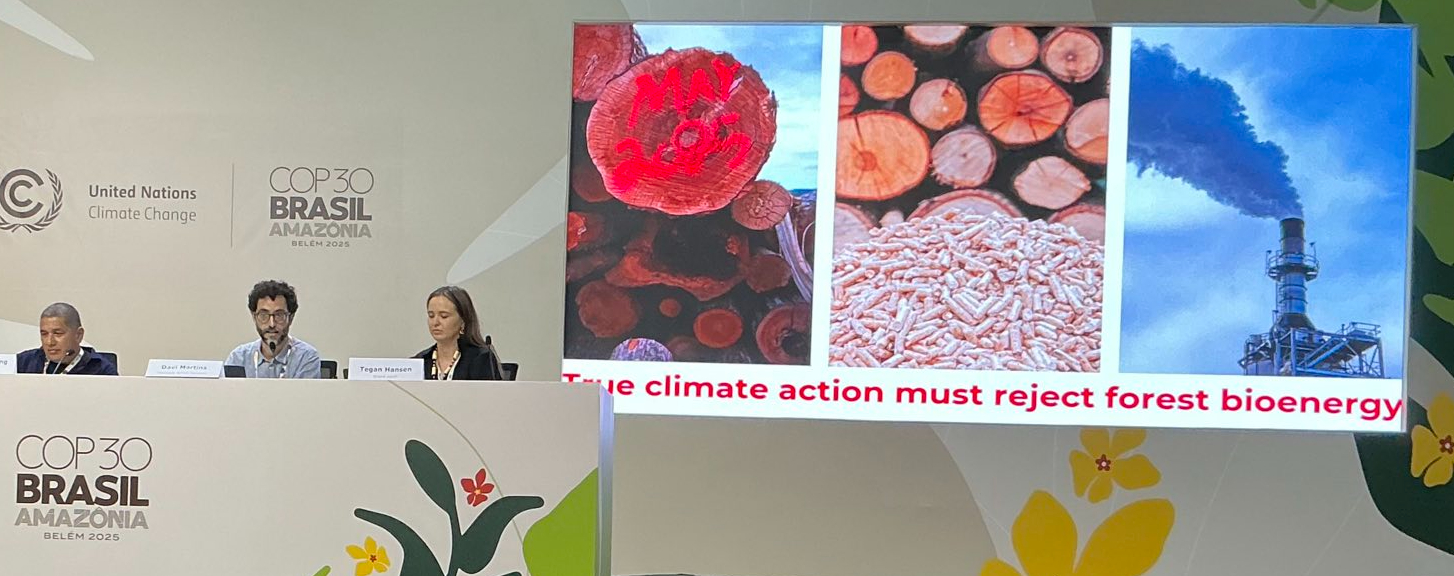
BELÉM, BRAZIL – [20th November 2025] – Red flags are flying for forests as negotiations head into the final days at COP 30, with latest texts revealing unacceptable weakening of earlier versions, apparently in the interests of securing a cover decision no matter the cost to the biosphere and climate, according to the Biomass Action Network.
As the much vaunted “Forests COP” veers dramatically off course, industrial logging of forests looks to have gained primacy over genuine forest protection, via coded language endorsing “sustainable management of forests” littered throughout the important Mitigation Work Program.
The wheels also seem to be coming off Climate and Nature Synergies in the item on co-operation with other international organisations, with the imperatives of Parties for action ignored by the secretariat, leaving increased and enhanced engagement between the three Rio Conventions on working together to protect climate and nature stuck by the roadside.
A Transition Away from Fossil Fuels (TAFF) is vital, but it must not be a transition that puts the impost on the biosphere. It should be a transition to genuine low emissions renewables paired with forest protection and restoration. Instead, we see a roadmap to continued and amplified exploitation of land and forests by industrial interests, dressed up as climate action.
Explaining Mitigation Work Program text:
- “Sustainable management of forests” means industrial scale logging with clearcut and other brutal methods, also including conversion to monoculture plantations. It has nothing to do with ecological sustainability, but rather with continued logging regimes.
- Innocuous sounding “importance of sustainable wood use and long-lived wood products” hides that under proposed extractive logging regimes the retrieval of relatively small amounts of long-lived wood products is achieved by clearcutting-style methods generating vast amounts of lower quality wood then substantially categorised as “waste” and “residues”. The days of careful, restrained single stem extraction of high-quality sawlog only are well and truly gone.
- Lower quality wood becomes biomass feedstock to be burnt in replacement of coal for energy generation under misleading claims of carbon neutrality, generating immediate emissions equalling or exceeding those of coal. This contradicts claims to long-lived carbon storage via logging and instead masquerades as renewable energy.
“Keeping forests standing with their carbon stock intact and out of the atmosphere, is the most effective mitigation action that can be achieved by forests, but this imperative seems to be losing out as a transition substituting burning coal with burning forest biomass for energy, and substituting petrol with liquid biofuels for transport, puts the impost on the biosphere. The energy transition away from fossil fuels must be a transition to genuine low emissions renewables paired with forest protection and restoration.” said Peg Putt, Coordinator of Policy and Campaigns at BAN.
“There is now only one day to get important texts on mitigation and on synergies vital to serious action on climate in forests secured before the last day of COP is consumed by the rush to a cover decision. We are waving red flags that this “Forests COP” is caving in to industrial interests in logging and agriculture in ways that will result in greater forest destruction and degradation disguised as climate action,” added Davi Martins, International Advocacy Campaigner at BAN.
Media Contacts:
Peg Putt (Eastern Australian time zone)
Coordinator – Policy and Campaigns, Biomass Action Network
peg.putt@gmail.com
Davi Martins (Brazil time zone)
International Advocacy Campaigner, Biomass Action Network
davi@environmentalpaper.org