
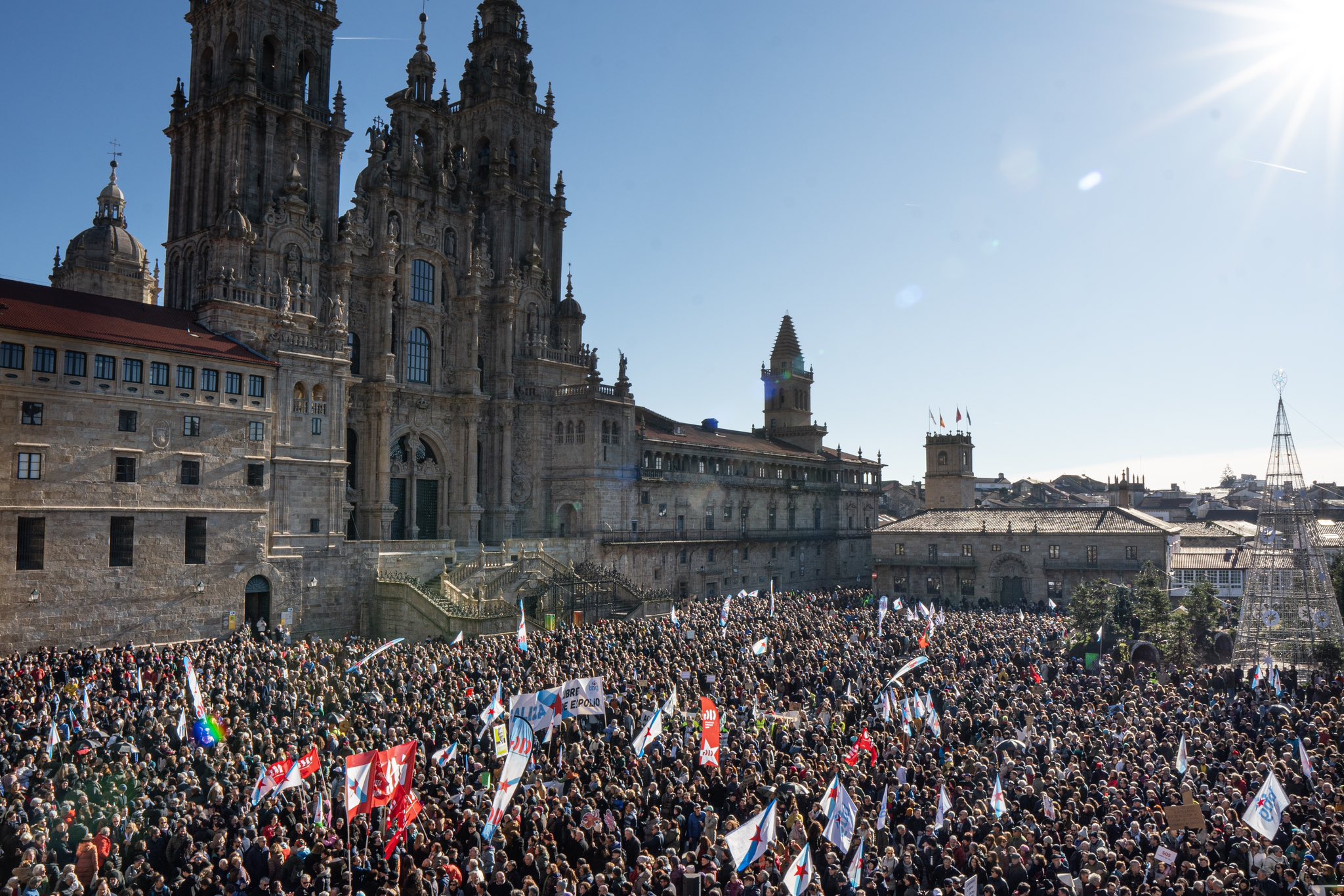
A success story of popular resistance against pulp plantations and for forest conservation.
Feb 23 – Our global movement for the protection of forests celebrated a major win: after a long battle, it is now clear that the new pulp mill will not be built by the Portuguese paper company Altri. Last Friday, the Galician government officially declared they would drop the planned Altri pulp mill in Palas de Rei, in Lugos (Galicia, Spain), after the national Spanish government excluded the necessary electric connection from its National Electrification Plan 2025-2030, turning the project unfeasible.
For the past few years, local communities, businesses and civil society organisations had been protesting and campaigning against the planned pulp mill, which would produce up to 400,000 tons/year of cellulose and 200,000 tons/year of lyocell. Protests held were the largest mobilisations since the Prestige accidents in the nineties, with a single protest drawing 100,000 people. If this project went ahead, it would destroy local habitats and threaten endemic wildlife species, pollute rivers with chemicals, and create a demand for pulp that would likely largely increase eucalyptus plantations in a region already inundated by some 1.3 millions hectares of such monocultures.
This is a victorious moment for local communities in a region already plagued by monocultures and summer wildfires, who fought relentlessly against the pulp and paper industry, which intended to continue its extractive and industrial model of monoculture harvesting. It is also celebratory moment for all the threatened endemic species of Lugos Galicia, who would see their habitats destroyed, its land already suffering with water scarcity and its rivers with chemical pollution. Greenpeace España welcomed the decision by the Counsellor of Economy and Industry María Jesús Lorenzana on February 20th that the Government of Galicia would proceed to archive the plans, effectively ending the project. It now calls for Altri to officially drop, once and for all, its plan to build a pulp mill in the region.
Manoel Santos, coordinator for Greenpeace Galicia, echoed this call: “Today, we need to celebrate a clear ‘ALTRI NO!’. Altri was a mad project from its inception. Two years after its public exposure, it was shown that it was inviable because it did not fulfill the needed requirements for its implementation. We await for the company to be responsible and announce its withdrawal for a project that not only puts our nature in jeopardy, but also our path towards a way of life compatible with the limits of the planet. We showed that unity and rigor with which social movements work in this case are the best barrier we have against projects which want to destroy the territory.”
Galicia, together with central and Northern Portugal, is a region suffering greatly with the consequences of the industrial monoculture model developed by the pulp industry for decades, which has transformed its natural landscape into an astonishing 1.3 million hectares area of eucalyptus plantations. As a consequence, the region has been facing extreme wildfire events over the years, water scarcity, a decrease in wildlife, and the disturbance of local livelihoods which depend on a thriving ecosystem.
Back to News