
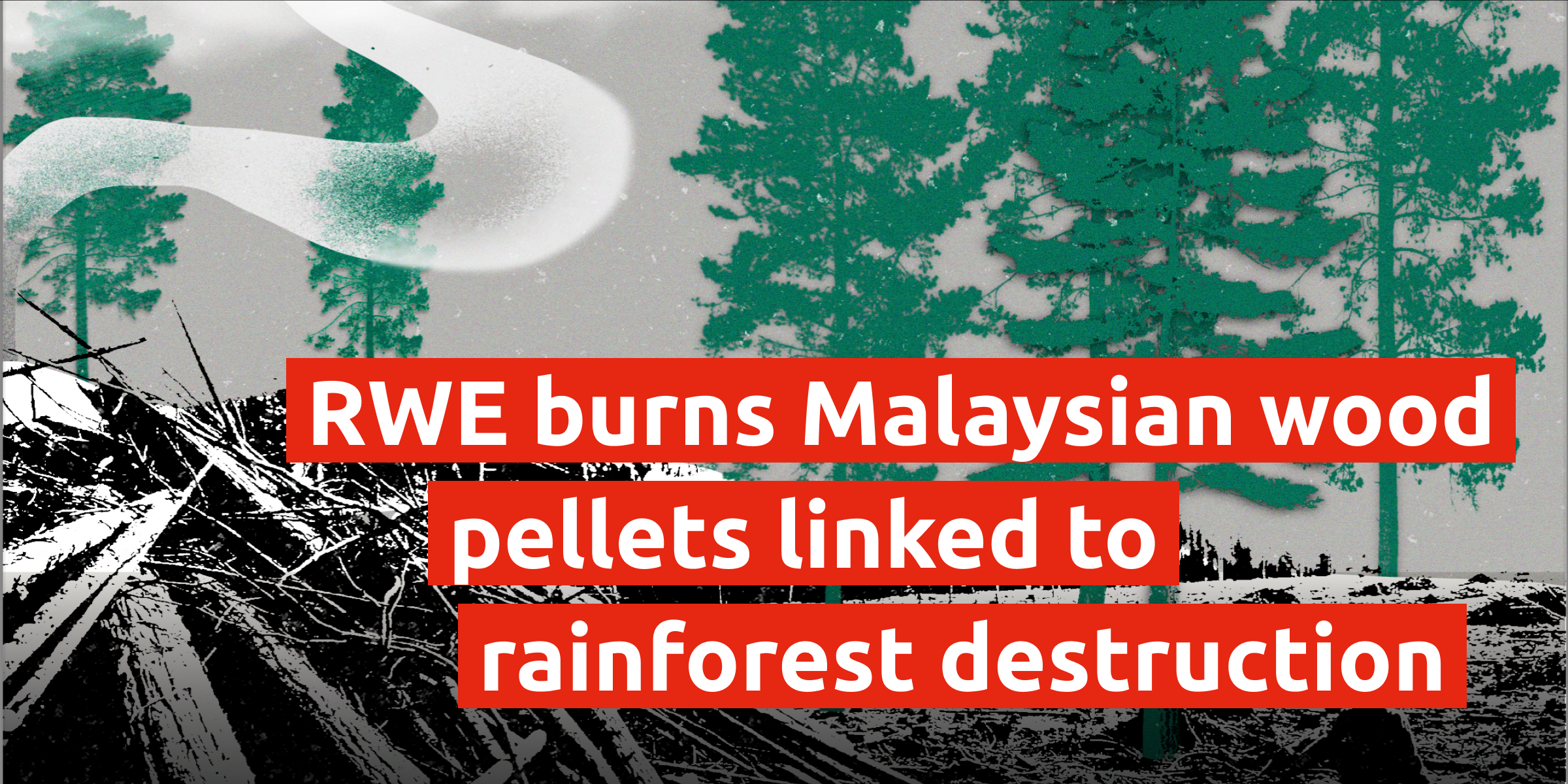
An investigation by Zembla, broadcast on 10 September 2026, revealed that wood pellets certified as sawmill residues were, in fact, made from whole trees felled in Malaysian rainforests or from plantations that replaced them. These wood pellets were then shipped to the Netherlands and burned by the German energy giant RWE in Dutch power stations to generate biomass energy.
The investigation was triggered by the NGO’s Biofuelwatch and Comité Schone Lucht who, in 2025, submitted a joint request for enforcement to the Dutch Emissions Authority (NEa), citing concerns that “Malaysian wood pellets imported to the Netherlands and burned in one or two RWE power stations may be sourced from suppliers who we believe to be non-compliant with SDE++ criteria(1) even though it has been certified…”
The NEa’s response revealed that, until the end of 2025, RWE’s Malaysian wood pellets were certified under the Green Gold Label as “Category 5” wood – meaning “sawmill waste and residues”. This classification did not require independent verification of the pellets’ forest source. Nevertheless, in January 2026, the NEa concluded that the pellets it examined met the sustainability regulations then in force, even as it acknowledged weaknesses in verifying the origin and classification of these so-called residues.
On the day the Zembla investigation aired, the Dutch newspaper, NRC, published an article (available here in English) based on a Freedom of Information (FOI) request submitted by Comité Schone Lucht in February 2026. The article demonstrated that, enabled by renewable energy subsidies, RWE contributed to the degradation of Malaysian forests. Comité Schone Lucht is demanding that the €2.5 billion in subsidies given to RWE be repaid.
In response to the rejection of the enforcement request by the Dutch Climate Minister, Biofuelwatch and Comité Schone Lucht have launched a joint appeal and Comité Schone Lucht filed a criminal complaint against RWE (depicted in the Zembla video.) Consequently, Dutch police are currently investigating possible fraud and other offences linked to the sourcing and certification of the wood pellets.
Fenna Swart, director of Comité Schone Lucht said: “The collaboration between Comité Schone Lucht and Biofuelwatch in submitting the request for enforcement action regarding major certification shortcomings of Malaysian wood pellets for RWE has yielded very significant results. Comité Schone Lucht is now preparing civil proceedings against the Dutch State. The core argument is that the government bears an independent responsibility to protect citizens, nature, and the climate when it is aware that oversight and monitoring are failing.”
Since 2026, the Netherlands has adopted the European Renewable Energy Directive III (RED III) requirements for tracing the origin and classification of residues, replacing the Green Gold Label. Despite this, imports of wood pellets from Rainbow Pellet(2) – RWE’s main Malaysian supplier – have continued, now with Sustainable Biomass Program (SBP) certification(3). The Zembla investigation revealed that Rainbow Pellet uses roundwood from clearcut rainforests and from acacia plantations established on recently cleared rainforest land. Nevertheless, the company remains SBP certified and is considered compliant with European biomass sustainability criteria.
This case highlights several problems with biomass certification. First, wood can be classified as a “residue” later in the supply chain, obscuring its original forest source. Second, certification schemes like the Sustainable Biomass Programme can certify biomass even when it is directly linked to rainforest destruction. As a result, the biomass industry can claim to use “sustainable biomass” and receive public subsidies, despite actually burning unique tropical rainforests.
Almuth, Co-Director of Biofuelwatch said: “The Zembla investigation reveals how wood linked directly to the clearance of tropical rainforest can be burned as ‘sustainable biomass’ in the EU and to attract subsidies as a result. This is yet more evidence that the sustainability criteria, which rely on voluntary certification, are not worth the paper they’re written on.”
Watch the full video investigation (in Dutch, but with English CC available).
——
Our thanks to Biofuelwatch and Comité Schone Lucht for support with this article.
(1) SDE++ (Stimulering Duurzame Energieproductie en Klimaattransitie) is a major Dutch government operating subsidy scheme
(2) Rainbow Pellets are also burned for electricity by Albioma on the island of Réunion, a French overseas territory. Albioma is owned by the private equity company KKR.
(3) EPN, SFOC, GEF, Mighty Earth, and Biofuelwatch report: “The Sustainable Biomass Programme: Certifying the unsustainable”