
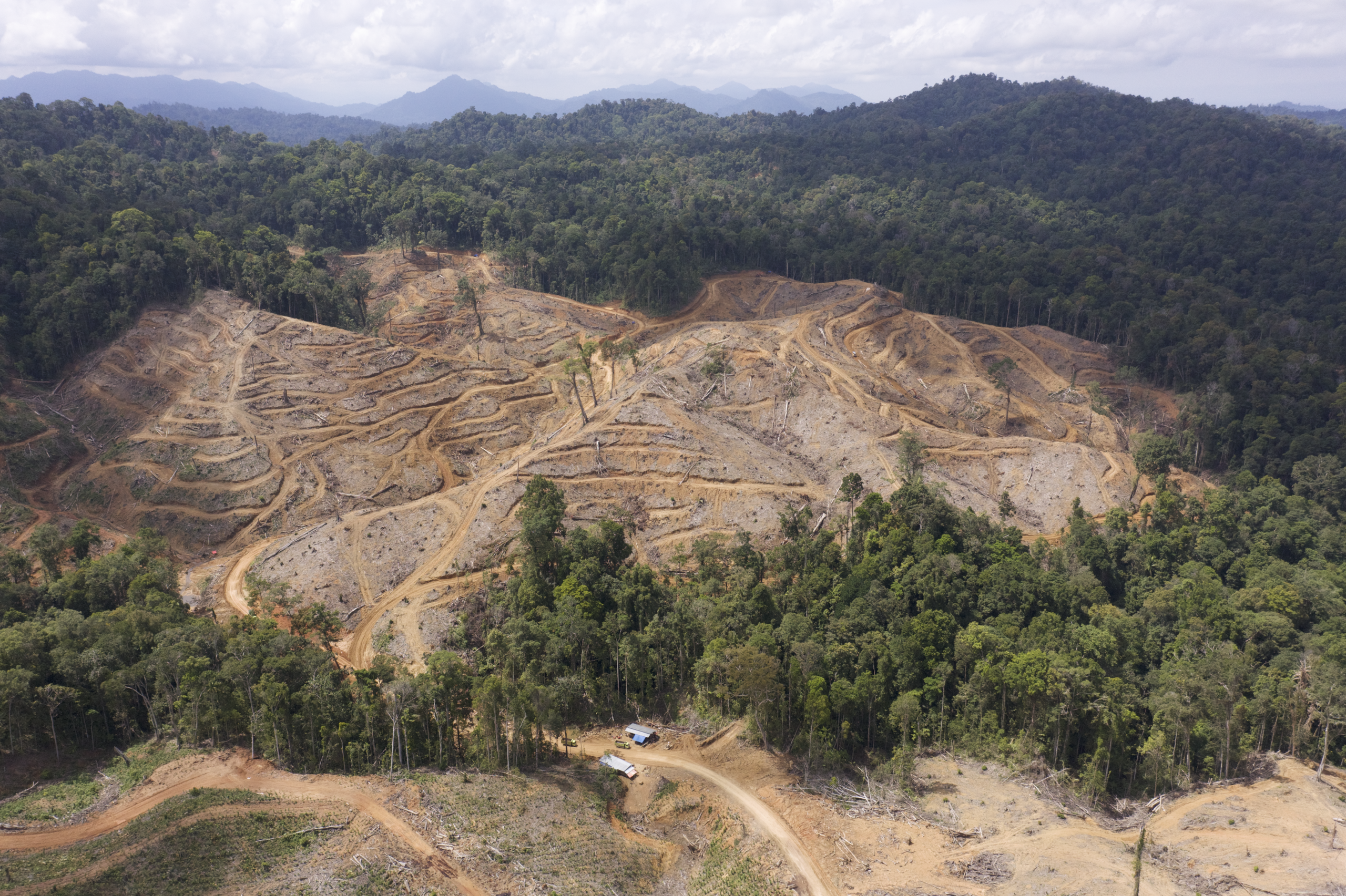
Pictured above: An area of forest clear cut for biomass energy in Gorontalo, Indonesia ⓒ Forest Watch Indonesia
— For immediate release —
June 8th, 2026
Half of all national climate plans (NDCs) mention bioenergy in some form. In more detailed Long-Term Strategies, this figure rises to 83 percent, according to members of the Biomass Action Network (BAN) who are in Bonn, Germany as UN climate negotiations open there today.
Only six countries have specific plans to deploy Bioenergy with Carbon Capture and Storage (BECCS), but these six countries alone could require up to 95 million hectares of land (an area more than twice the size of Germany) to grow sufficient biomass to fuel BECCS. The data originates from a forthcoming report by the Royal Society for the Protection of Birds (RSPB), expected to be published later this year.
Matt Williams, an independent climate and energy expert who conducted the analysis, said: “Burning biomass is one of the greatest global risks to forests. Many national climate plans acknowledge this danger when referencing bioenergy. While only a handful of countries currently plan to couple bioenergy with carbon capture, it’s an unproven and incredibly expensive technology. There’s still time to move beyond forest-hungry BECCS and do the best thing for the climate – leave forests standing.”
At COP30, the Brazilian Presidency pledged to develop two critical roadmaps: one for Transitioning Away from Fossil Fuels in a Just, Orderly and Equitable Manner, and another for Halting and Reversing Deforestation and Forest Degradation by 2030. If implemented effectively, these roadmaps could represent major progress for the energy transition and forest conservation – areas that have faced persistent challenges for years, if not decades. Yet, as new data confirms, unless false solutions such as large-scale bioenergy (woody biomass, biofuels, and BECCS) are excluded from these plans, both roadmaps are bound to fail.
Reija Mikkola, Policy Coordinator of the Biomass Action Network said, “Replacing fossil fuels with woody biomass presents an escalating threat to forests, the climate, and communities. A truly clean energy transition must safeguard forests – among our strongest natural defenses against catastrophic climate change. This transition must also be just, ensuring it does not compromise people’s access to clean air, food, or water. Yet, large-scale biomass energy undermines both climate goals and fundamental human rights.”
Global bioenergy expansion – already supplying 55% of renewable energy and 6% of total global energy – is driving rising demand for woody biomass. This intensifies pressure on forests and communities worldwide, amplifying both environmental and social concerns.
Forest Watch Indonesia identified 57 energy plantation forest companies spanning 1.8 million hectares, associated with 33,000 hectares of deforestation between 2021 and 2024, and an additional 15,024 hectares cleared in 2025. Indonesia is now among the top three wood pellet exporters in Southeast Asia, with 71% of exports originating from Gorontalo – where 59,155 hectares of forest have been lost since 2017 and further concessions are planned. Investigations indicate that over 80% of exports to Japan and South Korea are derived from the conversion of natural forests, highlighting the serious risks posed by bioenergy expansion.
Respati Bayu from Forest Watch Indonesia said: “Data from Indonesia clearly shows how global bioenergy demand is translating into real forest loss on the ground – much of it driven by export markets – highlighting the urgent need to exclude forest biomass from climate solutions if countries are serious about protecting forests and reducing emissions.”
Kwami Kpondzo, campaign coordinator at the Global Forest Coalition, said: “From the southeastern USA to Ghana, Brazil and Vietnam, biomass sourcing and burning is strongly linked to human rights abuses such as land and water grabbing, dispossession, gender-based impacts, increasing air pollution, and undermining food sovereignty. Continued expansion, as noted in the RSPB report, will increase the global nature of these impacts.”
The Biomass Action Network, a coalition of more than 220+ organisations working across 70 countries, calls for the exclusion of biomass energy from climate and renewable energy targets, while safeguarding forests. Our position statement, The Biomass Delusion, further outlines the significant harm large-scale forest biomass burning causes to the climate, forests, people, and the clean energy transition around the world.
Contacts:
Reija Mikkola: Coordinator, Biomass Action Network
reija@environmentalpaper.org
Matt Williams: for comments on the report
mattadamwilliams@gmail.com