
On Thursday, 27 November 2025, the European Commission published the EU Strategic Framework for a Competitive and Sustainable EU Bioeconomy. As its name suggests, this strategy aimed to combine the objectives of increasing competitiveness of the European Union’s economy with the sustainable use of natural resources. So much for theory. In practice, the EU’s new bioeconomy strategy prioritises economic goals over climate and nature protection by continuing to support sectors and practices based on the overexploitation of the biosphere. This direction threatens to further exceed planetary boundaries in the name of economic interests hidden under the guise of green growth.
The position presented here refers primarily to aspects of the strategy related to the pulp and paper and biomass energy industries and their contribution to the overexploitation of European and world forests. The concept of sustainability in the strategy is understood narrowly, limited mainly to reliable supplies of raw biological resources, including wood, without sufficiently taking into account the need to protect biodiversity, greenhouse gas removals by natural ecosystems and other important ecosystem services. Sustainability understood in this way drives the intensification of logging even further, encouraging clear-cuts, with very little regard to the ecological state of forests.
1. More, more and more wood!
Globally, we already use more wood compared to what the world’s forests can produce. Europe is no exception here. European forests are overexploited, and the key reason for this is the growing consumption of high-volume, low-quality wood-based products. Over the last 30 years, timber harvesting in EU Member States has increased by over 50%, reaching an astronomical amount of almost 0.5 billion m³ in recent years. Over half of this timber is used to produce paper, mainly for short-term uses like packaging, or burned to generate energy.
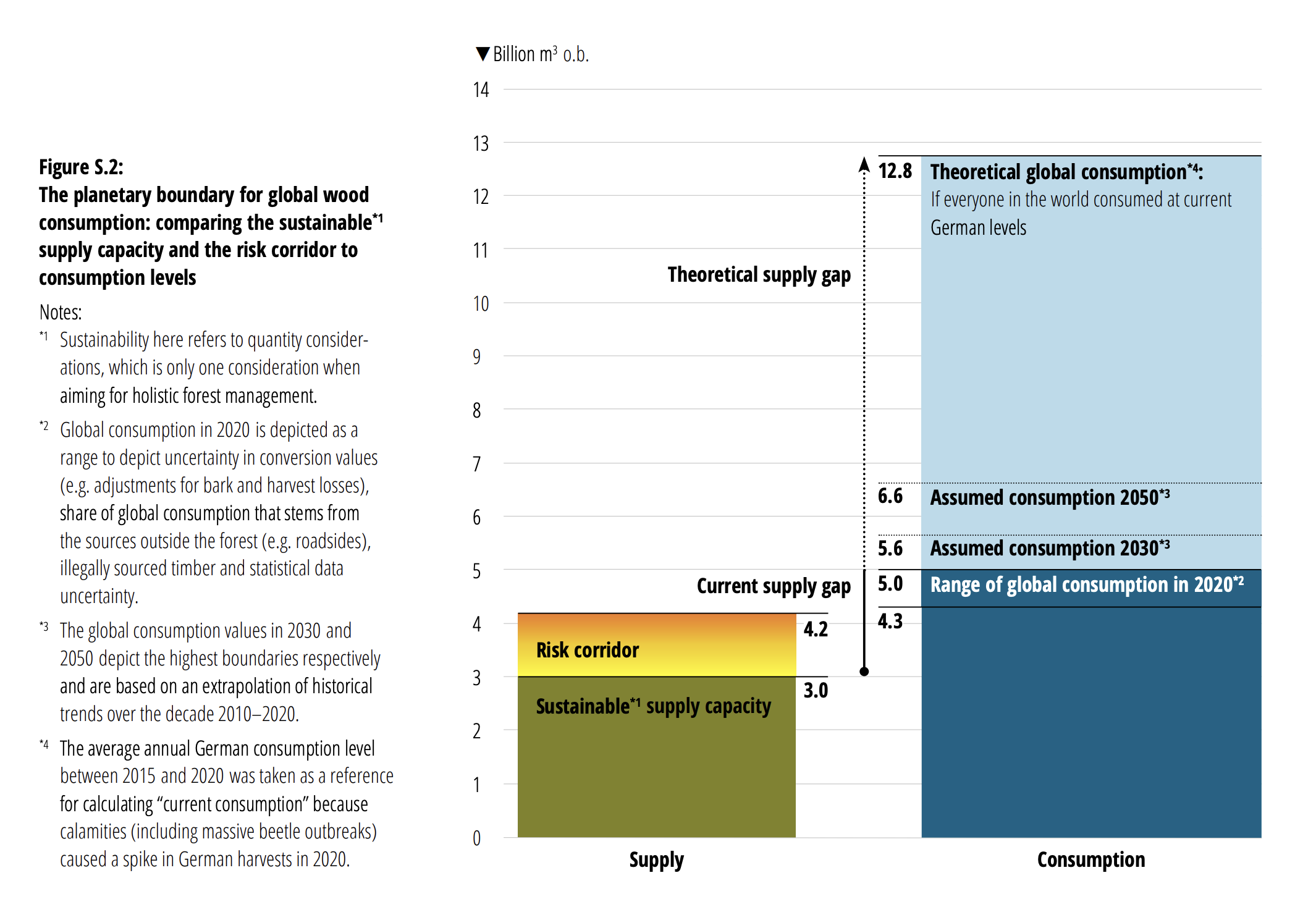
Comparison of global forest wood production capacity and idustrial use of wood. From University of Kassel of WWF.
At the same time, the condition of forests in the European Union is dire. Only 14% of Natura 2000 forest habitats in the EU are in favourable conservation status, and according to data from the European Environment Agency, forestry is one of the main threats to them. Increasing timber harvesting, driven by excessive consumption of short-lived wood-based products, has also led to a one-third decline in the amount absorbed by European Union forests over the last decade.
What is more, Europe is already unable to meet its enormous demand for wood-based products, forcing a number of its Member States to rely on imports. Making the European economy even more dependent on wood will only widen this gap, completely undermining the assumptions about striving for material and energy independence.
2. Deep concern: do not transition from fossil fuels to biosphere extraction
Fossil fuels have to be urgently phased-out. But the solution is not another assault on ecosystems. We alert the European Commission to our fundamental concern regarding the transition from fossil fuels towards the exploitation of the biosphere. Both practices harm the climate, environment and human health.
Other solutions are at hand:
- To phase out fossil fuels for energy generation, instead of burning biomass, we ought to invest in clean, renewable energy sources such as wind, solar, heat pumps, and energy efficiency.
- Instead of replacing disposable plastic packaging with disposable paper, we should be investing in reusable packaging.
We are confronting two global crises: a climate crisis and a biodiversity crisis. These crises feed off each other, while together they threaten life on earth and modern societies. A solution to one should not be at the expense of hastening the other.
3. Burning wood for energy is not sustainable, nor renewable
The inclusion of bioenergy, the burning of wood for energy generation, in the Bioeconomy Strategy follows an unacceptable approach towards promoting and incentivising large-scale biomass burning plants. There has been a massive increase in the amount of woody biomass burned for energy worldwide: a 50% increase in just 11 years between 2010 and 2021, and a 250% increase in global wood pellet production, which reached 47.5 million tonnes in 2022. This growth has been responsible for the decline of the forest carbon sink in the EU, the deforestation and degradation of valuable forests worldwide (including old-growth and primary forests in North America and Europe), and human rights violations including long- lasting impacts on human health and the grabbing of Indigenous and local communities’ land in the Global South.
Burning biomass for energy generation emits at least as much CO2 as coal burning, per unit of energy produced, and it is usually higher, as scientific research and evidence proves. Burning biomass for energy is not a solution to the climate crisis, nor the biodiversity crisis – it worsens these crises. The development of the bioenergy sector is responsible for tree monocultures in EU member-states such as Spain and Portugal, the destruction of natural continuity forests in Sweden, Finland and Estonia, as well as outside of Europe. The EU imports wood pellets from the USA and Canada to then burn for energy, as it does not produce enough within the EU. The mere scale of this sector is unsustainable.
The European Commission should not continue to push for bioenergy as a climate solution. The incentives that this strategy creates, namely through deregulation and the facilitation of investment opportunities and financing flows spells disaster for forests. The revision of the Renewable Energy Directive (RED) is yet another concerning step, as the inclusion of bioenergy should not have happened in the first place.
The promotion of biofuels for the aviation and maritime sectors is another cause for concern. On one hand, it looks once again to gain scale when the biosphere doesn’t support further demand. On the other hand, it completely ignores the fact that these biofuels still have high carbon footprints, especially if their production, such as of methanol, involves high volumes of wood, clear-cutting unprotected natural forests and driving further tree monocultures. Even hydrogen (and hydrogen related methanol) can hide the same impacts, if produced (normally in developing countries) by using biomass.
4. Depleting Carbon Sinks at an alarming rate
“In forests, locally adapted sustainable management can provide long-term supply to industry while maintaining a resilient carbon sink.”, p. 16
The notion that the EU can increase logging levels while avoiding the decline of the EU’s carbon sinks does not pass a simple math test. Today, the EU’s carbon sinks are already declining at alarming rates. Between 2010 and 2020, the EU’s total forest carbon sink decreased by nearly a third, from approximately 430 to 290 million tonnes of CO2 equivalent per year. A good example of this reality is the fact that forests in Finland and Estonia shifted from being carbon sinks to net carbon sources. This drastic change is a consequence of the overexploitation of forests in countries with strong pulp and paper and biomass energy sectors. In this regard, it is important to notice that “locally adapted sustainable management” is what led to this scenario in Estonia and Finland.
Logging more trees is not “green” nor “sustainable”, as this necessarily implies less carbon in forest ecosystems. Furthermore, when a great part of this wood is immediately burned for energy or used for short lived products like paper, the carbon is released into the atmosphere in the form of CO2. This simultaneously exacerbates both the climate crisis and the biodiversity crisis.
Therefore, to ensure forests are not further degraded or outright clear-cut, “sustainable management” should not be entertained as a solution, as it is a meaningless measure. This strategy ought to be based on a strong scientific basis and look at the available evidence which points to the needed reduction in demand for pulp and woody biomass.
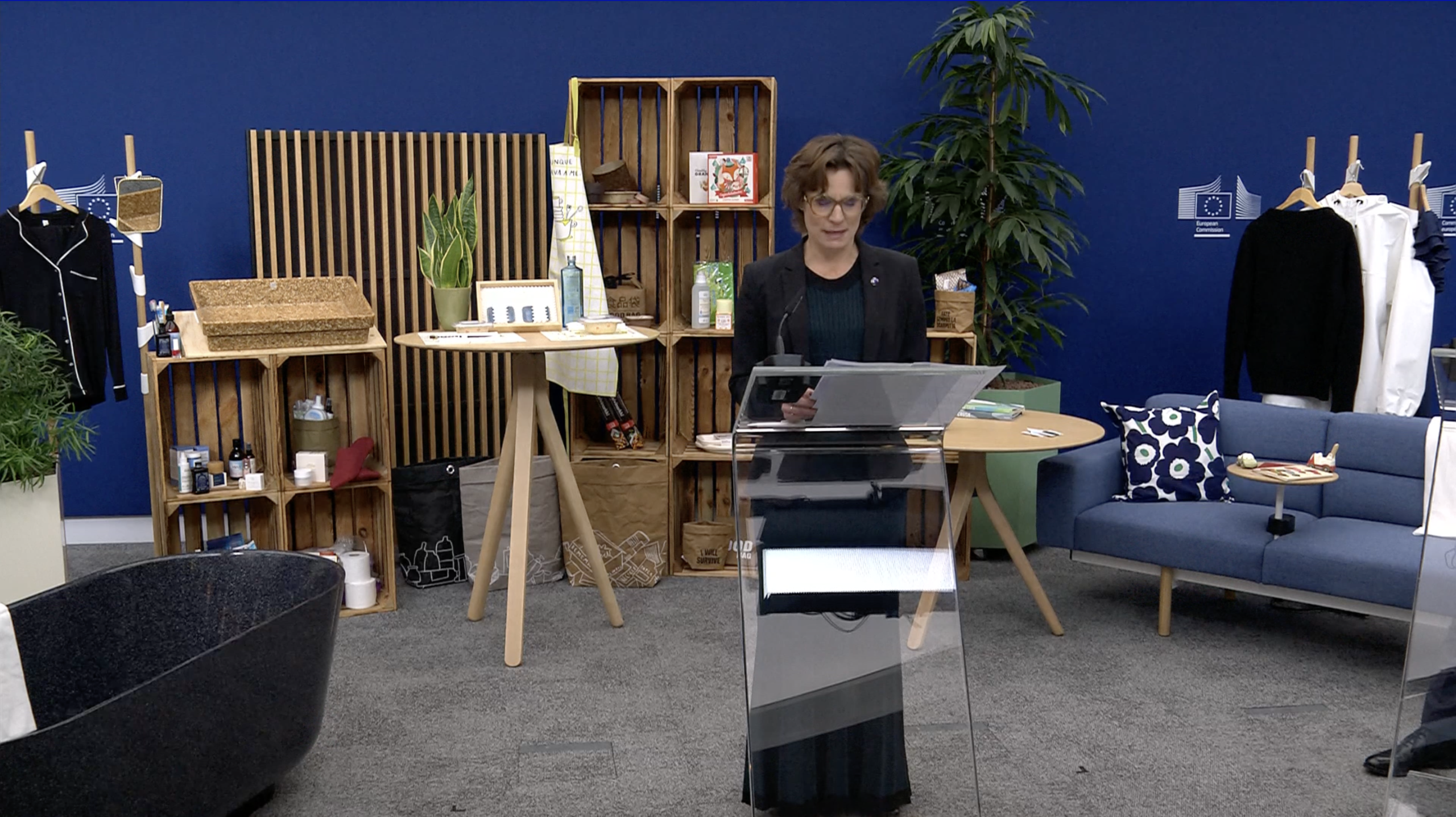 The setting of the presentation done by Commissioner Jessika Roswall illustrates well what the Bioeconomy Strategy entails: a lot of wood.
5. Incentives for more investment towards biorefineries (e.g. pulp mills)
“De-risking investments to scale-up innovation”, pag. 6
The EU Bioeconomy Strategy approach is yet again focused on gaining scale, into “closing financing gaps” and providing more investment money to sectors which have been responsible for driving the overexploitation of forests and depletion of their carbon sinks. This is done with little regard for the environmental and social consequences of further intensification of wood extraction.
In addition, the plan’s focus on “de-risking investments,” combined with the removal of environmental safeguards under the guise of “simplifying regulatory requirements,” is likely to attract opportunistic investors seeking quick profits or large conglomerates that do not genuinely need public financial support. Once again, the consequences for the environment and the global climate could be severe.
Providing financial incentives towards new biorefineries (name now commonly used for the old pulp mills) will only exacerbate the current crisis by further increasing the demand for woodfiber. This also applies to the planned incentives that the European Investment Bank Group (EIGB) should provide towards “scaling biomanufacturing, advanced bio-based materials”. This means providing support for over-exploiting ecosystems beyond any chance of recovery.
6. Innovation as a push for wasteful uses of wood
The EU Bioeconomy Strategy focuses on promoting nature over-exploitation at scale, e.g. through shifting from plastic to paper or bioplastic, from coal to biomass from synthetic textiles to wood based fabrics (man-made cellulosic fibres or MMCFs). This is fundamentally wrong. Material substitution only moves the problem, worsening it. The real solution is to reduce material consumption (raw materials) without affecting the quality of consumers’ lives (as an example by promoting reusable packaging to substitute disposable ones).
- The EU’s forests, as well as forests around the world, cannot withstand such inefficient uses of wood. These are large-scale, low efficiency and low value-added applications for wood. Instead, the Commission should be focusing on truly ecologically sustainable, natural resource-efficient ways that have high added value to the economy.
- Instead of promoting bioplastics and paper packaging, the EU ought to focus on implementing large scale reuse systems for packaging, in order to abandon the disposability and waste mindset in which our economies operate.
- Instead of promoting bioenergy with a rapid transition of the existing coal plants to burning biomass, the EU should promote clean, renewable energy sources, such as wind power and solar, incentivize energy efficiency and invest in technologies like heat pumps, which need support to be scaled up.