
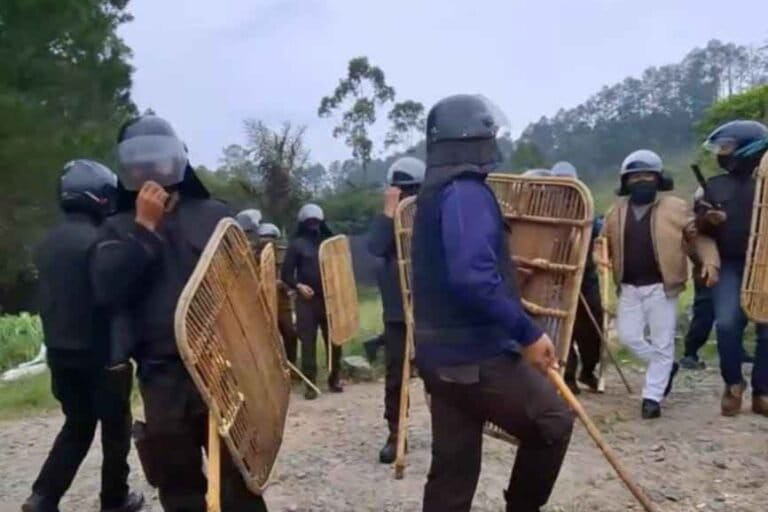
On 22 September 2025, security forces from PT Toba Pulp Lestari Tbk (TPL), a sister company of APRIL, assaulted an indigenous village in North Sumatra, Indonesia, amid an ongoing land conflict over customary territories.
According to the Indigenous Peoples Alliance of the Archipelago (AMAN), hundreds of TPL workers and security personnel stormed the villages of Buntu Panaturan, Nagori Sihaporas, Pematang Sidamanik, Simalungun, North Sumatra.
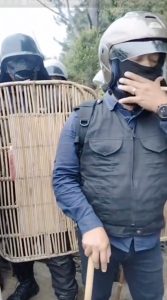
TPL Security armed with sticks and rattan shields – image from Instagram
The men wore all-black uniforms. “They were equipped with curved machetes, electric shock devices, wooden sticks, helmets with face shields, rattan shields, and boots,” said Mr Jhontoni, head of the AMAN Tano Batak Regional Executive Board, which represents indigenous communities.
Upon arriving at the location, the TPL officers immediately attacked the indigenous people’s institution, beating the residents who were protecting it, especially women.
Among the victims was a disabled child and Feny Siregar, a student from the Bogor Agricultural University (IPB University) doing field research in the area for her final thesis.
In addition to the assaults, TPL officers vandalized the community post, damaged six motorcycles, and destroyed part of the communal house. The communities now fear that further attacks may follow.
This is not the first act of violence. On 7 August 2025, three residents of Natinggir Hamlet, Simare Village, Borbor Sub-district, Toba Regency, North Sumatra, were assaulted by TPL security officers. One victim remains hospitalized. Despite the victim’s family filing a case with the local police, no action has been taken.
And about a year earlier, on 22 July 2024, five members of the Tano Batak indigenous community were abducted by individuals driving security vehicles belonging to TPL.
The Sihaporas people have been living in the area for about 200 years. They have ancestral ties and heritage linked to the forest, which they rely on for subsistence through farming and tapping sugar palm trees. They also gather medicinal plants from the forest for traditional rituals.
Forty years ago, TPL occupied almost 300,000 hectares of land in North Sumatra, including more than 30,000 hectares of customary land belonging to 23 communities in 12 different districts. The company deforested the land to convert it into tree plantations for paper production.
The community began resisting the company’s presence in 1998, following the fall of the New Order regime. For over 25 years, conflicts have arisen repeatedly between the community and company workers.
In an advisory to buyers and investors, WWF has demanded an independent investigation and recommended sourcing only from FSC-certified products.
In 2013, the Forest Stewardship Council (FSC) “disassociated” itself from APRIL for “being involved in large-scale deforestation activities in Indonesia and bringing negative social and environmental impacts to areas with high conservation values.” Despite this, the company is now seeking to regain FSC certification, even as NGOs call on the FSC to halt the process due to APRIL’s continued links to deforestation and human rights violations.