
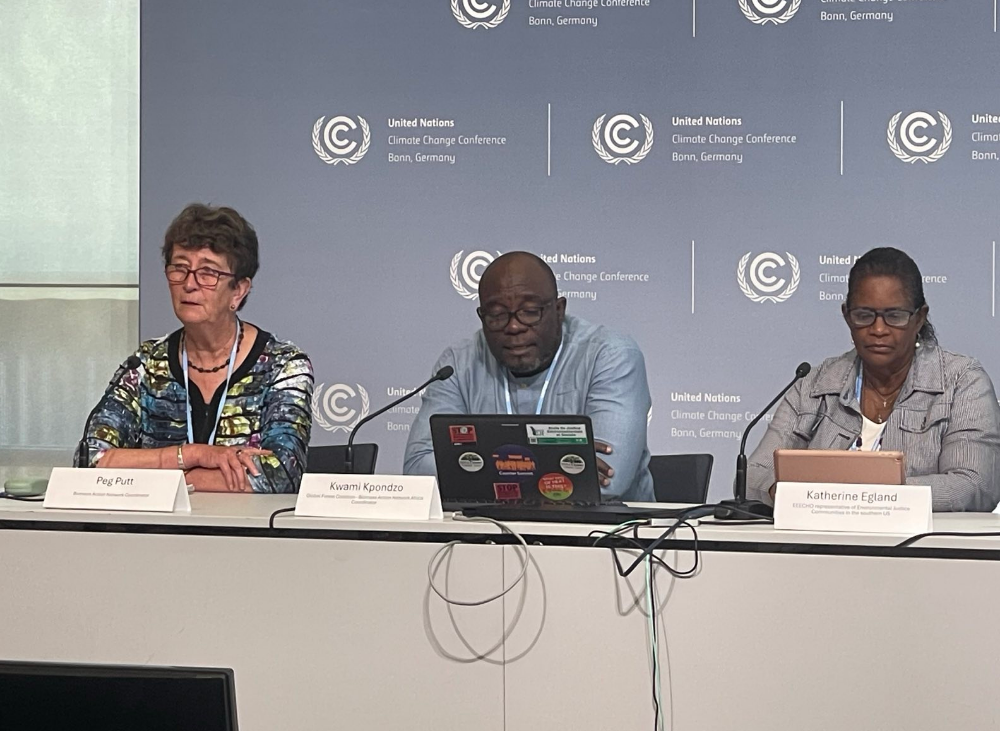
Reflecting on his time at the recent Climate Negotiations, Davi Martins (BAN’s Biomass Advocacy Campaigner) warns that real solutions like forest protection, genuine renewable energy, and community-led justice cannot wait. The countdown to Belém has begun, and with it, the final test of global climate solidarity.
The Biomass Action Network demands that COP30 must deliver
✅ Exclusion of false solutions (industrial biomass energy, carbon markets and geoengineering).
✅ A fossil-fuel-free Just Transition with dedicated finance.
✅ GST work plans with emission-peaking mandates (by 2025) and fossil phase-out timelines.
✅ Doubled adaptation finance and an operational loss and damage fund.
Progress on Justice, but Diminishing Ambitions
The UN Climate Change Conference in Bonn (SB62) has come to a close months ahead of a crucial COP30 in Belém, with parties leaving behind a picture of stark contrasts and growing anxieties. While the just transition was seen as a beacon of progress, its light has been dimmed by a dangerously watered-down global assessment, persistent disputes over adaptation finance, and the relentless promotion of false solutions such as industrial biomass and carbon markets. The path to a successful COP30, as advocated by the Brazilian presidency, is in a delicate position.
A Glimmer of Hope: Just Transition in the Spotlight
One could argue (with relevant observations) that progress on the just transition negotiations is positive. Parties have prepared a comprehensive briefing text to serve as the basis for an expert workshop which can provide important input for the Parties’ negotiations on a crucial COP30 Just Transition text. However, the negotiations in Bonn were marked by persistent language blockages. This weakened the goal of “moving away from fossil fuels in a fair, orderly, and equitable manner, recognizing that pathways to energy transition will vary from country to country depending on national circumstances,” to the complete exclusion of fossil fuels from the text, as well as any consideration of the realities of developing countries and low-income people.
Although this briefing is an important step in the right direction and demonstrates that sustained engagement can influence outcomes, crucial negotiations await in Belém on financial commitments, implementation mechanisms, and how to ensure that the final text reflects its transformative potential, especially for the most vulnerable.
.
The Great Challenge: Adaptation Finance and Two-Way Competition
Adaptation negotiations are a ‘hard pill to swallow’ which highlights the effects of long-term disruption in negotiations between more developed and less developed countries. The central issue remains the finances of the legacy. While developing countries urgently need increased, grant-based funding to address the accelerating climate impacts that are already disrupting lives and livelihoods, developed countries are reluctant to spend the much needed money on adaptation. Instead, they continue to promote aggressive diversification tactics such as carbon market approaches and private finance.
Global Stocktake: Ambitions Diluted at the Source
This year, nations had the opportunity to translate high-level policy signals from the Global Stocktake into a concrete action plan and mandate. However, parties did not want to pursue this agenda during the negotiations in Bonn. Instead, they have diluted the negotiations to the point where the decision must be made in Belém. The co-facilitators made multiple attempts to propose a text to guide the upcoming biennial work cycle (GST2), but this was systematically undermined over the course of the sessions. Issues like ambitious proposals for phasing out fossil fuels, raising peak emissions to 2025, and increasing funding have met strong resistance, particularly from industrialized countries and major emitters.
Homeless forests and powerful synergies
Important proposals on forest conservation and sustainable management, which are crucial for climate mitigation and adaptation, failed to find a clear negotiating framework in Bonn. The institutional ambiguity of UNFCCC hinders focused discussions and progress in protecting these important carbon sinks and biodiversity oases. On the other hand, the discussion on cooperation (with a highlight to the Brazilian delegation that did a major push for this agenda) was positive, where the need for synergies between various UN conventions (climate, biodiversity, desertification) gained importance. Recognizing the interconnectedness of these crises is essential for coherent action.
The outcomes from Bonn paint a deeply concerning picture for COP30 in Belém. The Brazilian Presidency faces a monumental challenge:
- Bonn’s outcomes crystallize the crisis of the UNFCCC processes as a whole.
- On one end justice advanced on paper, while on the other, ambition retreated in practice.
- The Just Transition draft offers hope, but only if delegates are ready for a serious social commitment in Belém.
- The GST’s weakening, adaptation’s abandonment, and the biomass energy threat, expose a system held hostage by wealthy nations and corporate interests.