
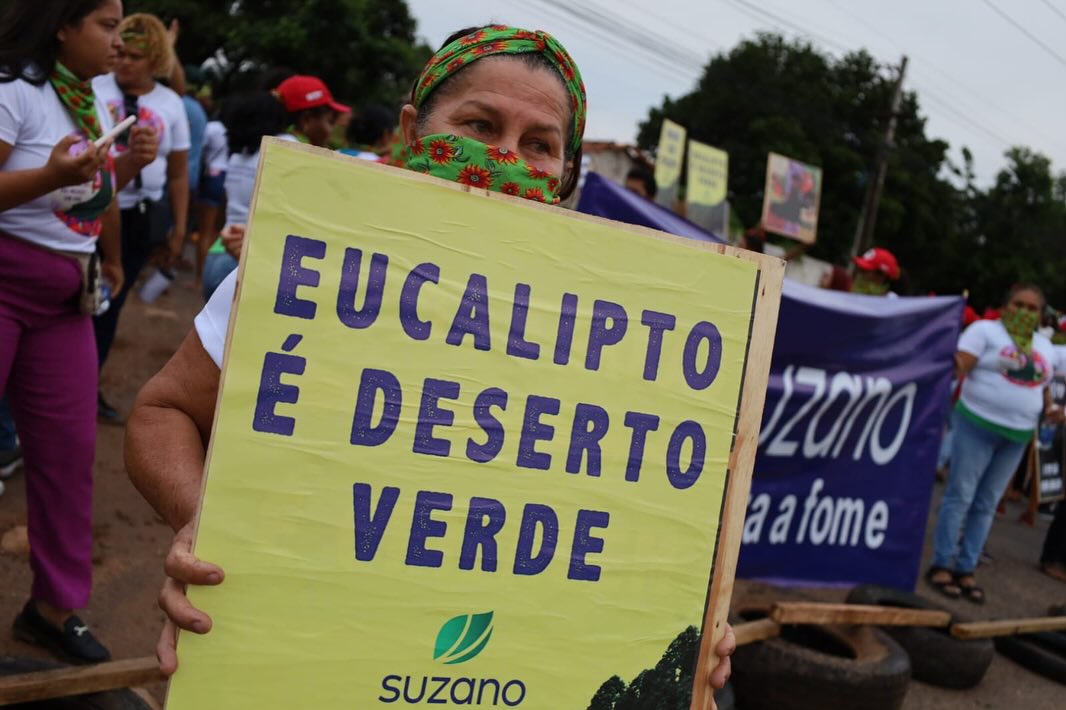
Suzano, the world’s largest producer of eucalyptus pulp, has requested the eviction of 600 families in the Brazilian state of Maranhão. The eviction, previously blocked by the Brazilian Federal Supreme Court, has now been authorized and is scheduled for June 30.
Suzano is a major landholder, controlling 2.7 million hectares across seven Brazilian states and three key biomes, and its operations affect hundreds of communities, including Indigenous and Quilombola groups.
While the land targeted for eviction in Maranhão represents only a small portion of its holdings, it is vital to the livelihoods of the affected communities.
The disputed area lies in the municipalities of São Pedro de Água Branca and Vila Nova dos Martírios, in Maranhão. Additionally, another 500 families in the nearby city of Imperatriz are also facing eviction by the same company.
Since the 1980s, Suzano has been acquiring land in western Maranhão, accumulating around 247,000 hectares of eucalyptus plantations. These plantations have significantly impacted the local water table, endangering both natural ecosystems and the survival of nearby communities, as eucalyptus trees are known for their high water consumption.
This aggressive expansion, including by expelling traditional owners, has sparked land occupations by landless families on parts of the contested territory. Suzano claims these occupations are criminal acts, but Brazilian courts have, in recent rulings involving the very same company, recognized some land occupations by traditional communities as legitimate. The fact is that land titles in Brazil are notoriously complex: an estimated 12% of arable land has been illegally claimed through fraudulent land titles (a practice known as grilagem).
This is not the first time Suzano has resorted to state force to suppress social conflicts. In 2020, the company was convicted—on appeal—by a Brazilian court for land disputes involving illegally acquired territory. Nevertheless, it continues to carry out evictions.
In São Pedro de Água Branca alone, 120 families have already been removed from the land they were cultivating. Their crops—including cassava, bananas, pineapples, cashews, mangoes, avocados, acerola, pumpkins, and rice—were destroyed.
Meanwhile, heavily armed private security guards hired by Suzano regularly patrol the area, including roads and camps where evicted families now live. There are also reports that the company has sprayed toxic pesticides from the air, contaminating the few remaining community gardens. These mass-evictions stand in stark contrast to Suzano’s public commitment to lift 200,000 people out of poverty in the regions where it operates. They are also violating basic social requirements. EPN has laid out a comprehensive set of demands to the Brazilian pulp and paper industry, their investors and business partners in Scorching the earth (pages 71-74)
Back to News