
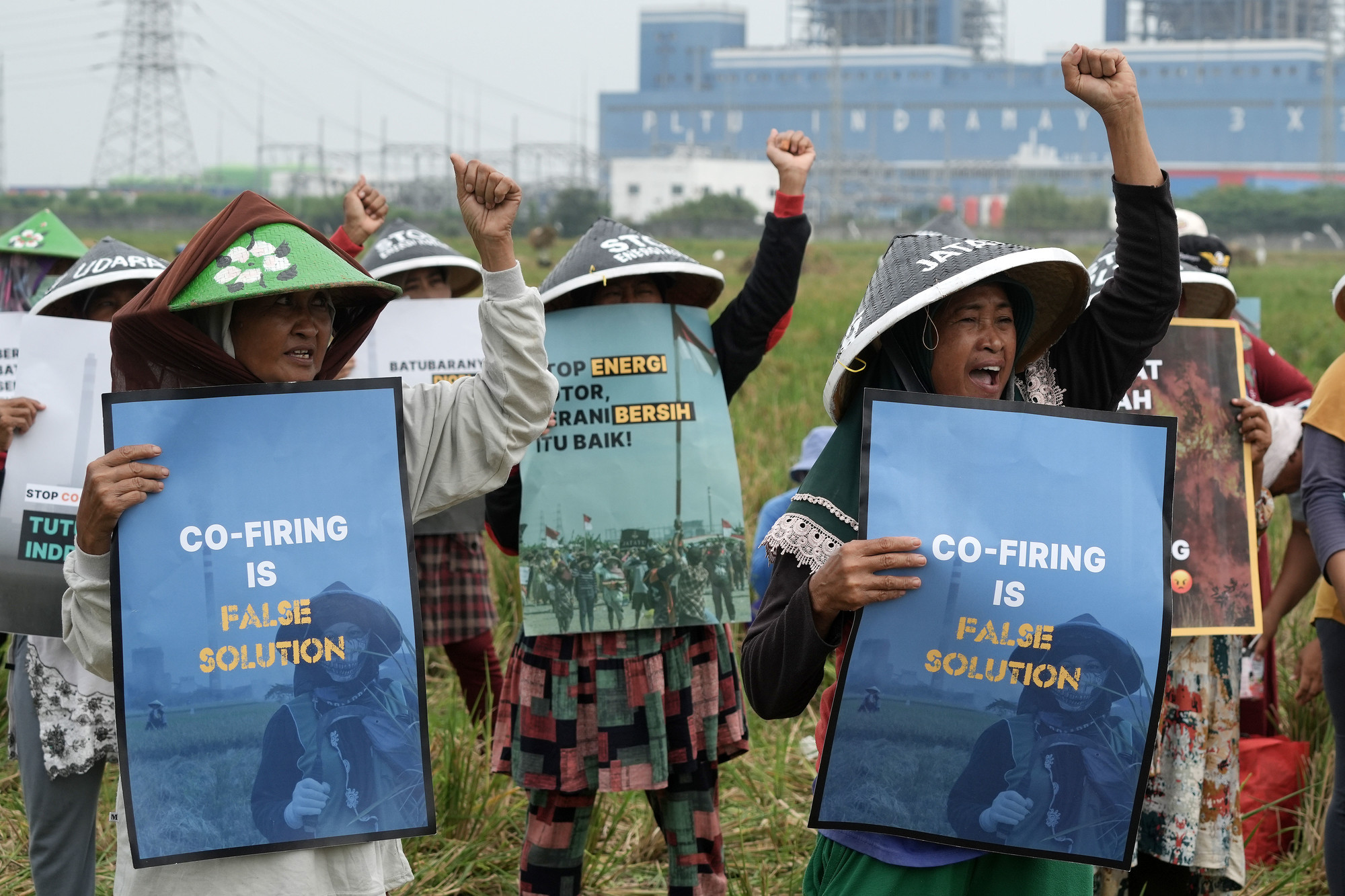
Jakarta, Indonesia – 13th June, 2025 – RE100, a global initiative of corporations committed to 100% renewable electricity, has announced a significant update to its technical criteria. Earlier this year, RE100 moved to explicitly dismiss co-firing with coal as a form of renewable energy.
With members like Google, Apple, Danone, Meta, and many more, this decision will send a powerful signal to markets and policymakers about the validity of biomass co-firing as a valid energy transition strategy. Especially in countries relying on biomass co-firing, like Indonesia, South Korea, Japan, as well as those in Europe.
This change comes as RE100 emphasizes that co-firing with coal presents a significant barrier to achieving swift energy transition goals. With the booming growth in true renewable energy sources, the practice of co-firing is no longer considered necessary or acceptable. Crucially, RE100 highlights that coal co-firing prolongs the environmental damage caused by coal and artificially sustains demand for this fossil fuel.
“This is a positive step forward,” states Amalya Reza, the Bioenergy Campaigner of Trend Asia Indonesia. “Corporations are aligning their practices with the genuine pursuit of 100% renewable electricity and beyond technologies that extend the life of coal. But that is not enough. The arguments against co-firing biomass should also encompass the fact that co-firing biomass will lead to deforestation. This will hopefully also put a stricter scrutiny on biomass itself, and this criteria should be refined to exclude industrial-scale biomass that would cause deforestation.”
“Co-firing coal with woody biomass does nothing to reduce emissions but does destroy forests,” said Peg Putt, Coordinator of Policy at the Biomass Action Network of EPN International. “It is frequently characterised as an emissions reduction measure due to a carbon accounting anomaly that fails to account for the carbon emissions of the wood in the energy sector, alongside those of the coal. In fact burning wood is equally emissive as burning coal, and frequently more emissive. The supposed emissions reduction is an illusion, instead there are large immediate emissions and they are not reabsorbed by growing forests for decades or centuries, if those forests are ever even allowed to recover.”
Indonesia’s Persistence With Biomass Greenwashing
While RE100 sets a new standard for corporate renewable energy commitments, a lot of countries are lagging behind. Indonesia, in particular, appears to be moving in the opposite direction. Indonesia is still encouraging corporations to invest in coal-fired power plants and to implement coal co-firing methods in their captive power plants. And biomass co-firing is also an integral part of Indonesia’s energy transition strategy, as it plans to co-fire at least 10% mix of biomass on all of its coal-fired power plants. Electricity from biomass co-firing is planned to contribute to 12,2% of Indonesia’s renewable energy mix by 2030.
This practice raises serious environmental alarms, with projections indicating it could lead to deforestation across at least 3 million hectares to meet biomass demands. This will threaten Indonesia’s remaining natural forests, which serves as an important carbon sink in the fight against climate change. This will also threaten the many indigenous people and local communities who rely on the forests for their livelihoods. Already land-grabbing for biomass energy is being reported.
Beyond Indonesia, other Asian nations like Japan and South Korea continue to utilize coal co-firing as a method and accept it as a renewable energy source. A particularly troubling aspect is their reliance on woody biomass sourced from other countries, contributing directly to deforestation in tropical forest nations such as Indonesia. Japanese institutions are also financing co-firing initiatives in the region under the guise of the energy transition.
It is imperative that more corporations globally adopt the updated RE100 technical criteria and cease using coal co-firing, both as implementers and investors. This is a stark reminder for the governments of the aforementioned countries that the future is steering away from biomass co-firing, as the ripple effects will clearly shift investment and innovation away from co-firing and into other renewable energy projects.
Looking ahead, we hope RE100 may further evolve its criteria to also exclude industrial-scale biomass, particularly given its potential to lead to widespread deforestation, the large immediate emissions of biomass burning that cannot be recovered by regrowth within Paris Agreement timeframes for action – if ever, and the inherent difficulties in ensuring its long-term sustainability, especially when most biomass is wood-based.
This renewed focus by RE100 serves as a crucial reminder that a true energy transition demands a move away from burning fuels, and clear, unambiguous commitments to sustainable, non-fossil non-carbon-based fuel energy sources.
————————————————————————————————————-
About Trend Asia: Trend Asia is a civil society organization that serves as an accelerator for just energy transition and sustainable development in Asia and Indonesia. It campaigns against the utilization of forest biomass and addresses the nexus of energy, forests, and communities, which poses significant risks to the vulnerable tropical rainforests and indigenous populations in Indonesia.
Contact: Email:firman.imaduddin(at)trendasia.org
About the Biomass Action Network (BAN): BAN is a network of more than 220 NGOs in 70 countries who have adopted the Biomass Delusion position statement. It outlines the harms and calls on governments, financiers, companies and civil society to avoid expansion of the forest biomass based energy industry and move away from its use, instead protecting and restoring the world’s forests as a climate solution.
Contact: Email:peg.putt(at)gmail.com
Back to News