
EPN’s Biomass Action Network has sent a letter to the UN outlining the negative impacts of large-scale “modern” biomass energy on people around the world. The submission was made in response to a call by the Special Rapporteur on Climate Change for input on the Human Rights impacts of renewable energy and critical minerals. This was a unique opportunity to draw attention to the detrimental effects that are being felt at every stage of the biomass supply chain and 84 non-government organisations signed on in support of the letter.
Concerns about the adverse human rights impacts of forest biomass energy throughout the supply chain are increasingly coming to light as the industry expands at a rapid rate. The examples included in the letter and below are just a snapshot of the negative impacts that are occurring all around the world and which are set to worsen if nothing is done to halt the biomass industry. To help disseminate these important stories, we have created a briefing based on the letter, which we hope will be a helpful campaign resource. If you have a story to share, please reach out to sophie@environmentalpaper.org
Examples of human rights impacts from biomass production
Nepal: A 2022 Report “The industrialisation of forest-based bioenergy production in Nepal and its impacts on women and other forest-dependent peoples” outlines some of the chief concerns regarding industrial-scale bioenergy production including: reduced access and scarcity of forest resources; lack of access to grazing lands for community livestock; increased air pollution and negative health impacts; unfair payments from the company for biomass; unsustainable collection of forest biomass; and undermining of community forestry decision making and authority, all of which has led to increased conflict between local communities and companies involved in bioenergy production.
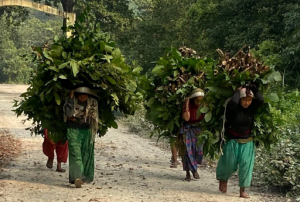
Indigenous women carrying fodder from the forest Photo: Bhola Bhattarai • NAFAN
NAFAN, the lead author of the report, outlines that “Marginalised, Indigenous and tribal communities still depend on forest products for their day-to-day existence, for food, shelter, employment, and trade. Over-exploitation of forest resources to meet industrial-scale biomass production will inevitably disturb forest biodiversity, degrade the soil and eventually affect the bioculture, medicinal values, and wild food production of the forest from which the Indigenous communities have traditionally survived.”
Women from the local community who spoke to NAFAN said that the increasing scarcity of grass, fodder and other forest products will lead to increased conflict within their communities. “As women are mainly responsible for collecting firewood, fodder, and leaf litter, this will disproportionately impact them, forcing them to travel further to source these materials.” The Nepal Indigenous forum (IPs SWBC Nepal) is currently involved in a process to try to ensure that the principles of Free, Prior and Informed Consent, is applied in the context of biomass harvesting.
Indonesia: In Indonesia the initiative to produce biomass on a mass scale is called the Energy Plantation (HTE) program, which replaces natural forest with monoculture plantations. It follows on from the HTI timber plantations development program, which has been responsible for the deforestation of about 2.7 million hectares of natural forest, and has the potential to affect a further 10 -17 million hectares (according to Forest Watch Indonesia). Exclusivity rights granted to the plantations are occurring without inventory, identification or settlement of third-party rights, without remote sensing maps or Governor’s recommendations. In these circumstances the communities are being sidelined, yet despite negative social and environmental impacts, the plantations are promoted by the energy transition program as ‘green’.
In Sumatra, East Java, Kalimantan, Sulawesi, and Maluku, biomass energy projects have stripped local and Indigenous communities of access to forests essential for food, medicine, cultural practices, and livelihoods, severing their connection to ancestral lands. In Jambi, the Indigenous Suku Anak Dalam community lost gardens, forests, and fields to PT Hijau Artha Nusa’s (PT HAN) bioenergy project. Despite deforesting 4,000 hectares, PT HAN replanted only 64.5 hectares and failed to compensate the community or honor agreements. In Maluku, companies operate bioenergy concessions without adhering to Free, Prior, and Informed Consent (FPIC) principles. The O Hanga Manyawa Indigenous people in North Maluku were unaware of a project on their ancestral land, receiving no information post-permit issuance. On Buru Island (Maluku), communities lost forests and farmland to state-owned enterprise (BUMN) funded plantations that ignored FPIC protocols.
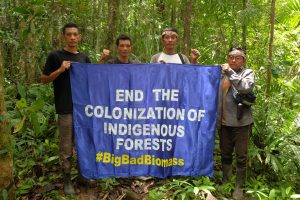
Indigenous groups in Indonesia protest against biomass energy plantations. Photo Trend Asia
A 2024 report “Borneo forest’s silent sacrifice: Japan’s Energy Transition and the Shadow of Indonesia Illegal Biomass Trade” explored the life of people living in the development area of the largest HTE programme in Indonesia and found that communities received none of the benefits of biomass energy and were not even electrified until mid-2023, instead the entire output of the ‘energy crop’ is exported to fulfil Japan’s domestic needs. The report also found that land conversion to monoculture plantations poses a significant threat to food security and diversity. As food chains are interconnected, this threat not only affects local communities that directly access and depend on traditional agroforestry systems, but also urban communities, which are dependent on supplies from surrounding rural areas. Given this interconnectivity, the threat cannot be confined locally.
Sweden: The prevailing Swedish forestry model of converting irreplaceable native forests into tree plantations, and substantially deployed to produce forest biomass feedstock, is threatening Indigenous Sámi peoples’ rights. After only 60 years of Sweden’s clear-cutting model, 71% of lichen-rich forests in Sweden have disappeared. These forests are crucial for the survival of the reindeer upon which Sami culture relies. Sámi communities are sounding the alarm and letting the world know that “the reindeer are starving” and have sent an open letter to the government.
Additional harm to Sami reindeer herders is caused by the systematic replacement of natural forests with contorta pine plantations (Pinus contorta, also known as lodgepole pine), which is non-native. Studies show that reindeer cannot find food, nor move freely, in areas with contorta pine and that the forestry industry’s preference for them has strongly contributed to the significant loss of lichen-rich forests. Sámi communities have a zero-tolerance policy towards planting contorta pine, but the forestry industry does not respect the Sámi communities’ rights to free, prior and informed consent (FPIC).
Chile: A report on Arauco’s Valdivia Biomass Power Station outlines conflicts with Indigenous communities in Chile. Wood burned in Valdivia, which is co-located with a large pulp mill, is ultimately sourced from vast areas of industrial eucalyptus and pine plantations that have had profoundly negative impacts on Chile’s Mapuche Indigenous Peoples. Conflicts over land ownership due to land-grabbing and fraudulent purchases of land for commercial tree plantations have affected thousands of peasant farmers and Mapuche families. The arrival of forest industries also led to a loss of cultural and economic diversity due to impacts on land-use and biodiversity, such as a decrease in the availability of medicinal plants used by communities, which has impacted Indigenous women disproportionately. Further impacts on water availability, soil fertility, as well as fire frequency and intensity, are also outlined
Ghana: In Ghana, the acquisition of 42,000 hectares of land in the Bono East Region by Norwegian company APSD to plant eucalyptus, has directly impacted community rights. Local people have described how they are now forced to walk huge distances around the plantation area, where previously they had right of way, putting women at particular risk as they gather firewood for cooking. The plantation itself is guarded by private security who come into local villages to check that no one has been hunting animals in the plantation for food. Locals have reported incidents of physical abuse, invasion of privacy and harassment at the hands of the company. Obtaining free, prior and informed consent has become a charade.
Examples of human rights impacts from biomass processing
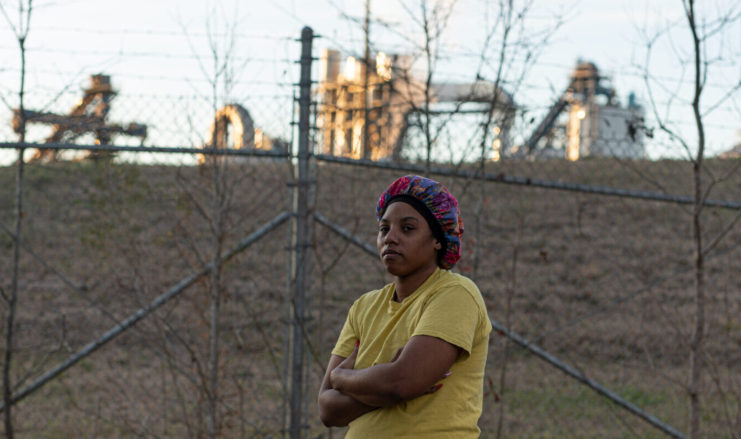
A resident in Gloster, Mississippi, stands in front of a pellet plant which began operations next to her community in 2014. Photo Andy Sarjahani/Unearthed
USA: The United States is the largest manufacturer and exporter of wood pellets globally. Systemic racial injustices there result in the disproportionate placement of biomass manufacturing industries in environmental justice communities. Environmental justice communities are typically defined as “neighborhoods composed predominantly of persons of color or a substantial proportion of persons below the poverty line, that are subjected to a disproportionate burden of environmental hazards and/or experiences a significantly reduced quality of life relative to surrounding or comparative communities.”Serious adverse health effects associated with the manufacturing of wood pellets are imperilling poor communities and communities of colour, particularly in the Southeastern United States. Pellet manufacture emits excessive amounts of deadly pollutants including particulates (PM₂.₅), volatile organic compounds (VOCs), nitrogen oxide (NOx), carbon monoxide (CO), carbon dioxide (CO₂), methanol, acrolein, and formaldehyde. Exposure to these chemicals has been shown to lead to respiratory illnesses, heart disease, premature deaths, low birth rates, Type 2 diabetes, strokes, Alzheimer’s, Parkinson’s, and lung, kidney, and bladder cancer and Southeastern U.S. residents exposed to these carcinogens are exhibiting many serious health effects.
The companies involved consistently violate provisions of the U.S. Clean Air Act, emitting well beyond their regulatory limits of dangerous chemicals. A litany of examples show ineffective regulation and fines for polluting, that are woefully insufficient and do not function as a deterrent. An investigation found that wood pellet mills owned by UK energy giant Drax have violated environmental regulations 11,378 times in the US since 2014. The violations, which occurred at six wood pellet mills, include exceeding permitted limits of toxic air pollutants, bypassing crucial emission-control technologies and releasing contaminants into waterways. Clearly this is a systematic disregard for pollution controls and for the human rights to clean air and water of those affected, which the companies involved and the US authorities are not acting upon.
The Biomass Action Network comprises 220+ NGOs located in 70 countries. Our position statement, the Biomass Delusion, summarises the harm caused to the climate, to forests, to people, and to the clean energy transition, by the large-scale burning of forest biomass for energy.
Back to News