
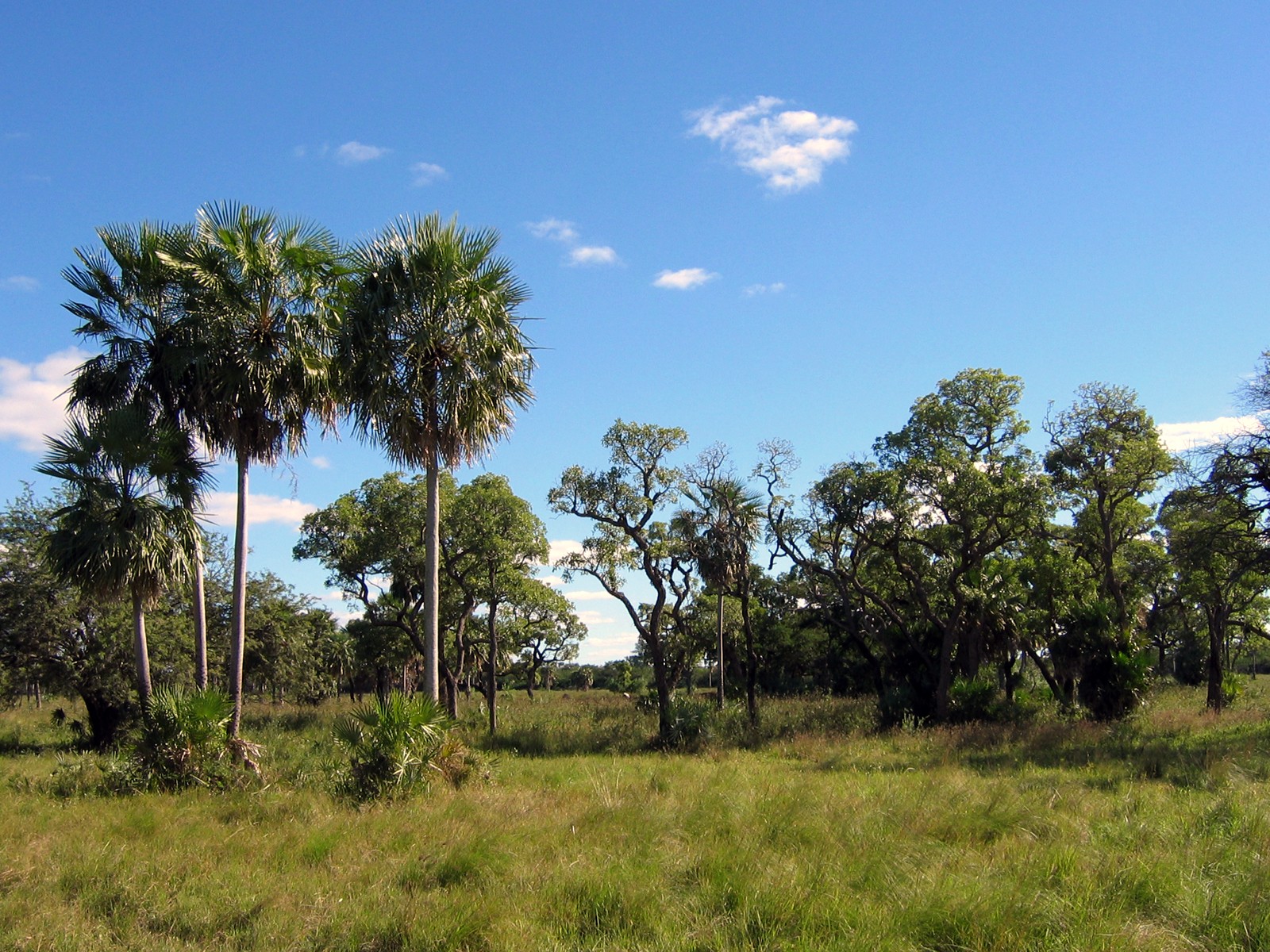
Landscape in the Gran Chaco, Paraguay, May 2004. Photo by Ilosuna. Creative Commons Attribution 1.0 (Generic).
After taking over vast tracts of land in all South America, the pulp & paper industry is now expanding in Paraguay. Paracel, a joint venture between a Paraguayan oil trader and foreign entities, is constructing a pulp mill and accompanying plantations in Paraguay. This is the first big pulp project in the country, making Paraguay the latest country to join the massive pulp expansion in Latin America (Brazil, Uruguay and Chile are its predecessors). As with so many pulp projects EPN and its partners have researched on this continent, the social and environmental issues are enormous. These can be read in two recent publications by EPN, Banking Information Center (BIC), Grupo SUNU de Acción Intercultural, AXIAL Naturaleza y Cultura, Instituto Maira and International Accountability Project (IAP),
It was in March 2021, when a group of officials from the city arrived in the village of Bella Vista (Amabay, Paraguay), where the Indigenous community Arroyo Ka’a lives. Pedro (not his real name) remembers it well: “They asked to gather people from the community as quickly as possible”. Among them was a representative of the governmental Indigenous agency (Instituto Paraguayo del Indigena – INDI) who, indigenous people reported, behaved very arrogantly. “They asked for identification documents of the people without explaining why”.
What the community did not know is that they were dealing with the huge Paracel pulp mill project in the nearby area of Concepción, with a capacity of 1,500,000 metric tons per annum – but capable of producing up to 1,800,000 t/year of pulp. In order to feed that mill, the company needs a large amount of wood. Paracel already controls hundreds of hectares of eucalyptus pulpwood plantations, but it will need to expand them further.
Nothing of that was discussed with the Arroyo Ka’a indigenous community. The officials presented a new project for planting eucalyptus trees, but only talked about job opportunities and development projects. They did not offer information about the company nor on the possible impacts that the project development would have on the environment and local communities. Then they insisted a lot for the local community representatives to sign documents without giving further explanations. “They acted strangely”, said Pedro. The community was puzzled and did not like the officials’ arrogance, and ended up mistrusting them. And so they refused to give their consent. The officials came back twice, but the community kept its position.
Instead of dealing with this problem, Paracel scrapped the Arroyo Ka’a community from the list of the indigenous groups potentially affected by the project. This is dangerous, as Paraguay is marked by long-standing conflicts over Indigenous traditional lands. The fact is that Paracel applied for US$ 200 million loan from IDB Invest, and 200 million in co-financing are expected from the US Development Finance Corporation (DFC). Both institutions require proper Free Prior Informed Consent (FPIC) by local communities. Further investment is being negotiated with the private bank Goldman Sachs and the Japanese Development Bank. So, to square the circle, the community that refused its consent was deleted from the consultation.
Despite the Arroyo Ka’a community knowing very little about the project, they guessed well. The mill is very likely to have vast impacts in the region. In our joint briefing, we show that the Paracel mill is at great risk of causing deforestation and to have an impact on the biodiversity in the departments of Concepción and Amambay because of its need to expand Eucalyptus plantations if the company wants to run the mill at full capacity. The plantations will also have a severe impact on the water resources, as eucalyptus trees will soak up most of the available water – every single tree needs up to 30 liters of water a day. As a result, the area, already suffering water stress, would become dry. The life of local people, based on local wells, is endangered, as well as the survival of remaining forests. Drought will also lead to extensive wildfires, because Eucalyptus is a fire prone species, as it already happened in other regions marked by eucalyptus (Chile, Portugal). As if this would not be enough, the mill’s discharges, contaminated with chlorine dioxide, sulphuric acid and eventually chlorinated organic compounds (such as dioxins and furans, which are persistent organic pollutants, or POPs), will go into the Paraguay river around 20 kilometers upstream from the drinking water catchment of the city of Concepción,posing a great hazard to the environment and human health. Not to mention the social impacts in the region of Paracel’s operation, where live at least nine Indigenous communities of the Pai Tavytera and Mbya guarani ethnic groups, whose livelihood will be affected by the project.
However, none of these impacts, and many more, were mentioned during the consultations held by Paracel with potentially affected communities.
The Arroyo Ka’a community is not the only one to report about a flawed consultation process. The communities Cerro Akangue and Ita Jeguaka also made similar accounts. Communities interviewed by Grupo SUNU (particularly those that rejected participating in the consultation process, Cerro Akangue and Ita Jeguaka) have expressed their concerns regarding environmental and social impacts on their communities and territories. Local communities also strongly fear land-grabbing by third party suppliers of the mill.
This is why the group of NGOs that published the briefings, strongly urges the financial institutions involved in the Paracel project to withdrew their support to the project or at least postpone its decision about financing it until:
- The consultation process, both of potentially affected communities and Indigenous communities, is re-done. FPIC consultation must be conducted again in good faith and following the international IFC standards.
- A comprehensive analysis of the long-term impacts of the plantation on water resources, local agriculture and remaining habitats, wildfire risk, and mill effluents impacts on the drinkable water table and the impacts of agrochemicals on the surrounding environment is developed.
Please find here the Briefing about the Paracel mill project and the Report from the field investigation on the FPIC consultation,
Back to News