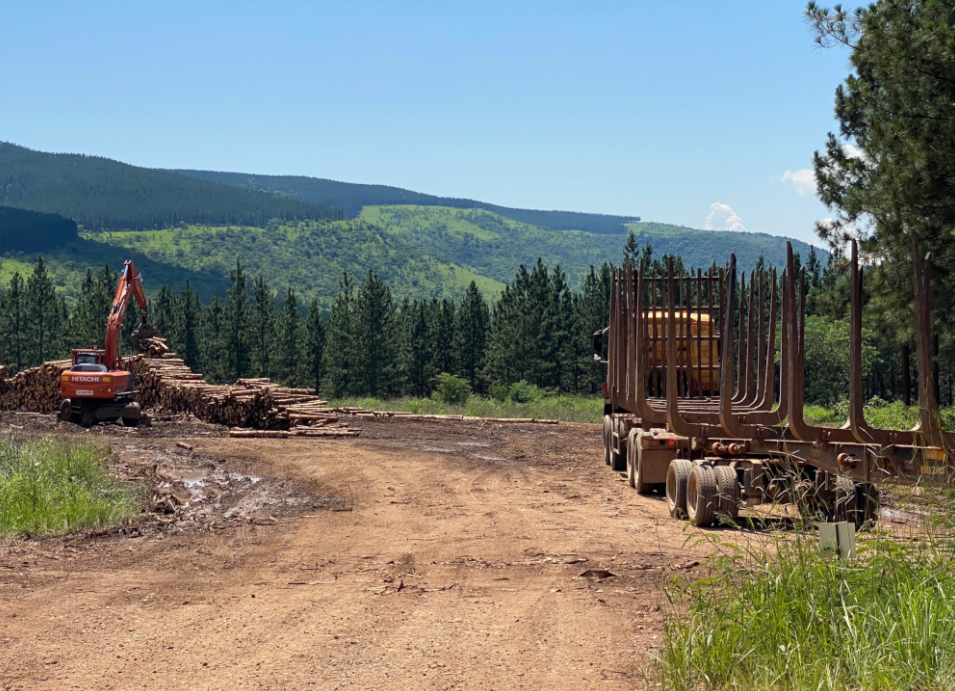
Picture: A Sappi logging site and pine plantation near Ngodwana, South Africa.
EPN’s Forests, Climate and Biomass working group have published a new case study, undertaken by our South Africa based member group GeaSphere. The case study looks into the biomass power station built by Ngodwana Pulp and Paper mill and the impacts of burning wood sourced from monoculture tree plantations.
All around the world, pulp & paper and biomass industries are escalating the destruction and degradation of forests and other biodiverse ecosystems, through their ever increasing demand for and consumption of forest products – an issue EPN highlighted in this statement on the International Day of Forests, on 21st of March 2022.
Increasingly, there is a direct link between pulp and paper and biomass industries, as pulp and paper mills seek to install over-sized, dedicated biomass boilers alongside traditional cogeneration units, in order to take advantage of monetary incentives for producing electricity from burning wood.
Operators claim that the “renewable” electricity they produce replaces electricity produced from fossil fuels and so helps to reduce emissions. However, the false assumption that burning wood from “sustainably managed” forests or plantations is carbon neutral means that carbon dioxide emissions from combustion are not accounted for. This is despite the large body of evidence (see our Biomass Energy, Forests and Climate Library) clearly showing that electricity generation from forest biomass is highly emissive.
At the same time, these developments often depend on destructive processes that harm ecosystems and increase the demand for wood. Ultimately, the wood that will be burned in the Ngodwana mill will be sourced from vast areas of monoculture tree plantations that have profoundly negative impacts on the region’s biodiverse grassland habitats. These “ecological deserts” are bereft of biodiversity, hold little carbon, and are often associated with landgrabbing and other human rights violations.
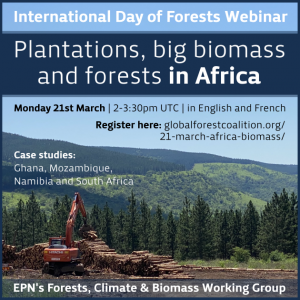
To coincide with the release of the Ngodwana case study, the Biomass Working Group’s Africa regional subgroup organised a Webinar, exploring the role of big biomass and tree plantations in Africa’s green energy transition, and the implications of this for forests and communities. Presentations looked at specific examples of plantation expansion and industrial biomass developments in four African countries, as well as taking a closer look at the Ngodwana case study.
The presentations from the Webinar are available here:
- GeaSphere (South Africa): Case study on the Ngodwana Biomass Energy Plant in South Africa, and Africa’s green energy challenge
- Civic Response (Ghana): The impacts of APSD’s eucalyptus plantations in Ghana and links to industrial-scale biomass energy
- Justiça Ambiental (Mozambique): Community struggle against plantations for pulp and paper, and links to biomass energy and forest restoration schemes
- Biofuelwatch (UK/US): Plans to export Namibian bushwood for European biomass energy – what will the impacts be?