
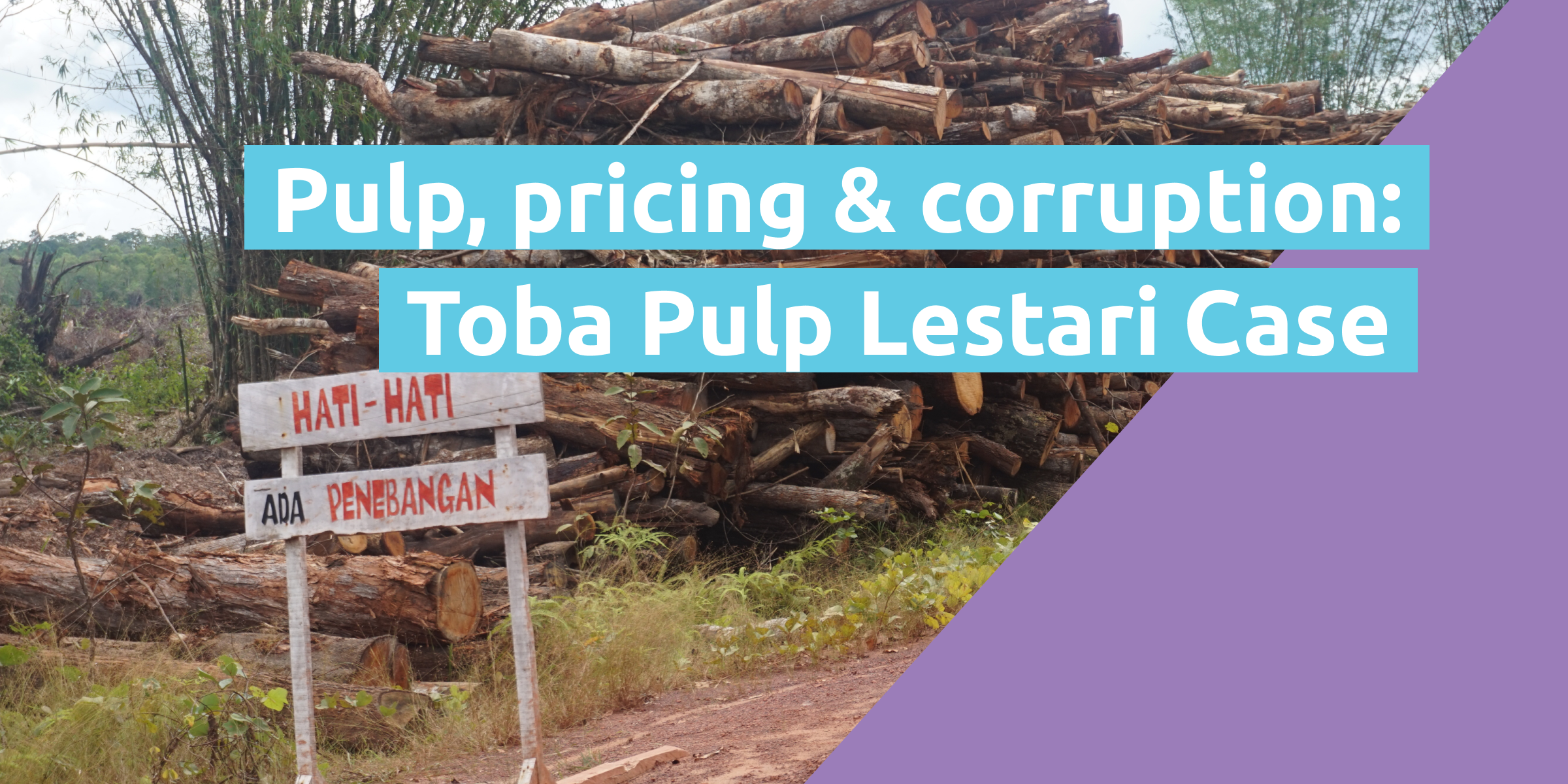
Former Toba Pulp Lestari director suspect in US$ 113.3 million transfer pricing corruption case
Jakarta, October 16, 2026 — Indonesia’s Attorney General’s Office has named Anwar Lawden, a former director and corporate secretary of the pulp & paper company PT Toba Pulp Lestari (TPL), as a suspect in an alleged transfer pricing corruption case involving transactions between 2008 and 2025. Investigators estimate that the alleged scheme caused losses of approximately IDR 2 trillion to the Indonesian state, or US$ 113.3 million.
TPL is a pulp producer operating in North Sumatra and is part of the business empire controlled by the entrepreneur Sukanto Tantoto, the owner of Asia Pacific Resources International Limited (APRIL), the second-largest paper conglomerate in Indonesia, and one of the worst deforesters in Indonesia.
While the corruption investigation concerns alleged financial and tax-related misconduct, this case points to wider questions about the social and environmental impacts of pulp production in the region.
Alleged transfer pricing manipulation
The TPL investigation case has a long history: in November 2020, a coalition of 25 civil society groups published evidence of the pulp industry’s practices of profit shifting in order to reduce corporate tax bills.
Transfer pricing manipulation refers to the deliberate setting of artificial or unfair prices for transactions between related companies within the same multinational group to shift profits from one country to another, often to reduce overall tax payments.
According to the Attorney General, investigators had questioned 116 witnesses, seized documents and electronic evidence, and obtained expert testimony from specialists in criminal law, state finance, and the pulp industry.
According to investigators, TPL allegedly facilitated exports of pulp products to an affiliated company, DP MMI, Ltd., as well as domestic sales to Asia Pacific Rayon (APR), a sister company and part of the business empire controlled by Tanoto.
According to investigators, the transactions involved under-invoicing through the manipulation of Harmonized System (HS) product classification codes. Authorities say certain products that should have been classified as dissolving pulp were allegedly classified as cheaper paper-grade pulp (hardwood kraft pulp, or BHKP). Authorities claim that the misclassification affected the reporting of transaction values and the assessment of the company’s tax obligations.
Alleged bribery of tax officials
Under Indonesia’s tax framework, TPL was required to submit to the relevant tax authorities transfer pricing documentation and corporate tax returns. These documents enable authorities to assess whether transactions between related companies comply with the arm’s-length principle, which requires prices to reflect those that independent parties would agree upon under comparable circumstances.
According to the Attorney General’s Office, TPL allegedly submitted transaction reports that did not properly reflect the underlying transactions.
Investigators further allege that TPL provided illegal payments to tax officials to prevent an accurate scrutiny of the company’s transactions. As a result, tax auditors allegedly failed to compare reported prices with the company’s transfer pricing documentation and tax returns or to verify whether the prices reflected fair market values.
The Attorney General’s Office estimates that the alleged arrangement between TPL and the tax auditors resulted in state losses of approximately IDR 2 trillion, or US$ 113.3 million. Authorities have also begun efforts to recover these alleged losses.
Legal Charges and Arrest
The former TPL director faces primary and subsidiary charges under Indonesia’s Criminal Code, alongside provisions of the country’s anti-corruption legislation.
According to the Attorney General’s Office, Anwar Lawden had previously failed to respond to an investigator’s summons. Authorities subsequently arrested him in Medan, North Sumatra, on October 15, 2026. Following his arrest, Anwar Lawden was detained and will be at the Salemba Detention Center, a facility operated by the Attorney General’s Office, for 20 days, from October 16 to November 4, 2026.
A controversial company: deforestation, land disputes and abuses of Indigenous communities’ rights
Beyond the financial investigation, TPL has faced years of criticism over disputes involving Indigenous communities and their ancestral territories in North Sumatra.
In a March 2024 article, the Environmental Paper Network highlighted the case of Sorbatua Siallagan, an Indigenous leader from the Dolok Parmonangan community who was arrested for farming on customary land questionably awarded as a forestry concession controlled by TPL. Community representatives maintained that the land was part of their ancestral territory. They had been struggling to reclaim land they considered their own, including an area of approximately 200 hectares that they said had been occupied by TPL.
In July 2024, five members of the Tano Batak Indigenous community were abducted by individuals reportedly using vehicles belonging to TPL’s security personnel. The incident occurred amid a longstanding conflict over customary land and raised concerns about the treatment of Indigenous peoples who oppose plantation expansion and seek recognition of their ancestral land rights.
Concerns escalated further in September 2025 when EPN reported allegations of violence involving TPL security personnel and Indigenous residents in North Sumatra. According to the Indigenous Peoples Alliance of the Archipelago (AMAN), hundreds of workers and security personnel allegedly entered villages in the Sihaporas area on September 22, 2025, during an ongoing dispute over customary land. The report alleged that residents were assaulted and community property was damaged.
These allegations highlight the tensions that can arise when industrial plantation concessions overlap with land claimed by Indigenous communities. For affected communities, the disputes are not simply about property boundaries: customary forests can provide food, medicinal plants, farming land, and resources essential to cultural and spiritual traditions. EPN has published a broader report about social conflict mapping that identified disputes involving TPL and numerous villages across North Sumatra.
The reports have prompted calls from environmental and Indigenous rights organisations for investigations into alleged abuses, the recognition of customary land rights, and the meaningful resolution of longstanding disputes.
The case adds to the scrutiny facing TPL, as it is the subject of longstanding criticism from environmental organisations and Indigenous rights advocates over land disputes, alleged human rights violations, and forest destruction.
TPL has also faced criticism over its environmental footprint, particularly the conversion of natural forest into plantations which supply the pulp industry.
In late January 2025, devastating floods and landslides struck Sumatra, killing at least 1,200 people and forcing more than 114,000 from their homes. Deforestation and poor land-use practices are at the root of the disaster, as the loss of forest cover and other land-use changes worsened the impacts of extreme rainfall in affected areas. As a result, TPL was among the companies affected by the Indonesian government’s January 2026 decision to revoke business permits for 28 companies operating in Aceh, North Sumatra, and West Sumatra.
In North Sumatra, these concerns have contributed to longstanding tensions between forestry businesses and local residents who seek to protect their land, livelihoods, and surrounding ecosystems.
Corporate accountability beyond the corruption Investigation
The alleged IDR 2 trillion state loss places the transfer pricing case among the major financial allegations facing Indonesia’s corporate sector. However, the scrutiny surrounding TPL extends beyond the tax investigation to longstanding disputes over land, forest management, and the violence against Indigenous communities.
The TPL case illustrates the different dimensions of corporate accountability in Indonesia’s pulp and paper sector. The transfer pricing investigation focuses on whether transactions were improperly classified or reported and whether tax officials were allegedly bribed to avoid proper scrutiny. Separately, environmental and Indigenous rights organisations have raised concerns about land conflicts, alleged violence, and the ecological consequences of plantation development.
These issues involve distinct legal questions and procedures. The legal process will determine whether the allegations against Anwar Lawden can be established in court. Separately, the concerns raised by environmental and Indigenous rights organisations point to the need for transparent investigations into the reported abuses, credible resolution of land disputes, and effective measures to address environmental damage.
Nevertheless, together they underscore the importance of transparent corporate reporting, independent regulatory oversight, effective environmental enforcement, and accessible remedies for communities affected by industrial operations.
For communities in North Sumatra, accountability involves more than financial recovery. It also concerns the protection of ancestral territories, access to forests and natural resources, and the ability to defend customary rights without fear of intimidation or violence.
As the corruption investigation proceeds, questions about corporate governance, environmental responsibility, and Indigenous rights remain part of the wider debate over the future of Indonesia’s pulp and paper industry. This also raises questions for investors, business partners, and buyers of pulp and paper products about how companies assess supply-chain risks, manage land disputes, and demonstrate compliance with environmental and human rights standards.
Back to News