
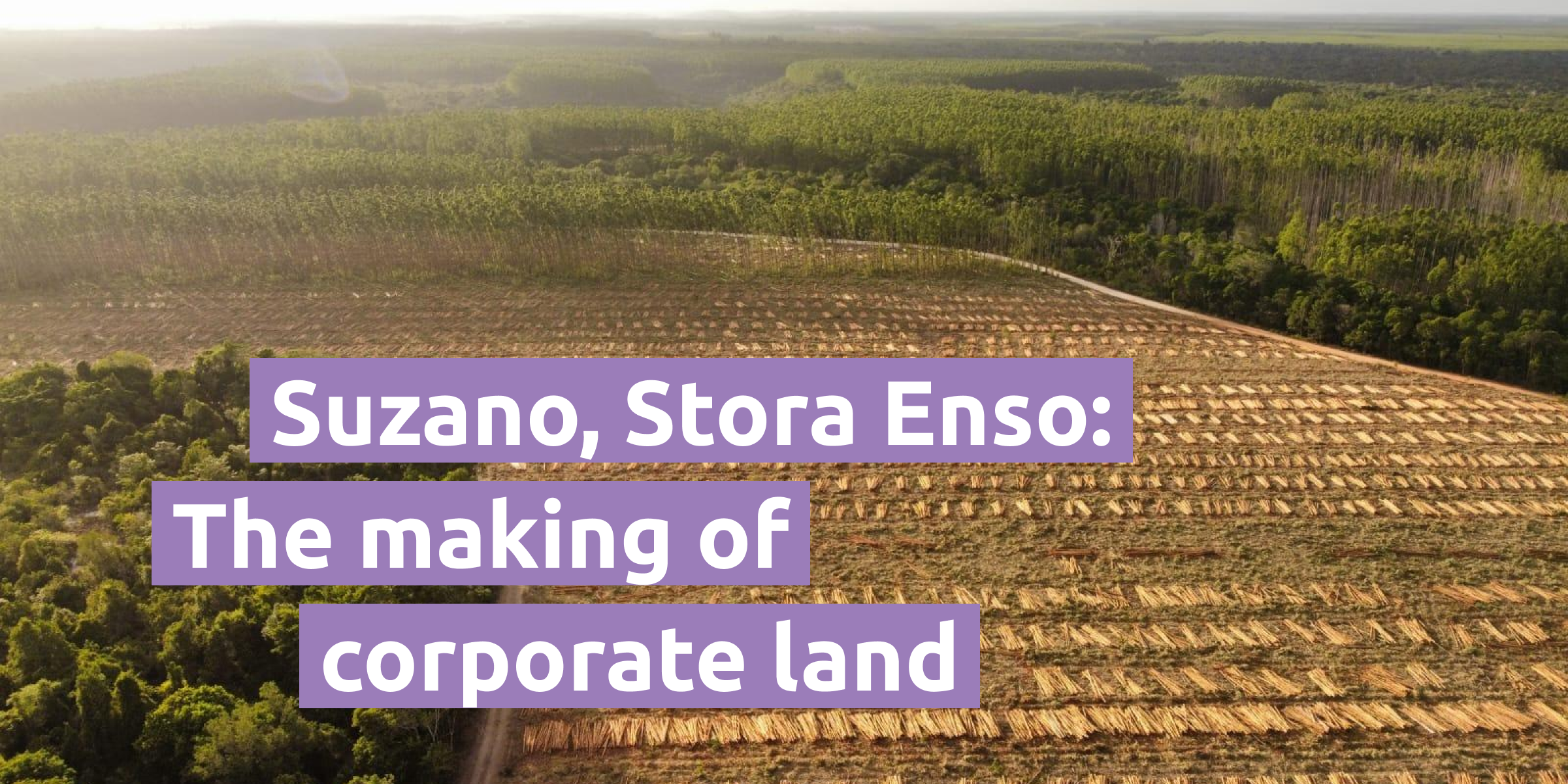
Veracel, Suzano and Stora Enso, the trajectory from land grabbing to corporate property
A recent scientific study sheds new light on the pulp & paper industry expansion in the far south of Bahia, Brazil. The research examines not only questions surrounding the origin and validity of land titles associated with the company, but also a broader process through which disputed or irregular land claims can acquire the appearance of legally established private property.
The study, “Corporate (Il)legal Enclosures: How Fraudulent Land Titles Override Community Rights in Forestry Land Conflicts in Bahia, Brazil,” was published in September 2026 in the Journal of Business Ethics and is authored by Markus Kröger, Maria Ehrnström-Fuentes and Adriana Margutti.
The findings are significant because they place the land conflicts surrounding Veracel within a wider discussion about corporate control of territory, land tenure, and the role of administrative and legal institutions in determining an extensive process of land grabbing.
Land grabbing and the consolidation of corporate territory
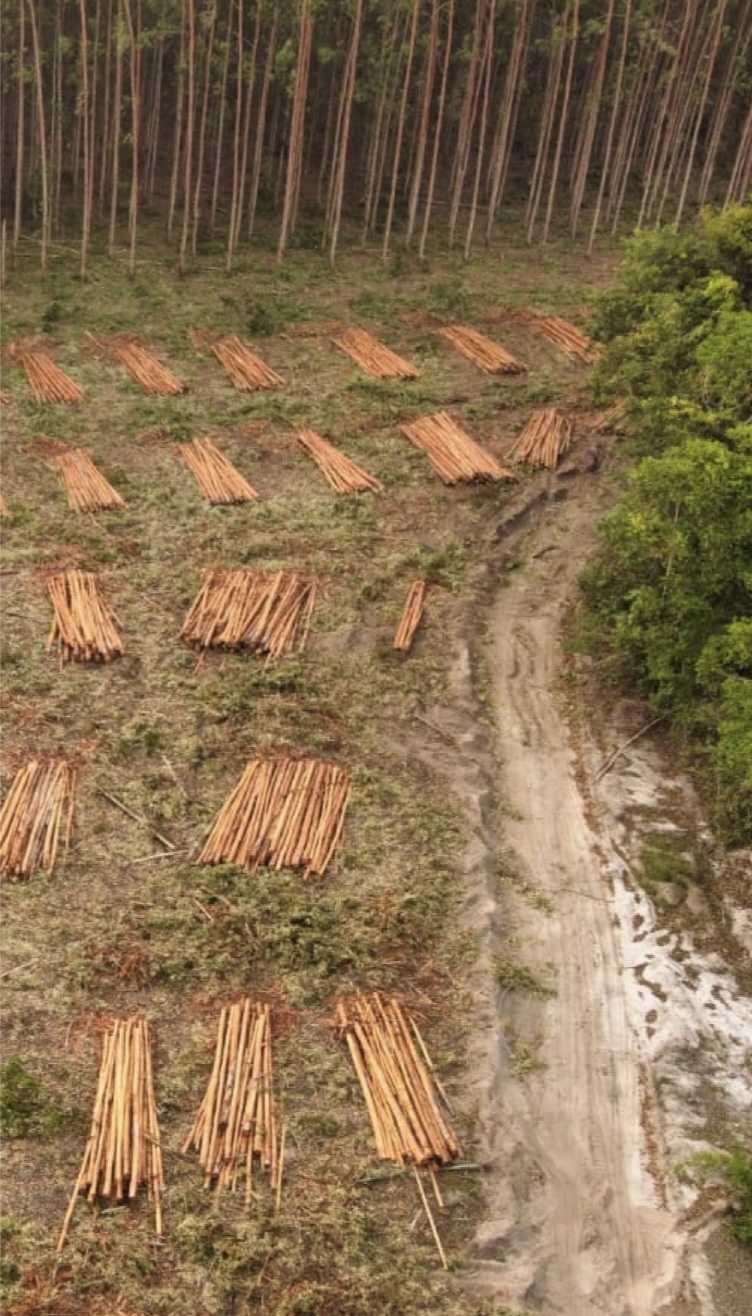
Eucalyptus plantations, Bahia – © Pataxò
The researchers examined documentation relating to land claims associated with Veracel, a paper company controlling a pulp mill and an extensive land-bank, more than 200,000 ha, developed on eucalyptus plantations in the far south of Bahia. Veracel was established as a joint venture between Brazilian pulp producer Suzano and the Swedish-Finnish forestry group Stora Enso.
The company claims to adhere to principles of legality, sustainability and respect for community rights, however the study identified a number of irregularities in land records owned by Veracel. This is not a minor problem. In Brazil, land tenure is very fragile and often disputed. Already in 2001, Brazil’s Ministry of Agrarian Development estimated that on a national scale, 100 millions ha of land (12% of all plantable land in Brazil) had been acquired using forged land certificates. In August 2020, a second-instance ruling was issued against Veracel in a case concerning property rights. In 2023, the Public Prosecutor’s Office in Bahia investigated an alleged scheme involving company employees who were reportedly tasked with registering public land in the names of small-scale farmers, after which the land was subsequently transferred to the company. Against this complex background, irregularities surrounding property titles suggest that a deeper investigation is urgently needed.
The records examined in the study include discrepancies between the locations described in documents and the land actually claimed, differences in the areas recorded in various documents, and the apparent lack of a consistent chain of title—the documentary sequence intended to demonstrate how ownership of a property was transferred over time.
The significance of these findings goes beyond individual documents. According to the study, questionable or fraudulent titles can enter administrative and judicial processes and, through repeated use within those systems, acquire increasing institutional recognition. The authors describe this process as “corporate (il)legal enclosure.”
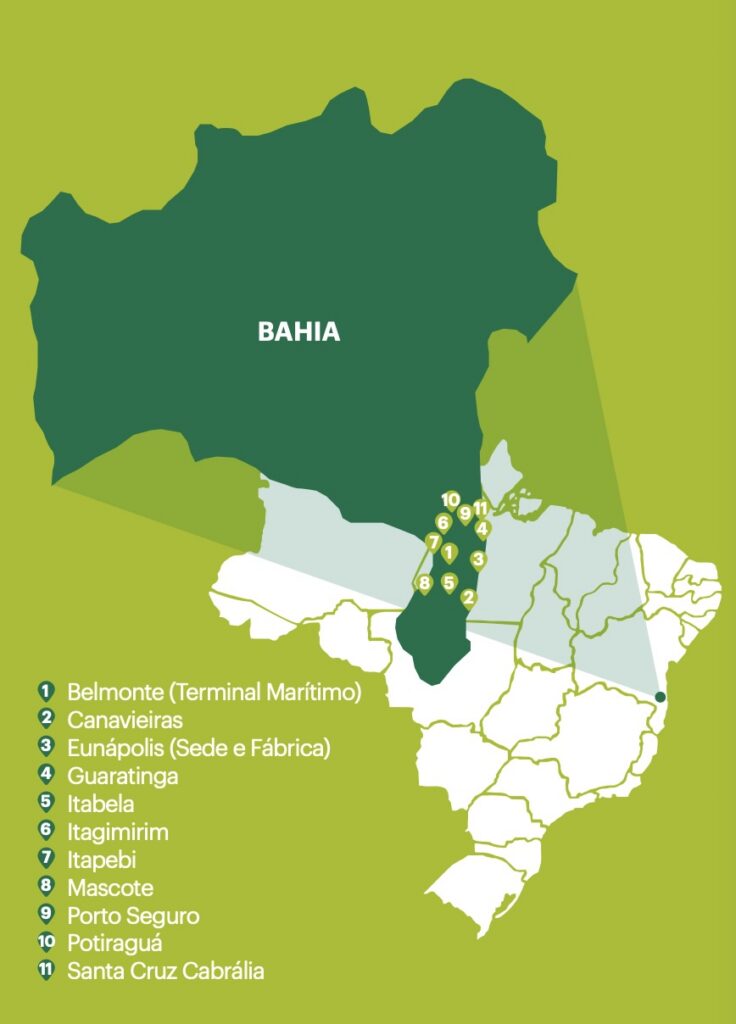
Impacted areas by Veracel – © Veracel
The concept draws attention to the interaction between formal legality and practices that may have originated in violation of land-tenure rules. A disputed claim does not necessarily cease to be contested simply because it is documented. Rather, documentation can itself become part of a longer process through which a claim is presented, processed and eventually treated as evidence of private ownership.
This is particularly relevant in regions where land tenure has historically been shaped by concentrated ownership, disputed boundaries, incomplete records and the systematic appropriation of public or community-held lands.
Large corporations have considerable legal, financial and administrative resources. These resources can enable companies to pursue claims through state institutions and legal proceedings over extended periods, potentially changing how contested claims are treated and understood.
The issue is therefore not simply whether a particular document is valid or invalid. It is also about the institutional processes through which documents are interpreted, challenged or rather accepted and incorporated into subsequent records.
From questionable title to apparently legitimate property
The land in the far south of Bahia is marked by a story of extensive conflicts with the indigenous Pataxó people, accusing Veracel of being co-responsible for the ongoing destruction of their ancestral territory and claiming their traditional land back. And yet, their claims are not being met by the authorities, despite being in principle recognized by the Constitution. Land titles are part of this.
One of the study’s key conclusions relates to how allegedly fraudulent or problematic titles enter into official systems. Once a document becomes part of administrative records, registration procedures or court proceedings, it can acquire a degree of institutional credibility. Over time, this can make the original circumstances surrounding the claim increasingly difficult to reconstruct or challenge. Land that was once subject to community claims, public ownership, or unresolved tenure disputes may eventually appear in official or corporate records simply as private property. The historical and legal disputes surrounding its acquisition can become less visible as subsequent transactions, registrations and institutional decisions build upon earlier documentation. This is particularly consequential in the context of large-scale forestry. Once land becomes part of a company’s productive territory, its economic value and strategic importance can reinforce the corporate interest in maintaining the status quo.
A local land conflict with global implications
The Veracel case also illustrates why land conflicts in Bahia cannot be viewed solely as local disputes. Through its parent companies, Suzano and Stora Enso, Veracel is embedded in the global pulp and paper industry and in international supply chains. Decisions concerning land use, the management of eucalyptus plantations, and industrial production in Bahia therefore have implications that extend far beyond the communities directly affected by these territorial disputes. Moreover, the power and influence of large corporations transcend beyond local dynamics, shaping land-use practices at a wider scale.
The case raises a broader question about the responsibilities of multinational corporations operating in countries where land-tenure systems have historically been marked by abuse and inequality, incomplete documentation and disputes over the appropriation of public and community lands.
This highlights the importance of transparency and independent scrutiny of corporate land holdings—not only at the point when land is acquired, but throughout the processes through which ownership claims are registered, consolidated and defended, especially as these holdings are supported with public money, both from Brazilian and multilateral financial institutions.
How is it possible for companies whose land tenure is so opaque and contested to claim full adherence to the highest standards of corporate social responsibility (CSR), and be rewarded for this with customer preference, access to green credit, and lavish loans on favourable terms?
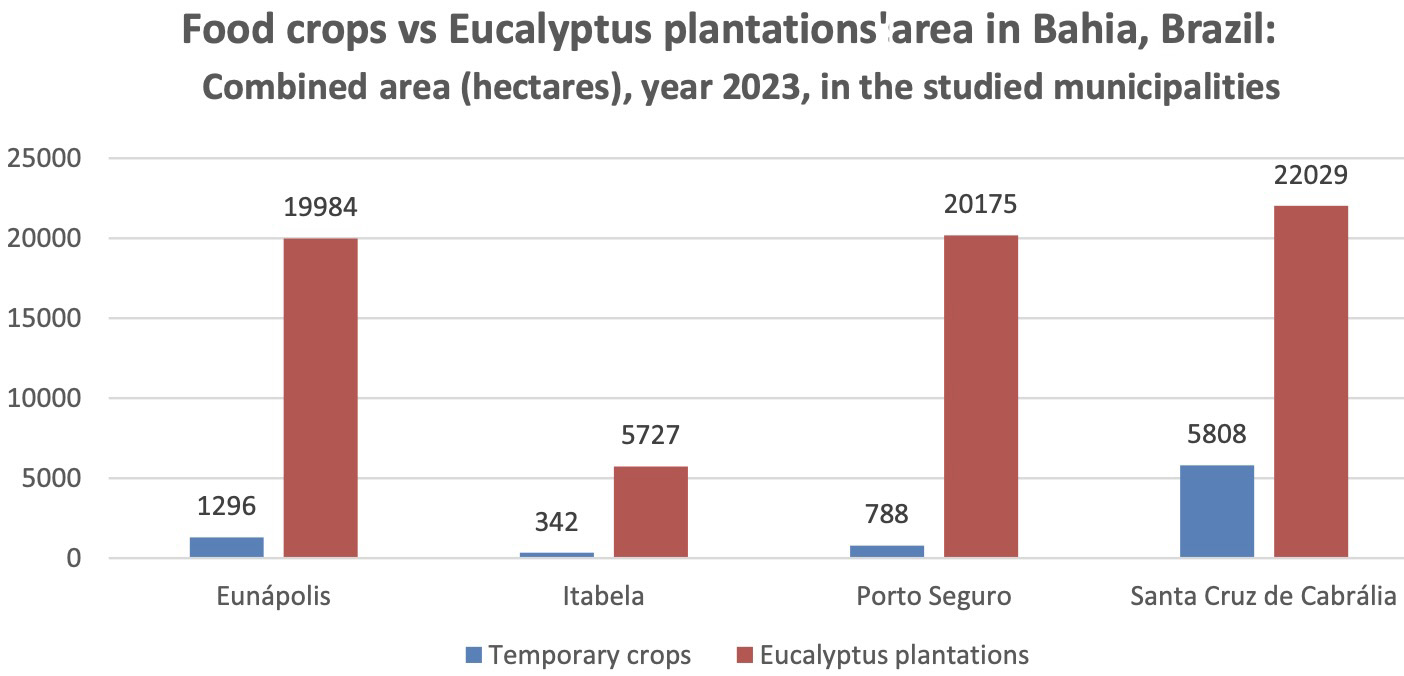
Food crops vs Eucalyptus plantations’ area in Bahia, Brazil © Markus Kröger et Al.
The study’s findings also raise the question of how does a contested land claim become recognized as property, and how do the institutions involved contribute to that transformation? For communities affected by land conflicts, this is a highly relevant question. A document that appears authoritative today may have a much more complicated history. And once that history has been incorporated into successive administrative, legal and commercial processes, challenging the resulting property claim can become considerably more difficult.
The Veracel case, as examined by Kröger, Ehrnström-Fuentes and Margutti, therefore offers an important lens through which to examine the relationship between corporate power, land tenure and the production of legality.
It also raises a fundamental question for policymakers, civil society and investors: when land becomes recognized as corporate property, what histories of ownership, dispossession and community rights remain visible—and which ones disappear from the record?
Back to News