
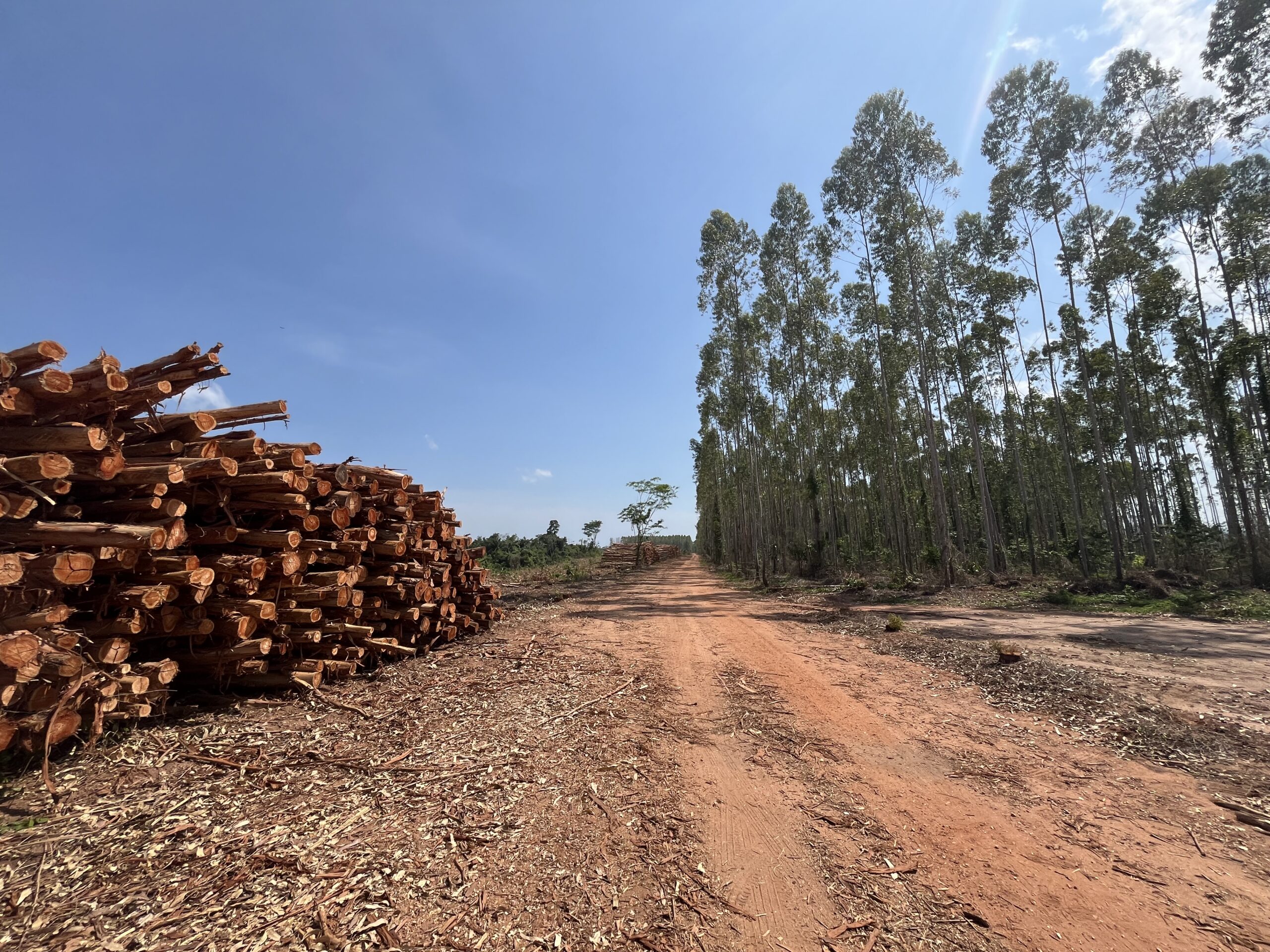
A new investigation into Aperam BioEnergia’s eucalyptus plantations, charcoal and biochar production in Brazil’s Upper Jequitinhonha Valley documents decades of land dispossession, water depletion, Cerrado destruction and conflict, challenging the idea that this industrial model represents a genuine climate solution.
The Global Forest Coalition (GFC), together with Biofuelwatch, EPN’s Biomass Action Network and the Hands Off Mother Earth (HOME) Alliance, is launching Dry Streams in an Ocean of Eucalyptus: Aperam BioEnergia’s Green Steel and Carbon Removal Illusion, a new investigation into the social and environmental impacts of Aperam BioEnergia’s operations in Minas Gerais, Brazil.
Based on field research and interviews with traditional and Quilombola communities, as well as research and information from public officials and experts, the report examines how Aperam’s large-scale eucalyptus plantations have transformed the landscapes and livelihoods of communities in the Upper Jequitinhonha region. It also examines the company’s charcoal production and emerging biochar and carbon-removal business, questioning the use of “green steel”, “biochar” and “carbon removal” to present an extractive industrial model as climate action.
Disappearing water, disappearing forests
Aperam manages around 150,000 hectares in Minas Gerais, approximately two-thirds of which is covered by eucalyptus plantations. Much of this plantation landscape was established from the 1970s onwards on lands traditionally used by local chapadeira-groteira and Quilombola communities.
The consequences have been profound. Native vegetation on the Chapada das Veredas plateau fell from 86.1% in 1973 to just 24.6% in 2018, while communities have lost areas traditionally used for grazing, gathering, fishing and collecting wood.
Water is now one of the most urgent concerns. A 2019 survey found that 89% of local springs had dried up, while research cited in the report found that water tables fell by approximately 4.5 metres between 1974 and 2019. Eucalyptus plantations on the Chapada das Veredas alone are estimated to consume 31.9 billion litres of water each year. The impacts are particularly gendered, with women often bearing primary responsibility for securing water for their households.
From ‘green steel’ to carbon removal
Aperam produces more than 420,000 tonnes of charcoal each year from its eucalyptus plantations to supply its steel production. The company has also developed a biochar business and sells carbon-removal credits based on charcoal fines.
The report challenges the idea that turning these materials into “carbon removal” products makes the underlying industrial system a climate solution. Questions remain around carbon permanence, emissions from production and potential pollutants, while carbon markets risk giving new financial and environmental value to a system that continues to consume land and water and undermine community rights.
Expansion backed by international finance
Despite these concerns, Aperam is planning further expansion with international financial backing. In February 2025, the company signed a €250 million financing package, including up to €150 million from the International Finance Corporation (IFC), to support the acquisition of 42,600 hectares and the expansion of charcoal production, kilns, bio-oil and seedling production.
The IFC itself recognised that the project could generate “significant adverse” environmental and social risks that could be “diverse and irreversible”. Meanwhile, a federal investigation was opened in Minas Gerais in August 2026 into the socio-environmental impacts of Aperam’s eucalyptus expansion.
Communities are demanding a different future
The report centres the experiences and demands of the traditional and Quilombola communities living alongside Aperam’s plantations. Communities are calling for the return and restoration of their traditional lands, restoration of the veredas and native Cerrado, secure access to water, and support for agroecology and community-led livelihoods. Women and community organisations are already demonstrating the possibilities of a different future, including through initiatives focused on territorial rights, livelihoods and economic independence.
Our calls
GFC is calling on governments, financiers, certification schemes and global buyers to stop supporting the expansion of Aperam’s plantation and carbon-removal model and instead support justice and ecological restoration.
In particular, we are calling for:
- An immediate halt to Aperam’s expansion, including further acquisition of traditional and Quilombola lands.
- Independent investigation and accountability for historical land acquisition, environmental impacts and alleged rights violations, alongside recognition and restitution of traditional and Quilombola territories.
- The restoration of critical water recharge areas, veredas and native Cerrado ecosystems, and measures to address water depletion.
- Suspension of financial support and investment until existing harms are remedied and environmental and social safeguards are independently demonstrated to have been met.
- Suspension of relevant sustainability certifications pending transparent investigation and meaningful in-field verification of community concerns.
- A shift in investment towards community-led restoration, agroecology, water security and community livelihoods, rather than further industrial monocultures and carbon-market schemes.
The case of Aperam is part of a much wider challenge facing climate action. Industrial plantations, biomass, “green steel” and carbon removal are increasingly being presented as solutions to the climate crisis, while the land, water and communities affected by these models continue to bear the costs.
Real climate action requires reducing emissions at source, protecting and restoring native ecosystems, and supporting the rights, livelihoods and leadership of the communities who depend on them.
📖 Download the full report:
(EN) Dry Streams in an Ocean of Eucalyptus: Aperam BioEnergia’s Green Steel and Carbon Removal Illusion
(PT) Córregos secos em um oceano de eucalipto: o aço verde e a ilusão da remoção de carbono da Aperam BioEnergia