
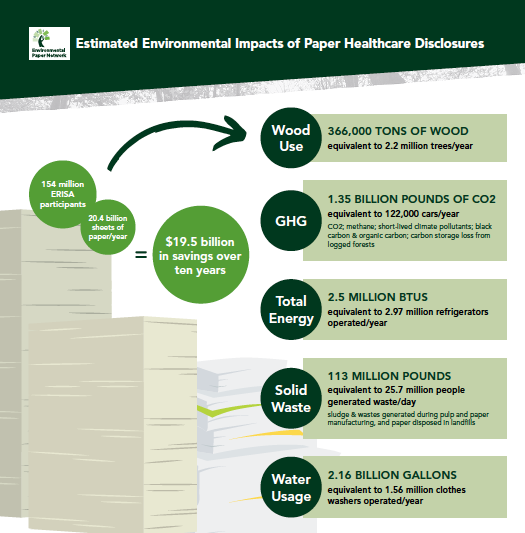
A new Environmental Paper Network analysis finds that modernizing outdated ERISA health plan disclosure rules by allowing electronic delivery by default, while preserving consumers’ right to receive paper communications, could save the equivalent of 366,000 tons of wood (more than 2 million trees) every year, reduce more than 1 billion pounds of greenhouse gas emissions, conserve over 2 billion gallons of water, and save employers and health plans $19.5 billion over the next decade.
Every year, outdated federal rules require employers and health plans to print and mail more than 20 billion sheets of paper to participants in employer-sponsored health plans. While these disclosures contain important information, the decades-old rules governing how they’re delivered have failed to keep pace with the digital age.
EPN’s new policy brief, Modernizing ERISA Health Plan Disclosure Rules for the Digital Age, examines how a simple update to these rules could generate significant environmental, economic, and consumer benefits. Allowing electronic delivery by default for ERISA health plan disclosures could save employers and health plans $19.5 billion over the next decade, and EPN’s analysis shows this policy would conserve the equivalent of 2.2 million trees and 2.16 billion gallons of water every year, reduce 1.35 billion pounds of greenhouse gas emissions annually, all while preserving every participant’s right to receive paper communications if they prefer.
At Environmental Paper Network (EPN), we believe paper is a valuable resource that should be used wisely. That’s why we work to transform how paper is produced and consumed, including by advancing policies that eliminate unnecessary paper use while preserving paper where it adds value. Modernizing outdated federal paper mandates is one important way to advance that mission.
An Outdated Policy Ready for an Update
The Employee Retirement Income Security Act (ERISA) regulates employer-sponsored health and retirement plans covering approximately 154 million Americans. To protect participants, employers and health plans are required to provide a variety of notices and disclosures throughout the year.
Current Department of Labor regulations generally require health plan disclosures to be delivered on paper by default, with electronic delivery permitted only under limited circumstances. As a result, employers and health plans print and mail more than 20.4 billion sheets of paper every year, spending an estimated $2.8 billion annually on printing, postage, and mailing.
Fortunately, the solution is straightforward.
In 2020, the Department of Labor adopted a safe harbor rule allowing ERISA retirement plan disclosures to be delivered electronically by default while preserving participants’ ability to receive paper copies at no cost. Extending that same framework to ERISA health plan disclosures would modernize a decades-old policy while maintaining paper as an option for those who prefer it.
Better for Participants and Employers
Modernizing ERISA health plan disclosures provides people with greater flexibility while making communication more efficient.
A nationally representative survey found that nearly eight in ten employees enrolled in ERISA-covered health plans would prefer electronic delivery by default, provided they retain the option to receive paper communications whenever they choose. Electronic delivery also makes important plan information easier to access, search, store, and retrieve when it’s needed most.
The financial benefits are equally compelling. A 2025 analysis estimates that allowing electronic delivery by default for ERISA health plan disclosures would generate $19.5 billion in savings between 2025 and 2034, or roughly $2 billion each year. Those savings would primarily come from reducing the need to print, process, and mail billions of paper disclosures, allowing employers and health plan administrators to direct more resources toward serving participants.
An Opportunity to Reduce Paper’s Environmental Footprint
Using paper wisely means reducing unnecessary consumption where effective digital alternatives already exist. ERISA health plan disclosures represent one of the clearest opportunities to achieve that goal.
Using EPN’s Paper Calculator™ Version 4.1, we estimated the environmental impacts associated with the paper currently required for ERISA health plan disclosures. The results demonstrate that a relatively simple policy update could deliver substantial environmental benefits every year, including:
- Saving the equivalent of 2.2 million trees
- Conserving 2.16 billion gallons of water
- Preventing 1.35 billion pounds of greenhouse gas emissions, equivalent to removing approximately 122,000 passenger vehicles from the road for one year
- Eliminating 113 million pounds of solid waste
The policy change would also reduce emissions of hazardous air pollutants, particulate matter, sulfur dioxide, volatile organic compounds, and other pollutants associated with paper manufacturing. These are meaningful environmental gains achieved through a simple policy update that preserves consumer choice.
A Commonsense Next Step
Modernizing ERISA health plan disclosure rules is a practical reform whose time has come.
It builds on a successful framework already in place for retirement plans. It reflects how people prefer to receive information today. It reduces unnecessary costs for employers and health plans while conserving forests, water, energy, and other natural resources. It also preserves every participant’s right to continue receiving paper communications at no cost.
Modernizing ERISA health plan disclosures is a rare opportunity to deliver environmental, economic, and consumer benefits through a single, commonsense policy change. By extending the Department of Labor’s existing e-delivery safe harbor from ERISA pension plans to ERISA health plans, policymakers can modernize decades-old regulations while reducing costs, conserving natural resources, and improving how millions of Americans receive important health plan information.
To learn more, read EPN’s policy brief, Modernizing ERISA Health Plan Disclosure Rules for the Digital Age, for the full analysis of this opportunity and its environmental, economic, and consumer benefits.
Back to News