
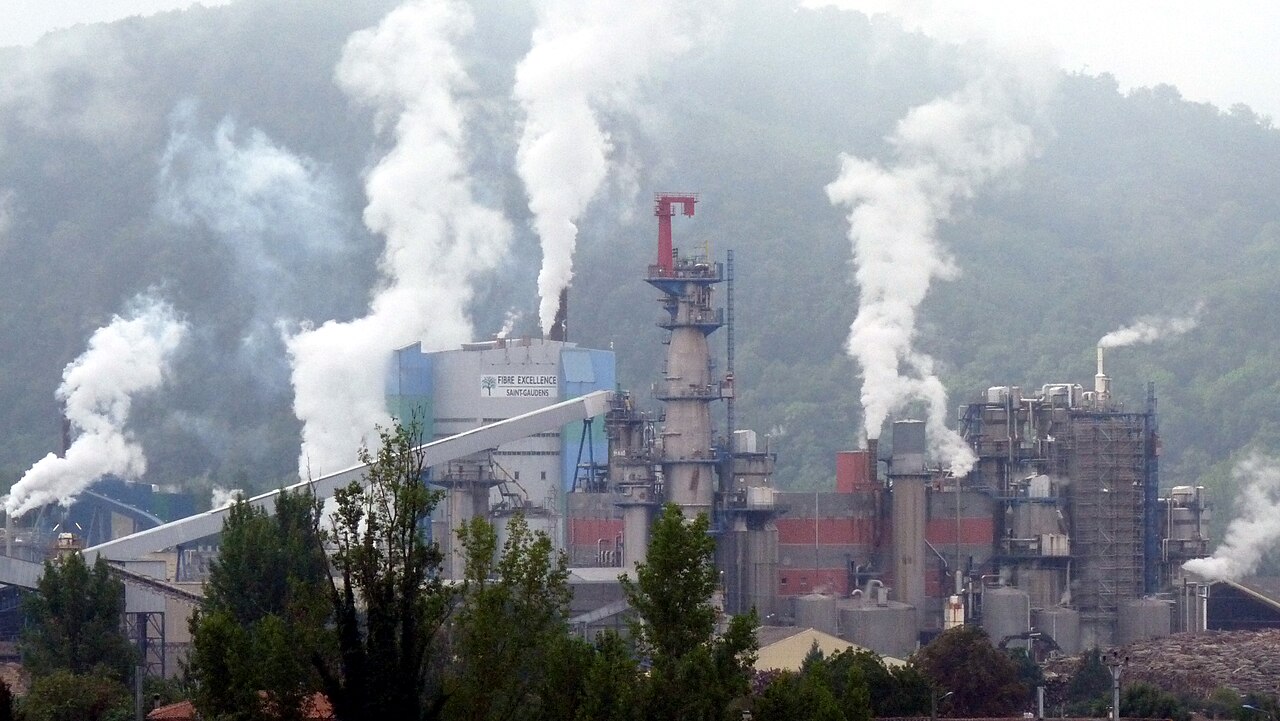
Cellulose factory in St Gaudens (France). © Jean Paul Alandry, Wikipedia Commons Licence.
The largest remaining pulp company in France, Fibre Excellence, has filed for bankruptcy and its fate will be known soon. Wood market distortions created by bioenergy subsidies have destroyed the company’s inefficient bioelectricity business, and the French State has been asked to bail it out. The drama echoes previous efforts to game governments undertaken by the company’s owner, Indonesian billionaire Jackson Wijaya – possibly the most powerful pulp and paper businessman in the world. While the company’s workers, the many foresters selling it wood, and the pulp industry in France are left wondering about their future, the French government is being asked to give more bioenergy subsidies to the company to compensate for damage caused by its bioenergy subsidies policy!
This is an absurd situation: it would make more sense to phase out bioenergy subsidies across the board, thereby reducing wood market distortions. Behind the individual company’s woes and the uncertain fate of its workers and suppliers, public decision-makers need to answer difficult questions: how can a just transition be found for the pulp and paper sector, and, more broadly, the forestry sector? Couldn’t wood – and public funds – be better used?
The pulp and paper industry is facing serious challenges, despite the considerable and excessive financial and political support it benefits from in the EU.
Fibre Excellence, and its two factories in Saint-Gaudens (Pyrénées) and Tarascon (Provence), is the largest of the remaining pulp companies operating in France, employing 670 workers. Its pulp is used by customers to produce writing paper, hygiene products, specialty papers and packaging, and it also produces electricity in installations burning its by-products (mainly bark and black liquor). The Tarascon factory is nicknamed the “stinking factory” in the region, and has been controversial for the toxic air and water pollution it has been causing, as well as for not paying its pollution fines and duties. The Saint-Gaudens factory has, however, been investing to reduce its air and water pollutant emissions in the past years, as has the Tarascon factory to some extent.
Using about 2.5 million tonnes of wood a year, Fibre Excellence is a major buyer of roundwood in France. The French wood industries trade association estimates that the company’s purchases indirectly support 10,000 jobs in the regional forestry sector.
As the EU has maintained a zero-tariffs policy on raw pulp imports since 2004, Fibre Excellence is directly exposed to international competition. The company has been making headlines for months because of its increasingly uncertain future. While it still reported profits in 2024, 2023, and 2022, it claims to have incurred a €30 million loss in 2025 (the company had not published its official accounts for 2025 at the time of writing). On 27 April 2026, the Toulouse Court of Commerce put it under bankruptcy proceedings for 6 months after the company’s owner since 2010, Domtar (formerly Paper Excellence), refused to inject more capital in the company despite financial support proposals by the French State. The company’s management is now searching for a new investor.
The Domtar group, also owned by Jackson Wijaya, is one of the largest pulp and paper companies in the world, controlling over 22 million hectares of forest in Canada and operating over fifty pulp and paper mills in Canada and the United States.
In addition, in 2024, Wijaya inherited the company Asia Pulp and Paper (APP), also one of the largest in the world, thereby creating possibly the largest global group in the pulp and paper industry. APP and its parent group Sinar Mas have long been plagued by accusations of environmental destruction, deforestation and human rights abuses, and were expelled from the Forest Stewardship Council (FSC) in 2007. Investigations in 2023 showed that Fibre Excellence/Domtar and APP were in fact very closely linked, maintaining a facade of being distinct companies through complex offshore holdings to enable the Wijaya family to access the more regulated North American and European pulp markets, but actually sharing strategies and having integrated supply chains.
Bioenergy subsidies artificially push wood prices up
The main reasons invoked by Fibre Excellence’s management for the company’s recent woes are a 50% jump in industry wood prices since 2021 and the start of Russia’s war against Ukraine, a 20% decrease in pulp prices since mid-2024 after an all-high in September 2022, lower European demand for pulp since the Spring of 2025, and the market distorsions from subsidised biomass installations for energy production from wood burning, as these can pay higher prices for the wood feedstocks Fibre Excellence typically sources from.
Independent sources confirm that industry wood prices remained high in France over the 2021-2025 period due to competition from the bioenergy sector, which can also use the pulp and paper industry’s typical woody biomass feedstocks (including chips, sawdust, and other forestry and processing residues).
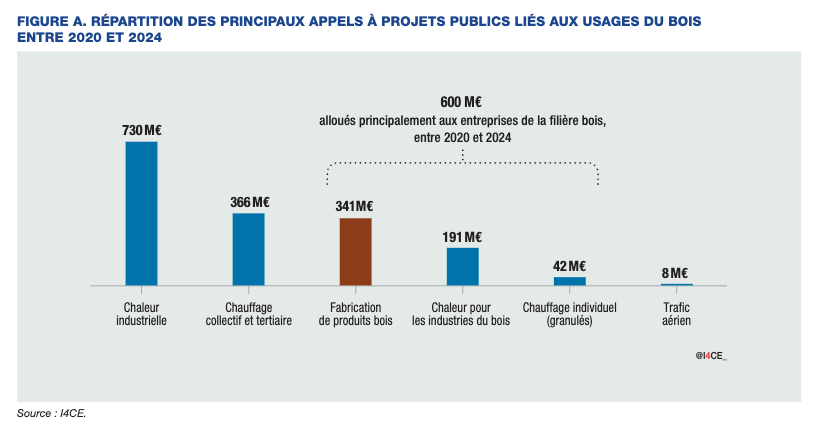
In France, since 2020, nearly €1.3 billion has been spent by public authorities to support energy production from wood burning, mainly heat, representing about 80% of the total public support to wood-using industries in the country. In comparison, only 341 million was spent on material uses of wood. Source: I4CE
The proportion of the traded wood harvest in France going to bioenergy grew from 40% in 2007 to 49% in 2022 (to which one must add informal wood harvesting for residential heating, for which there is no data).
The bulk of the support goes to hundreds of smaller bioenergy units, subsidised by France’s Renewable Energy Agency ADEME for heat production but also to a few large units. The largest example is Gazel Energie, a subsidiary of the giant Czech energy company EPH, operating the 150 megawatt (MW) Gardanne biomass and coal power plant near Marseille, Provence. The company obtained an extraordinarily high guaranteed power purchase agreement from the French government in December 2024: between €250 and €260/MWh (for maximum 4000 hours of production per year), more than four times the annual average price for electricity that year (€58/MWh).
In comparison, Fibre Excellence has had guaranteed power purchase prices of 120 and 105 €/MWh in Saint-Gaudens and Tarascon. Reported external revenue from power sales represented about 11% of the company’s turnover in 2024.
The company’s management has been urging the French government to replicate the Gardanne precedent and massively increase the power purchase price guarantee, to at least €180/MWh, as per its estimated current production costs, currently about three times higher than the market average.
Despite the considerable price difference, the French government accepted a 20% increase, as long as this covers the company’s financial needs until 2030.
But this proposal was deemed insufficient by Domtar, and Fibre Excellence filed for bankruptcy. One can expect that any new investor interested in buying the company will try to obtain new financial support commitments from the French public authorities, some of whom have been very vocal in pledging their support.
Does it make sense for French public authorities to inject more bioenergy subsidies to keep afloat Fibre Excellence’s electricity production, when its prohibitive production costs are partly caused by the same government’s own policy to subsidise biomass installations across the country? Wouldn’t it make more sense to stop bleeding French taxpayers and end bioenergy subsidies across the board to stop artificially pushing wood prices up, and for such an inefficient use?
Gaming governments
Another, less reported angle to the story is that several of Wijaya’s companies, including Fibre Excellence, have already claimed to experience economic hardship despite massive public support from governments, and ended up filing for bankruptcy and thereby not paying their debts.
For instance, in 2020, the Tarascon factory filed for bankruptcy, with its current owner (then called Paper Excellence) already refusing to bring more capital to save the company and to pay the considerable fines it owed to the French State for pollution – as well as the debts it owed to its parent companies, themselves the property of Paper Excellence. The French state had lent €8.6 million to the company to help it survive, and supported the building of its bioelectricity installation to the tune of €20 million.
But Paper Excellence then used exceptional COVID legislation to buy its own subsidiary afresh, without its €108 million debt! The French State justified its support by mentioning the major role this factory had in the regional forestry economy.
In Canada, where it is the largest pulp and paper in the country, Paper Excellence/Domtar has seemingly used the same “jobs blackmail” and debt nesting playbook. Despite receiving CA$200 million in subsidies and tax rebates from the government between 2020 and 2024, it permanently closed three pulp mills over that period and only maintains 11 of its 16 mills in the country. In 2021, when it spent CA$3 billion in an “all-cash transaction” to purchase US pulp company Domtar, Paper Excellence was at the same time refusing to support its subsidiary Northern Pulp and seven others in Nova Scotia, all declaring themselves “insolvent” and unable to repay the large loans given by the local government to the company supposedly for technical improvements to pollution control equipment and keeping rural jobs.
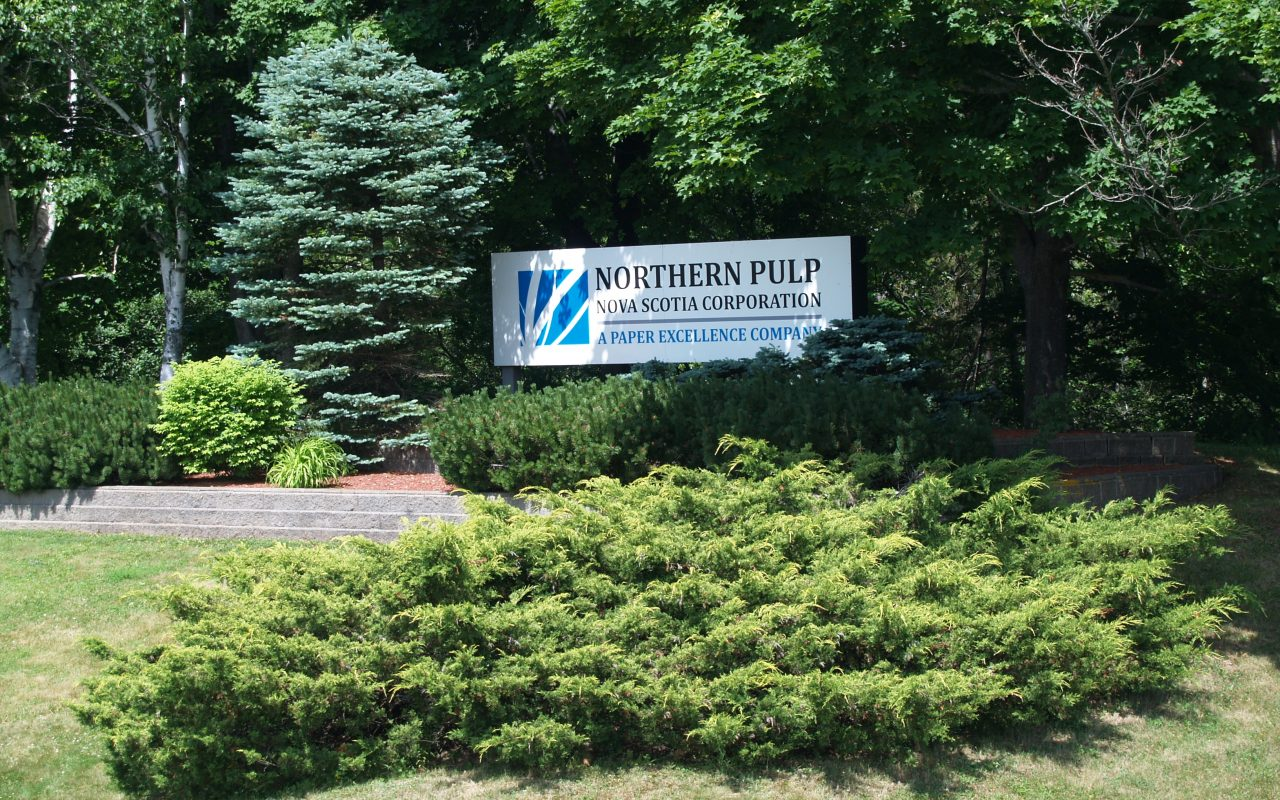
The Northern Pulp company, a subsidiary of Domtar in Canada, closed down despite governmental support. ⓒ Joan Baxter
In 2012, APP defaulted on a CA$13.9 billion debt and failed to uphold environmental commitments made as part of its debt restructuring, including commitments related to logging primary forests for its pulp mills.
On June 4, Fibre Excellence’s management submitted a takeover bid to the Toulouse Commercial Court after no external buyer came forward. The offer, filed on 1 June, covers all of the group’s industrial and forestry assets and its entire workforce. They propose to create a new company to acquire all the group’s assets and retain the workforce, which would be underpinned by a shareholders’ agreement involving (yet undisclosed) private investors alongside public stakeholders, including France’s Occitanie and Sud regions. The offer comes with high demands of the French government: “a feed-in tariff for electricity generated at its sites that reflects actual production costs; secured access to at least 25% of public timber supplies; and reintegration into the European CO₂ quota system.” No industrial investor seems to have come forward, the company’s management arguing that a deal with the French state is needed first to secure the company’s competitiveness and attract those. The French government has so far been reluctant. Toulouse’s Commercial Court stated they would rule on the company’s future on July 6th. Considering Wijaya’s track record, strict scrutiny will be needed to ensure future investors are not linked to the billionaire’s group. On June 16, Mathieu Pigasse, a well-known French left-leaning banker and potential candidate to the 2027 presidential elections, expressed support for Fibre Excellence’s management’s offer, bringing new hope to the company workers.
What future for the pulp and paper industry in France?
Ending bioenergy subsidies
To try and save the company, its workers’ trade unions had developed plans to invest into new specialty uses, “fluff” pulp in Saint-Gaudens (for diapers) and highly resistant pulp in Tarascon. They also supported their management’s demands to increase the electricity purchasing price, as they are looking for any solution that could save their jobs: nationalising the company, regulating wood prices, and/or temporary financial support from the government.

Fibre Excellence Saint Gaudens workers protesting against the company’s closure, January 2026. ⓒ NPA
Despite the damages they have been inflicting on people and forests for decades, it has become difficult for pulp and paper industries to remain competitive in Europe. European pulp producers have among the highest wood costs in the world and bioenergy subsidies are worsening the situation; energy costs are high (although pulp mills typically produce a lot of their energy needs on-site by burning processing residues); and they’re not protected against unfair international competition (Brazilian pulp is the cheapest on the planet in part thanks to horrendous growing practices in monoculture genetically modified eucalyptus plantations). Gascogne Papier, another large pulp and paper producer in France’s South-West, is also experiencing economic hardship (€20 million loss in 2024). The sector has recently called on the EU to stop direct bioenergy subsidies.
This begs larger questions which the French government, and many other EU governments, are facing: how to organise a fair transition for the pulp and paper sector to deliver higher-quality products (fast packaging provides low margins) in a way that is socially and environmentally more sustainable? Would implementation of the EU Deforestation Regulation help protect European pulp companies against unfair competition? If a deal is found and the French government accepts a higher level of public support to Fibre Excellence, how can they ensure that the company operates in a more environmentally sustainable way, that also reduces health impacts on its neighbours? The bioenergy subsidies have created a dependency in the company and this cannot be sustainable economically: what will become of the workers in the long run?
Supporting higher added value wood chains, diversification, and forest restoration?
The French government had offered a €150 million support package to Fibre Excellence to avoid bankruptcy. While this was refused by Domtar as insufficient, this kind of money could support the development or modernisation of several dozen local sawmills. Shifting wood use from pulp to sawnwood and downstream industries increases value per unit of timber and supports more jobs in rural economies. With a favourable policy environment – including procurement, trade, and incentive alignment – such an investment would diversify economic and strategic risks, and strengthen long-term resilience compared to concentrating funds in a single pulp producer. It would also encourage closer-to-nature management and reduce pressure for high-volume extraction.
The €150 million could also be directed to the Office National des Forêts (ONF), the agency managing France’s public forests, and be used for restoration. Investing in ONF’s field staffing would address employment and ecological challenges simultaneously.
Every forest is different and so are the economic activities in and around it: rather than pushing for constant homogenisation for economies of scale, which increases fragility, the challenge all decision-makers face today is how to increase resilience and robustness in forests and forest-based industries. Like in nature, this will have to come from diversity.