
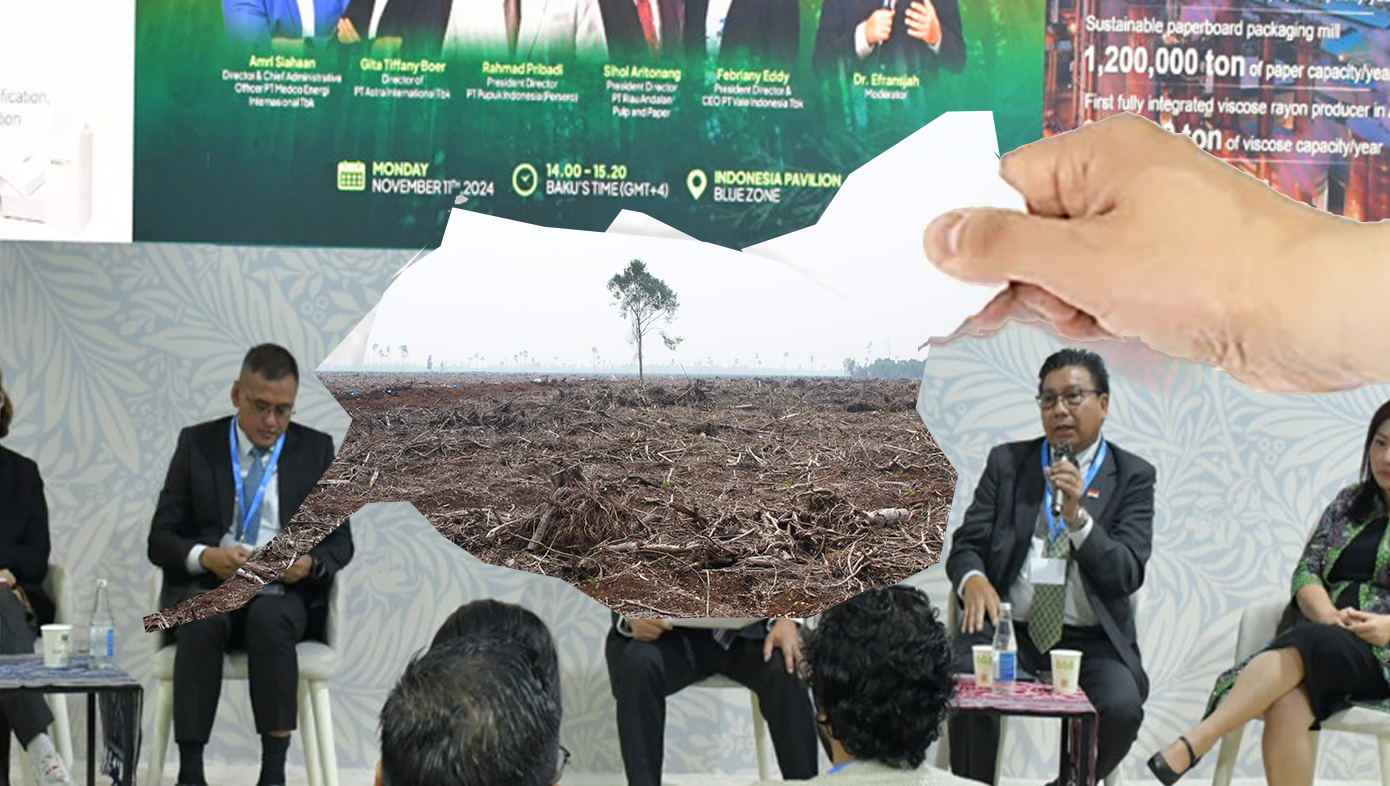
To see how a global climate summit is going, it is not necessary to take note of the number of polluting companies showing up there, but this may help.
All kinds of companies travelled to Baku, one of the largest global oil hubs. They register for meetings and panels, present their beautiful glossy image, and meanwhile take the opportunity to lobby the delegates heavily—a win-win.
Among all these villains, they couldn’t miss the most vicious ravager of the Indonesian rainforests, the APRIL Group. This company developed its plantations at the cost of natural forests and peatlands. Peat forests represent one of the largest world carbon sinks, but once drained to allow acacia plantations, they release huge amounts of CO2, up to 80 tonnes per year per hectare. As a result, the 265,000 hectares of plantations on dried peat managed by APRIL’s subsidiaries or long-term supplier companies release every year about 19 million tonnes of CO2, more than the whole emissions of a country such as Slovenia.
In Baku, the APRIL Group presented a statement during the CEO Dialogue session at the Indonesia Pavilion at the UNFCCC COP29. “We conserve natural forests in our plantation concessions”, they announced. “This is what we refer to as our Production-Protection approach. This approach allows APRIL’s plantation areas to serve as a natural forest protection zone.”
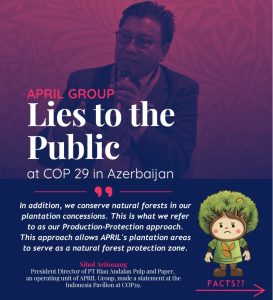 According to a list published by the Indonesian network Jikalahari, the reality is quite different:
- APRIL is causing extensive deforestation, with estimated ecological damage, economic loss, and ecological recovery of 43.07 billion USD
- It has been involved in corruption to obtain logging permits in natural forests, with sixteen corporations affiliated with the group having been found to have engaged in bribery activities.
- It continues to clear natural rainforests: in March 2024, Jikalahari discovered that APRIL Group subsidiaries PT Selaras Abadi Utama (SAU) and PT Riau Andalan Pulp and Paper (RAPP) Estate Sungai Mandau had engaged in several activities that violated environmental regulations. These included cutting down natural forests, the construction of new canals, damage to peat ecosystems that serve a protective function, and planting acacia trees outside the designated concession area without the necessary permits.
April is also behind the company extensively logging in the remaining dense tropical forests of Borneo, a true faunistic paradise populated by elephants, tapirs and a wide range of species of birds. Yet, they are being devastated. According to satellite mapping, just an APRIL supplier, PT Mayawana Persada, has cut 55,000 hectares of rainforests, converted them into acacia and eucalyptus plantations and continues expanding. On the way, it also converted local community gardens and orchards.
While presenting its green image at Baku, the company is also building, behind shadow companies, a huge pulp mill in the eastern corner of Borneo. An in-depth research by NGOs identified the Tarakan mill as secretly controlled by the same business group controlling APRIL. To feed this mill, the last rainforests remaining in the eastern corner of Borneo are being destroyed.
This is the result of the so-called Nature Protection Through a Production-Protection Approach being discussed in Baku.
There are two main things necessary to reduce CO2 emissions in Indonesia: drastically cut the use of fossil fuels and protect the forests, with a special focus on peatlands. What we see in Indonesia is different: fossil fuels will stay, while deforestation is expanding increasingly under the banner of a misguided ‘decarbonisation’, either for new biomass burning or for ‘carbon-free’ products such as paper.
Back to News