
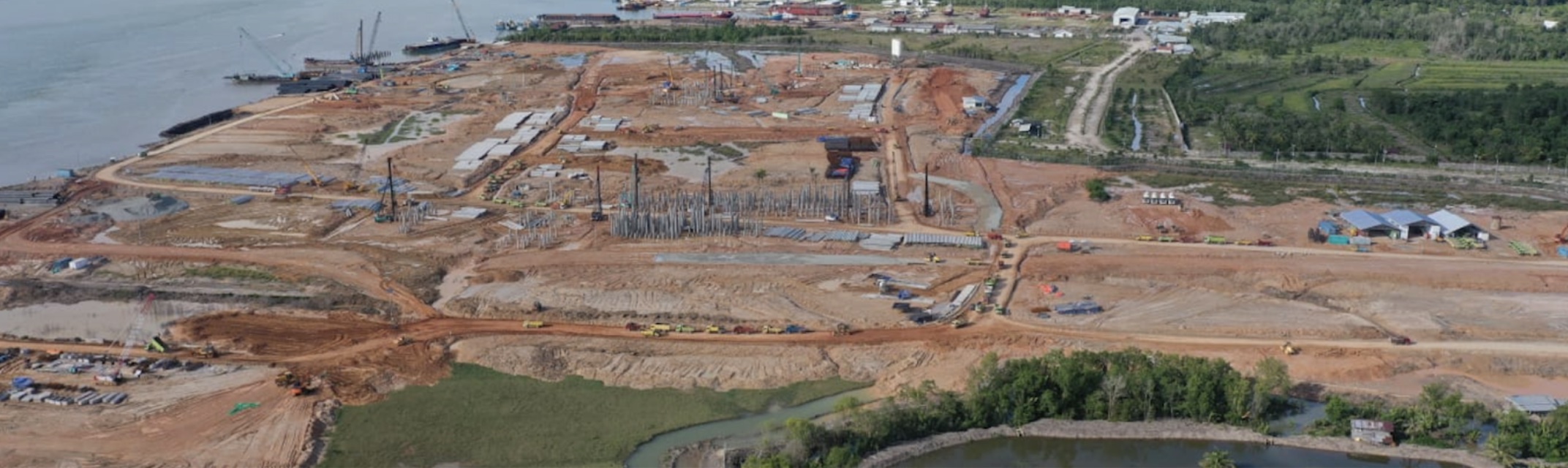
This used to be one of the most beautiful places in the world, now it looks like a circle of hell. Tarakan is located on an island three hours by boat from the Malaysian border, facing the estuary of the Sepauk River, an idyllic picture of twisted loops bordered by forests and ponds.In that idyllic alternation of rounded greens and blues, a large dark rectangle has been carved into the living body of the island. It is a new huge pulp mill, the first one being built on Borneo island. Behind the new pulp mill there are the owners of Asia Pacific Resources International Limited (APRIL), one of the two pulp & paper giants in Indonesia.
Near the construction site, the air is an inferno of dust. A constant procession of trucks moving earth, with peaks of a truck every twenty seconds, day and night.
In reality those trucks do not simply transport earth: they transport hills. Entire hills, with trees, vegetable gardens, houses and everything else, are being dug out to carry earth to what will be the foundations of the paper mill (the legality of this operation has been questioned.) With time villages’ houses are swallowed.
It is no better for those downstream. The constant coming and going of vehicles has devastated the road, making it look more like a battlefield. But what is worse, is the dust. The vehicles raise clouds of dust that envelop the entire area. The dust settles in the lungs, settles in the hearts of the huts, covers the plants in the gardens with a thick patina, drying them out inexorably.
The procession of trucks cuts villages and communities in two, stopping at nothing. Those who cross their path do so at their own risk.
Adiratna (not her real name) is the leader of a group of local women. She speaks about the life in their orchards that is gradually drying out, of the noise and dust that oppress them. And about the protests, three of them, that were organized. There followed many promises, none ever fulfilled. They sent petitions to the authorities, with even worse results.
“We are small people, they are big people. Our voice is not heard,” says Adiratna. Although her voice is forceful and convincing, it is only the voice of a community of women. While operating the new paper mill is one of the largest industrial groups in the country, with connections far, far above.

Adindo operations, Ulet Ifansasti/Greenpeace
Many other ’small people’ are suffering even worse impacts in the area, because of this pulp mill. They are those living in the forest at the backyard of the new mill. In the eastern corner of Borneo, exactly where the last large intact rainforest of the island lies, wide slices of land are controlled by a pulpwood plantation company, PT Adindo Hutani Lestari, another company linked to the APRIL.
This area has long been covered by the dense tropical forests. Among these, wild pigs thrived, serving as a crucial food source for the local people. It also was a faunistic paradise, populated by elephants, tapirs and a wide range of species of birds. The plantations are leading to their end. According to Nusantara Atlas, Adindo has cut 35,32,000 hectares of rainforests, converted them into acacia and eucalyptus plantations and continues expanding. In the way, it also converted local community gardens and orchards. Adindo already supplies APRIL and is in the best position to supply the new mill.
These plantations are leading to the end of one of the world’s most important rainforest ecosystems.
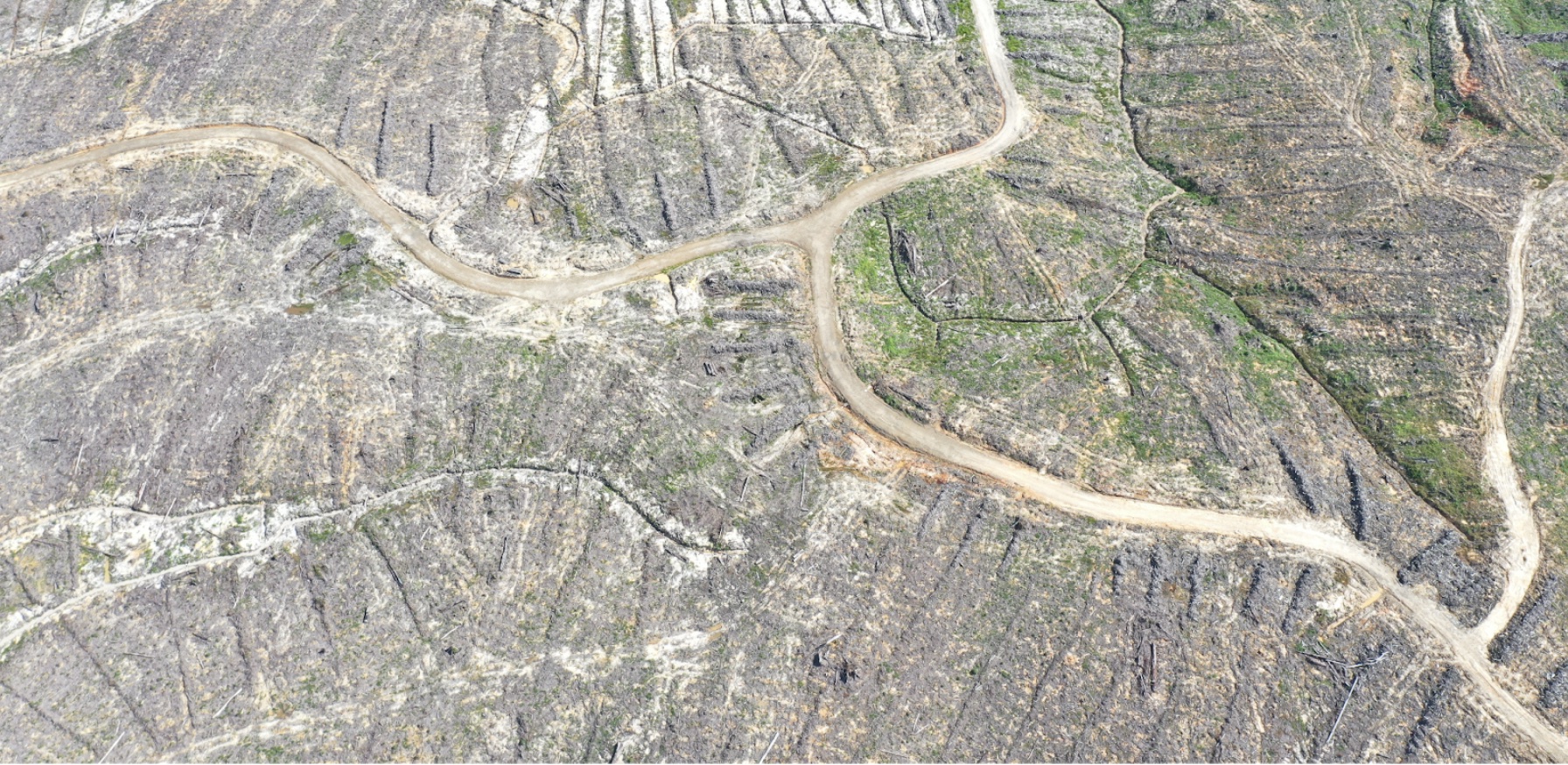
Adindo concession in North Kalimantan
Deforestation is back
What is happening in the eastern corner of Borneo is actually the epicenter of a new surge of deforestation currently impacting Indonesia.
After a peak of deforestation in the 1990s and 2000s, mostly driven by pulp & paper and palm oil, the last decade was marked by such a strong decline in deforestation that many considered the problem solved, or at least on its way to resolution. This has unfortunately not been the case.. According to TRASE, a supply chain monitoring research platform, there is a resurgence in forest loss attributed to Indonesia’s pulp sector, with a fivefold increase observed in 2022 compared to 2017 levels.
The pulp & paper industry has played a significant role in driving deforestation, having cleared about a million hectares of forest since 2001. In response to public pressure, the two companies dominating the paper business in Indonesia, APRIL and its competitor Asia Pulp & Paper (APP) and committed to zero-deforestation in 2013 and 2015, respectively. This led to a substantial reduction in deforestation rates (85% reduction between 2010-12 and 2017-2019).
But from 2017, deforestation linked to wood pulp production began to boom again, increasing almost fivefold between 2017 and 2022, as revealed by Trase.
In 2016, the OKI new pulp mill in Sumatra – one of the world’s largest – started its operations, and pulp production in Indonesia expanded by 46%. APP, running the mill, assured it would not cause any deforestation, but it failed to bring evidence to support this claim.
Then in 2021 APP announced plans to to triple its production of the OKI mill from 2.45 millions to 7 millions tons of kraft pulp.
Meanwhile, APRIL announced a capacity increase by 55% at its Kerinci mill, increasing its production from 13 million to 20 million tons.
Finally, in 2022 a new mysterious mill started to be built in the eastern corner of Borneo. An in-depth research by NGOs identified the Tarakan mill as secretly controlled by the same business group controlling APRIL.
The ongoing spike of deforestation is driven by pulp milling capacity expansion, in turn driven by a global surge in demand for wood pulp and viscose, respectively for single-use packaging and for clothing.
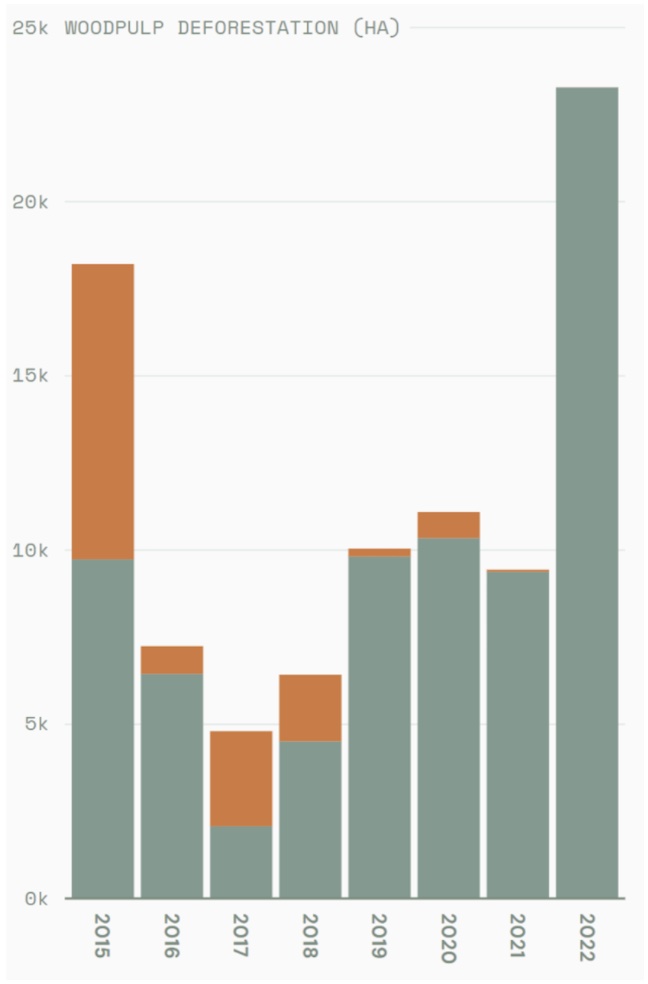
TRASE data in orange non active concessions in grey active concessions
This is particularly severe for Borneo. Trase’s spatial analysis indicates that the majority (98%) of the new deforestation in Indonesia occurred in Borneo. In 2022 alone, the pulp industry in Indonesian Borneo cleared 23,000 hectares, an area almost the surface of Paris.
Most of the current deforestation, from the concessions held by Mayawana Persada in Central Kalimantan, to those managed by Nusantara Fiber in Eastern Kalimantan and by Adindo in the North Kalimantan are aimed to supply the new mill being built in Tarakan. One single pulp mill that can be well described as a major threat of deforestation for Indonesia.
Back to News