
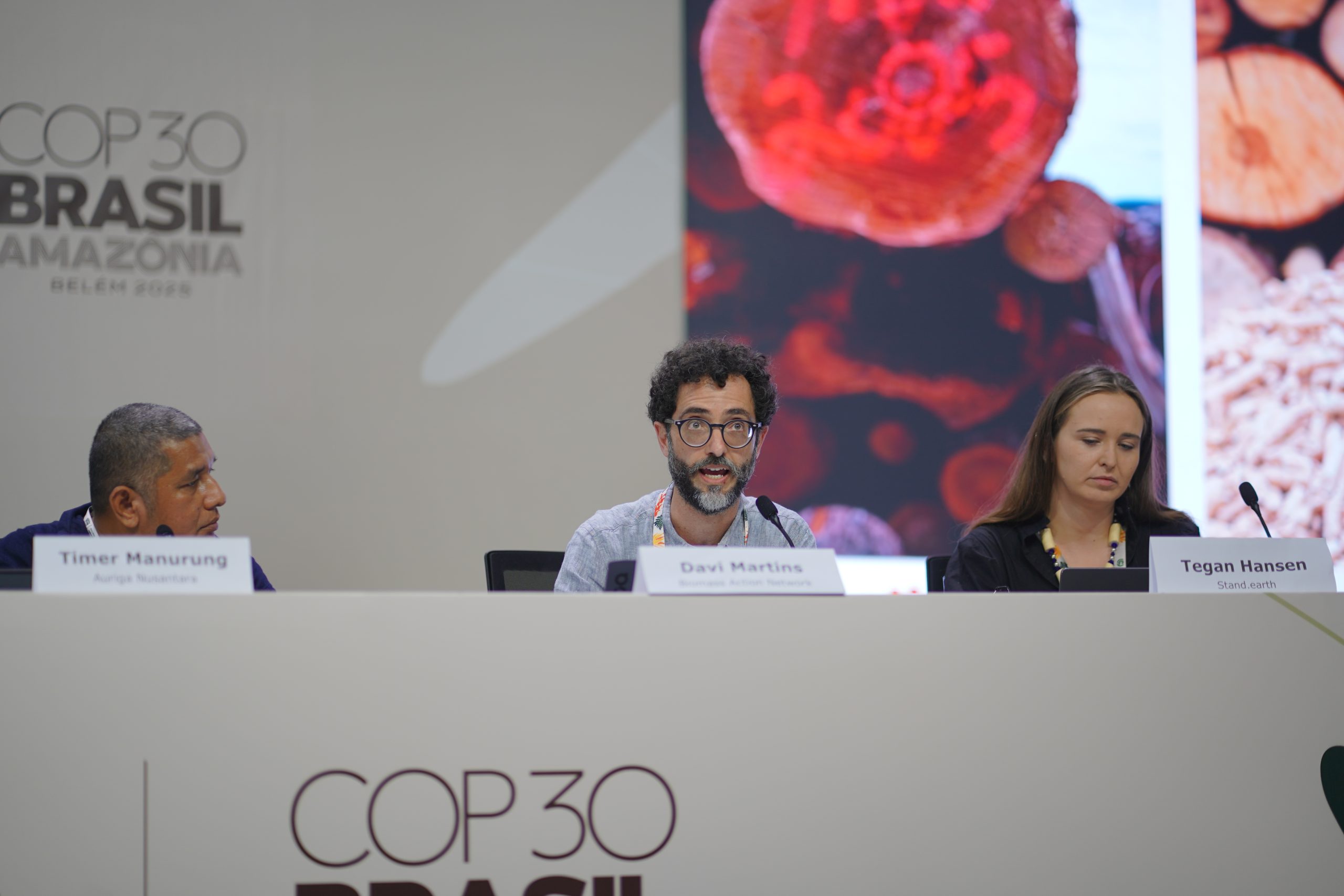
Opinion piece by Davi Martins who is on the ground at COP30 with BAN’s Biomass Taskforce
I hear voices coming through the thin corridor walls. Lingering in the dense atmosphere that has set inside the Blue Zone lies a never ending, unforgiving whisper. You might not notice immediately, but it’s there and it will defy negotiators, observers and lobbyists all the way until the final negotiation table, until the lights have turned off, until Belém is no longer the Brazilian Capital. Climate finance. Did you hear? Yes, you’ve heard it right! Climate finance!!!
The lack of concrete advances in negotiations can be tracked back to the political paralysis that climate finance produced since, well… to be honest since the Paris Agreement. Here in Belém, ten years later, little has changed, a massive investment gap between what developing countries need and what developed countries want to pay. It should also be shocking to hear (shouldn’t it? After all these years?) that we are not just failing to invest enough; we are actively investing in the wrong solutions, pouring negotiation efforts into actions that will drive billions into technologies that worsen the problem they’re meant to solve.
The core mission of the UNFCCC talks is to create a collective framework for climate adaptation. Yet, conflicts over metrics, finance, and implementation have left us with an empty promise. Vulnerable nations are left waiting, while political leaders struggle to build bridges. This stalemate is a direct manifestation of the investment gap and without a clear, actionable plan from world leaders, private and public capital remains hesitant, misallocated, or stuck in neutral. The “how” of funding a just transition remains unanswered, widening the equity gap alongside the financial one.
Climate finance…. Investments… are getting louder day-by-day, echoing the even louder faulty air conditioning at the venue this year, and reminding us that we have an elephant in the room! And it might be a herd! So, where is the money going? A staggering example lies in the bioenergy industry, a sector that has benefited from a profound misdirection of climate funds. The industry creates a green illusion, claiming to run on “wood waste” and “residues.” In reality, the volumes of actual timber are immense, often comprising the majority of wood from logging operations. Driven by generous renewable energy subsidies, burning biomass has intensified logging and expanded logging areas, despite the resulting energy producing higher CO2 equivalent emissions than the fossil fuels it is supposed to replace, whilst destroying biodiversity rich carbon sinks vital for climate mitigation.
A recent report by the Biomass Action Network, Burning Billions for Biomass, found that just five major economies have spent nearly $250 billion since 2002 subsidizing this problematic energy source.
This misallocation of capital has a triple-negative effect:
- It competes with real solutions: These billions directly compete with subsidies that could be accelerating the deployment of much cheaper, genuinely low-emissions renewables like solar and wind, and funding energy efficiency measures.
- It increases emissions: Even with the application of Bioenergy with Carbon Capture and Storage (BECCS)—a colossally expensive and largely unproven technology—biomass energy often produces higher emissions than alternative renewables without BECCS. The investment market has taken note: in 2021 the Dow S&P Clean Energy Index expelled major players like Drax and Albioma due to their high emissions, and they have not been reinstated.
- It worsens the investment gap: Every dollar spent on biomass is a dollar not spent on building a competitive, low-carbon, and job-creating economy of the future.
The path forward is not a mystery. A report by Trinomics Consultants, energy advisors to the European Commission, provides a clear blueprint. It calls for an end to subsidies for commercial-scale bioenergy and BECCS, and for these funds to be reallocated, geared by matched funding, to three superior alternatives:
- Genuine Renewables: Wind, solar, and heat pumps.
- Demand-Suppressing Enterprise: Recycling, insulation, fuel efficiency, and sector-wide decarbonization.
- Ecosystem Conservation: Investing in the protection & restoration of carbon-absorbent natural landscapes.
The payoff? Compared to a scenario adopting BECCS, subsidy reallocation could achieve 26% of the EU’s net-zero targets by 2050, while also boosting economic competitiveness, fighting inflation (40 billion euros per annum in energy cost savings), creating 94 billion euros per year in Gross Value Added, and generating 1.6 million extra high-tech jobs in Europe. The same logic applies globally.
In addition to the economic ‘opportunity costs’ of diverting massive amounts of capital to forest bioenergy, there are the direct costs too: to the environment, healthcare and business. The wood bioenergy industry, together with its timber supply, represents perhaps around 1% of Gross Domestic Product, while the producers of the other 99% must pay twice over:
Providing these subsidies for wood-based commercial scale power (the least cost-effective form of ‘renewable’), is chronically unprofitable. And thus a constant drain on taxpayer and consumer – over 35 billion euros a year by 2050 if BECCS proceeds. Add to this the rapidly rising costs of aggravated climate change: erratic weather causing immense damage, huge expenditure on adaptation, disruption of input supply, and rising raw material prices
How much longer will the interests of the vast majority be held to ransom by successful subsidy lobbying by an unsustainable industry?
The informal notes and unresolved conflicts at the climate talks are a symptom of a deeper disease: a failure to strategically align our financial resources with our planetary and social goals.
We are facing two gaps: one of political will and one of capital allocation. They are inextricably linked. By continuing to subsidize false solutions like biomass, we are actively widening the investment gap for the technologies and strategies that can genuinely secure a safe, equitable, and prosperous future.
The message to the political leaders entering the high-level segment of the talks is clear. Bridging the political divide means making tough choices about where the money flows. It’s time to stop funding the problem and start strategically investing in the solution—a transition that is not only green, but also just and built on a foundation of genuine, zero-carbon innovation.
With acknowledgement to Wild Europe for economic & investment inputs
Back to News